Drones to Be the Next U.S.-Japan Cooperation Focus... U.S. Ambassador Says Japan Should Become a Production Hub
- Input
- 2026-10-25 12:45:25
- Updated
- 2026-10-25 12:45:25
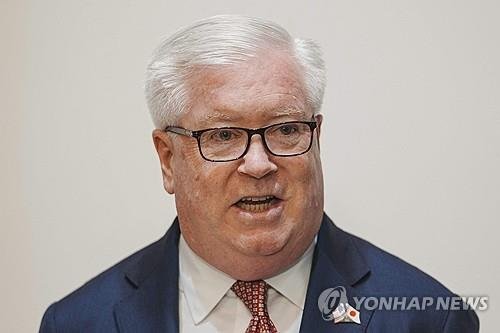
【Financial News, Tokyo = Correspondent Seo Hyejin】George Glass, the U.S. ambassador to Japan, outlined a plan to make Japan a production hub for drones for the U.S.-Japan alliance in the Indo-Pacific region. The proposal is to strengthen security cooperation between the two countries by combining U.S. drone technology with Japan’s manufacturing capabilities.
According to the Nikkei on the 25th, Ambassador Glass attended the “Fuji Meeting” in Tokyo the previous day, jointly hosted by the Japan Center for Economic Research and the Japan Institute of International Affairs (JIIA), and said, “The next area of success in U.S.-Japan cooperation is the drone industry.”
“Now is the time to combine U.S. technological know-how with Japan’s production capacity and bring out the strengths of both countries in the drone sector,” he stressed. “Our goal is to establish Japan as a drone production hub for the U.S.-Japan alliance in the Indo-Pacific region.”
Ambassador Glass made the remarks as low-cost drones are changing the nature of warfare. In the war in Ukraine, there have been repeated instances of inexpensive drones being deployed in large numbers to strike costly military equipment. In the United States, defense technology companies that develop drones, including Anduril Industries, are gaining prominence.
Japan has a parts supply chain and production base built up through its automotive industry. Ambassador Glass said he intended to expand cooperation in the drone sector by combining these manufacturing capabilities with U.S. technology.
Citing Russia’s invasion of Ukraine and the military conflict between the United States and Israel, on one side, and Iran, on the other, he said the security environment was deteriorating. He said threats were also growing in the Indo-Pacific region and that the U.S.-Japan alliance’s “deterrence capabilities must be strengthened promptly.”
He rejected China’s criticism, which called Japan’s efforts to strengthen its defense capabilities “new militarism,” as “unreasonable,” saying it “only obscures the essence of the issue.”
Meanwhile, Japanese Prime Minister Sanae Takaichi also emphasized strengthening the U.S.-Japan alliance in a video message she sent to the meeting that day.
Takaichi described the U.S.-Japan alliance as “the cornerstone of Japan’s foreign and security policy and the foundation supporting peace and prosperity in the Indo-Pacific region and the international community.”
She also mentioned that she had held talks twice with U.S. President Donald Trump last September, through an in-person meeting and a phone call. Takaichi said, “Building on close coordination and strong trust between our leaders, we will further strengthen the U.S.-Japan alliance’s deterrence and response capabilities.”
She went on to say, “We will further advance the ‘Free and Open Indo-Pacific’ (FOIP) and safeguard peace and prosperity in the region,” adding, “Now, when the international order is undergoing major upheaval, is precisely the time for the United States and Japan to pool their wisdom and take on shared challenges.”
[email protected] Seo Hyejin Reporter