Jeju National University selected to develop satellite to monitor gwaengsaengimojaban off Jeju coast from space
- Input
- 2026-10-25 11:37:11
- Updated
- 2026-10-25 11:37:11
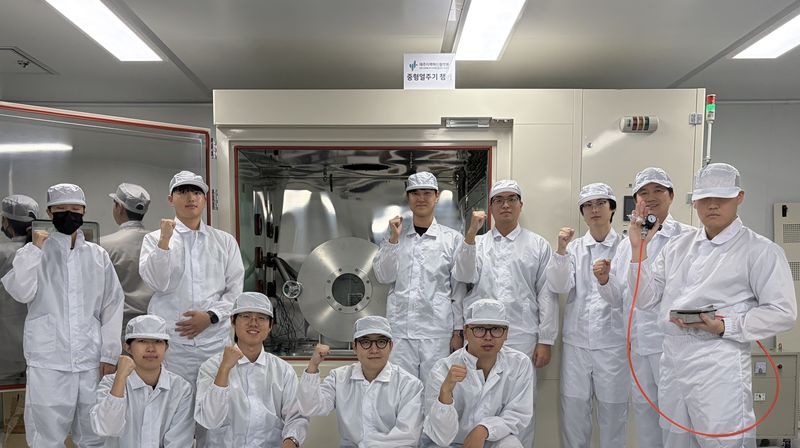
【Financial News, Jeju—Jeong Yong-bok】 Jeju National University undergraduates are setting out to develop a small satellite that will monitor from space the large quantities of gwaengsaengimojaban washing up along Jeju’s coast. The team was selected in a government competition and is eligible for up to 700 million won in development funding.
According to the Korea Aerospace Research Institute and Jeju National University on the 25th, Blue Orbit, a team made up of Jeju National University undergraduates, was selected as one of five finalists in the beginner satellite division of the 7th Cube Satellite Competition.
In the competition, hosted by the Korea AeroSpace Administration and organized by the Korea Aerospace Research Institute, seven university teams from across the country were selected: five in the beginner division and two in the advanced division. KARI officially announced the results on the 22nd.
The beginner division lineup included Jeju National University, Pusan National University’s Plato Sat, Kyung Hee University (KHU)’s PADO-SAT, Gyeongsang National University’s OFDIR, and Korea Aerospace University (KAU)’s KAUSAIL. Yonsei University and Chosun University were selected for the advanced division.
The satellite’s main mission, as developed by Jeju National University students, will be to observe large quantities of gwaengsaengimojaban entering waters around Jeju and elsewhere in South Korea. The goal is to establish a system that can use satellites to monitor the seaweed drifting on the water and track its movement.
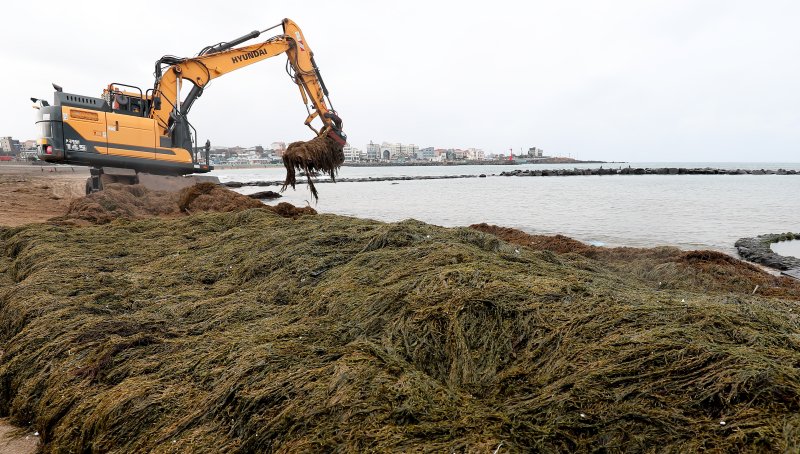
Gwaengsaengimojaban is a type of brown algae that lives in the ocean. It travels long distances with ocean currents and winds, and when large quantities wash ashore, it can harm fisheries, aquaculture and tourism. Every year in Jeju, efforts are repeated to collect gwaengsaengimojaban that has washed up along the coast.
South Korean research institutions are already using satellites to observe gwaengsaengimojaban. Last year, the Korea Institute of Ocean Science and Technology announced research findings that identified its routes into coastal waters by combining observations from the Cheollian Ocean Observation Satellites 1 and 2B with a movement-prediction model analyzing ocean currents and winds.
While previous research analyzed movement routes using data from ocean-observation satellites, the Jeju National University students’ challenge is to design and build a small satellite themselves to observe a specific marine environmental problem.
A CubeSat is a small satellite made by assembling standardized, compact structural units. Smaller than large satellites, CubeSats are used by universities and research institutions to develop space technology and test it in the actual space environment.
The competition selected the final teams after a first-round evaluation of the originality of their satellite missions and their design capabilities, followed by a second-round review of whether the satellites could actually be built. The beginner division focuses on developing satellites that carry out one primary mission.
The selected teams in the beginner division will receive up to 700 million won each in development funding. This is the maximum support amount, including preliminary design funding already paid out, and the actual amount may vary depending on the project and budget management.
The selected teams must design and build their satellites, conduct space-environment testing and complete a final pre-launch review to develop satellites that are ready for launch. The government plans to provide an opportunity to launch the completed satellites aboard Nuri (KSLV-II) or launch vehicles operated by domestic private companies, among others.
Earlier competitions also resulted in actual launches into space. Of the CubeSats developed by the six teams selected in the 6th competition, four were carried on Nuri’s fourth launch last November, and the remaining two were carried on its fifth launch this October.
Jeju National University’s selection is also drawing attention as an achievement by undergraduates who voluntarily formed a team despite having no satellite-related department or dedicated research and testing facilities.
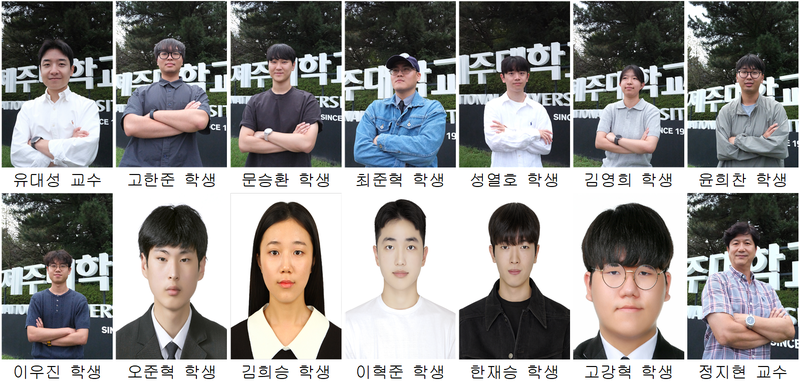
Blue Orbit was formed around ACE-L, Jeju National University’s aerospace club. Ko Han-jun, a student in the Department of Mechanical Systems Engineering, leads the team, which includes 12 students from the departments of Mechanical Systems Engineering, Electrical Engineering, Communication Engineering and Computer Engineering.
Team members built their technical foundation by studying specialized books and papers needed for satellite design. Professor Yoo Dae-seong of the Department of Communication Engineering serves as faculty adviser, while Professor Jeong Ji-hyeon of the Department of Mechanical Systems Engineering supports the students’ development plans as steering committee chair.
Jeju Province also provided support. With the cooperation of its Advanced Industries Division, the team invited experts in the satellite field and used funding from the aerospace track of the Regional Growth Talent Development System (ANCHOR) to cover the costs of inviting experts and participating in the competition.
However, being selected does not guarantee a successful satellite launch. The team must secure components validated at the design stage and complete a spacecraft and equipment capable of operating in the space environment. It also still needs to establish systems for testing and operating the satellite on the ground.
Professor Jeong Ji-hyeon identified developing test equipment to verify the satellite’s attitude-control performance, conducting thermal, vacuum and vibration tests, and operating a ground station as key tasks. These are steps to confirm that the satellite can withstand the extreme conditions of space and the launch process.
Professor Jeong said, “There are many technical and financial challenges to address, from sourcing verified components to developing air-bearing and geomagnetic-field systems in-house, conducting thermal, vacuum and vibration verification tests, and establishing and operating a ground station, so securing additional funding is urgent.”
[email protected] Jeong Yong-bok Reporter