[Exclusive] Fake AI-generated precedents are proliferating, but courts lack statistics and the government has no guidelines
- Input
- 2026-10-25 15:26:30
- Updated
- 2026-10-25 15:26:30
[Financial News] As cases emerge in which fabricated precedents generated by artificial intelligence (AI) are cited in court proceedings, it has emerged that the courts, despite devising response measures, do not separately track related cases or the status of disciplinary referrals. The government has yet to decide even whether to issue guidelines covering legal AI services as a whole.
On the 25th, according to materials obtained from the Court Administration Office by Kim Han-gyu, a Democratic Party of Korea lawmaker on the Legislation and Judiciary Committee of the National Assembly, the Office replied, “To date, we have not separately compiled or managed the number of cases in which the use of generative AI to cite fabricated precedents or statutes, or to submit false or altered evidence, has been confirmed.” It also does not track the number of cases referred to or reported to the Korean Bar Association (KBA) for disciplinary action on these grounds, the outcomes, or measures taken by courts, such as ordering parties to bear litigation costs or restricting arguments.
This does not mean that no disciplinary referrals or sanctions have actually occurred. The point is that such measures are for individual trial panels to decide, and the Court Administration Office has no separate statistics to assess the overall situation.
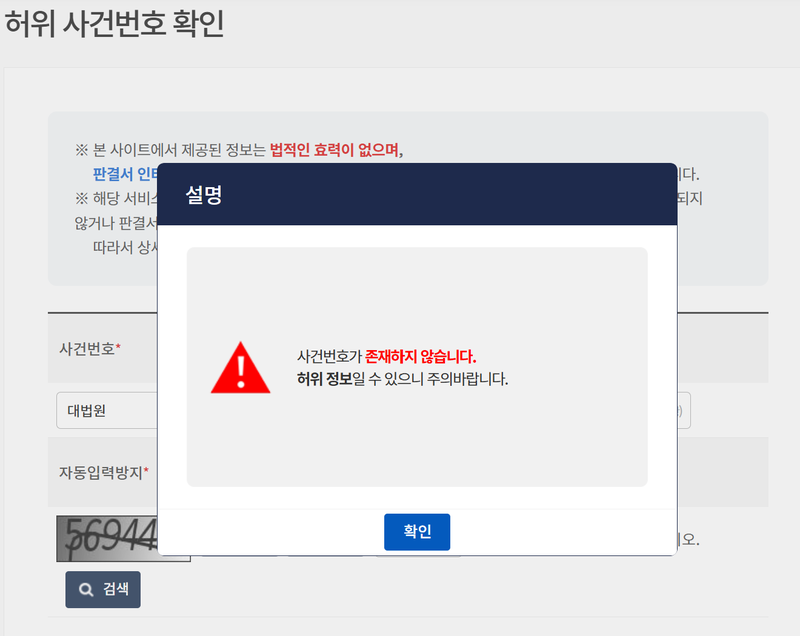
In March, the Court Administration Office had proposed response measures through a task force on responding to false claims and evidence submissions using AI. These included requiring parties to bear litigation costs when citations of fabricated precedents caused unnecessary expenses, restricting statements in the relevant brief, noting false citations in judgments, and referring attorneys for disciplinary action. In February, a feature to check whether case numbers were false was also introduced on the Judicial Information Disclosure Portal.
In one instance, a trial panel flagged a fabricated precedent after confirming it. In April, the Seoul High Court’s Civil Division 33, presided over by Judge Lee Chang-hyeong, noted in a footnote to its ruling in a deposit-return case that the case numbers of all three rulings cited by the defendant in its brief stating the grounds for appeal appeared not to exist. Searching those case numbers on the Judicial Information Disclosure Portal brings up a notice that they do not exist.
The Court Administration Office said it had announced the response measures on the court’s internal bulletin board at the end of March but had not drawn up separate internal guidelines. The Office said, “These are matters to be decided after comprehensively considering the specific facts of each case, the nature of the parties’ conduct, and the impact of false materials on the trial,” adding, “It would not be appropriate to establish uniform internal guidelines.”
The Ministry of Justice’s guidelines for AI legal tech are also still under discussion. The Ministry told Rep. Kim’s office that it had launched the AI Legal Tech Special Subcommittee in February and held five meetings by July, but had not decided on the guidelines’ content or direction, or even whether to issue them. Regarding the previously reported plan to restrict domestic legal tech companies from providing paid legal services, it said the plan was “nothing more than internal meeting materials summarizing the issues.”
The Ministry of Justice said it was “listening to a range of views from the legal profession, the legal tech industry and others on numerous issues, including how to respond to AI-generated fabricated precedents, but no specific review findings have been reached.” About 43.13 million won was spent on the committee’s activities, including fees for AI services and allowances for committee members.
Rep. Kim Han-gyu said, “The growth of the AI legal tech market is an irreversible trend,” and criticized the courts and the Ministry of Justice, saying, “It is deeply regrettable that they have not even been able to grasp the actual situation.”
[email protected] Choi Eun-sol Reporter