Hyundai Motor Group’s China Sales Decline for Eighth Straight Month; September Share Falls Below 1%
- Input
- 2026-10-25 11:00:05
- Updated
- 2026-10-25 11:00:05
According to a report by Hana Securities analyzing China Passenger Car Association (CPCA) statistics on the 25th, Hyundai Motor Company’s retail sales in China fell 47% to around 4,000 units in September, while Kia Corporation’s dropped 31% to around 5,000. Combined sales totaled around 9,000 units, falling below 10,000 for the first time this year.
Combined sales fell from 18,000 units in January to 15,000 in June, 10,000 in August and 9,000 in September. The two companies once had a combined market share of more than 10% and sold 200,000 units a month in the mid-2010s. Combined sales from January to September totaled 115,000 units, down 22% from the same period a year earlier, while their cumulative market share fell to 0.6%, down 0.1 percentage points from last year.
The Chinese market itself also contracted. September retail sales of passenger cars fell 28% to 1.618 million units. Local brands saw sales decline 25%, but their market share rose to 69.8%, while major joint-venture brands were down 36%. BYD sold 247,000 units (-24%), Tesla 65,000 (-9%) and Volkswagen around 136,000 (-41%). Retail sales of new energy vehicles fell 17% to 1.084 million units, but their share of the market reached 67%. Changes in the Chinese government’s new energy vehicle policies are also believed to have contributed to the market contraction.
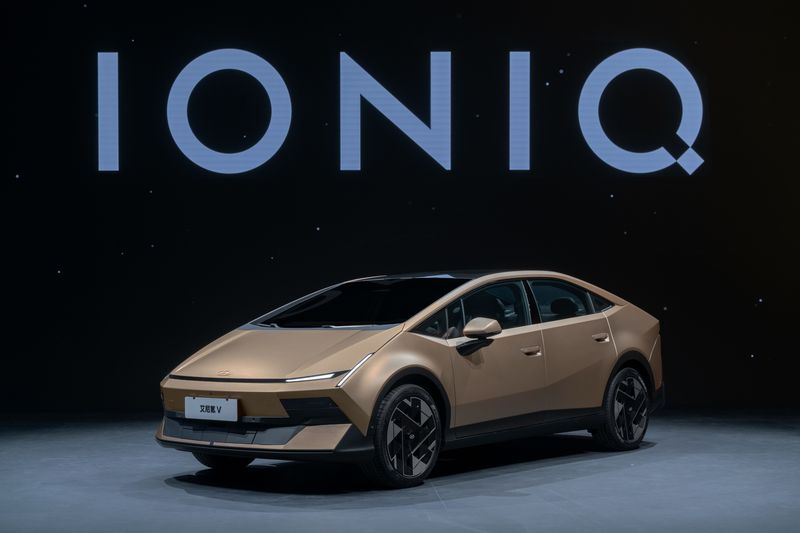
The performance of new EV models developed for the local market has yet to stand out. Hyundai Motor Company’s Elexio, launched last year as an electric SUV tailored to China, sold 1,216 units from October to December last year, but just 251 from January to September this year. Ioniq V, the Ioniq brand’s first model tailored to China, sold 558 units in September.
Hyundai Motor Group Chairman Chung Eui-sun visited the Beijing Auto Show last April for the first time in eight years, bolstering the group’s renewed push into the Chinese market. Hyundai Motor Company plans to launch a new electrified SUV in the first half of next year and expand its electrified vehicle lineup into the midsize and large segments with range-extended electric vehicles (EREVs) and other models. Its goal is to raise annual sales to around 500,000 units by introducing 20 new models over the next five years.
[email protected] Kim Dong-chan Reporter