Trucks Shut Out, Passenger Cars Get Through... Time to Move Beyond the “Subsidy Bar” and Support Production
- Input
- 2026-10-25 14:59:29
- Updated
- 2026-10-25 14:59:29
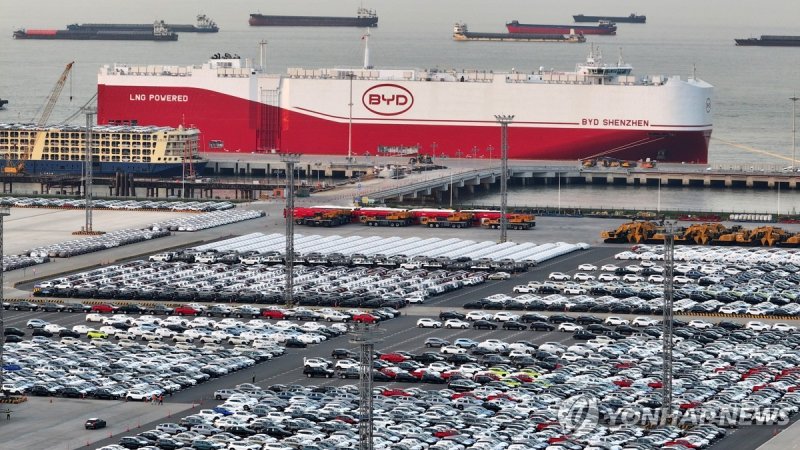
■Commercial vehicles: Raise the “bar” and build up “alternatives”
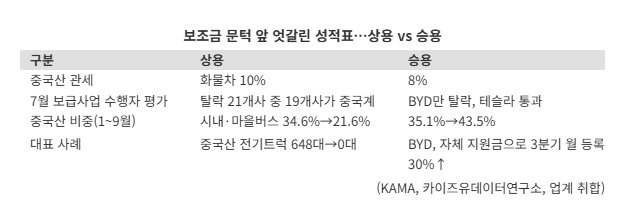
According to industry sources on the 25th, Chinese-made vehicles accounted for more than half of the electric bus market just three years ago. The Korea Automobile & Mobility Association (KAMA) says Chinese-made vehicles accounted for 54.1% of newly registered electric vans in 2023.
The government responded by raising the subsidy threshold in stages. In 2024, it began differentiating payments based on battery energy density, and last year it added a driving-range-per-charge criterion. This year, the Ministry of Land, Infrastructure and Transport also applied the energy-density criterion to subsidies for low-floor buses. Starting in July, it even introduced an “Evaluation of Program Operators” to screen companies eligible for subsidies, assessing factors such as their contribution to domestic supply chains (40 points out of 100). This system puts Chinese-made buses at a disadvantage, as they mainly use lithium iron phosphate (LFP) batteries, which have lower energy density.
Domestic models filled the gap. According to the Kaizyu Data Research Institute, in the mid-size, village-bus-class electric bus market, domestic models increased from 222 in January–September last year to 382 this year, while Chinese-made models were cut by more than half, from 289 to 134. KGM Commercial Co., Ltd., the commercial vehicle affiliate of KG Mobility, delivered its first 7-meter-class low-floor electric bus, the E-STANA, to a village bus operator in February. The Kia PV5 Cargo led the electric cargo vehicle market.
As a result, the Chinese-made share of city- and village-bus-class electric buses fell 13.0 percentage points, from 34.6% in January–September last year to 21.6% this year. In electric cargo vehicles, the share dropped from 6.7% to 0.5%, effectively reaching “zero.”
■Chinese electric cars clear the passenger-vehicle subsidy bar
The passenger car market moved in the opposite direction. KAMA figures show that the domestic share of passenger EVs declined each year from 69.0% in 2022, falling below half to 48.7% in January–September this year.The same assessment produced different results. Industry sources say that 19 of the 21 companies rejected in the commercial vehicle sector were Chinese manufacturers or importers, while BYD was the only company excluded in the passenger car sector. Because the assessment is conducted at the company level rather than by vehicle model, a company that meets the criteria can receive subsidies even for cars made overseas.
Tesla, which imports Model Y and Model 3 vehicles made at its Shanghai plant, passed the assessment. According to KAMA, 89,131 Teslas were registered in January–September alone.
Even after BYD was rejected, its sales did not fall. From July, BYD passenger cars lost both national and local subsidies, but the company filled the gap by offering its own incentives in the 1-million-won range for each model. The amount it spent over three months is estimated at about 10 billion won. BYD’s average monthly registrations in the third quarter (2,528) were actually 30% higher than in the first half (1,945).
Subsidies do not depend on where a vehicle is made. Shanghai-made Model Y and Model 3 vehicles receive national subsidies of 1.68 million to 2.15 million won per vehicle under the same criteria as domestically made EVs. The government set next year’s EV purchase subsidy budget at 2.1403 trillion won, a 32.8% increase over this year.
■The alternative: “EV tax credits”
Industry sources say the limitations of relying on purchase subsidies alone are clear.Lee Ho-geun, a professor in the Department of Future Automotive Engineering at Daeduk University, said, “Depending on consumers’ choices, purchase subsidies can benefit imported EVs as well as domestically produced cars.” He added, “Because production tax credits are linked to domestic output, they could provide a more direct incentive to maintain operating rates at domestic plants, orders for parts suppliers, and production jobs.”
The analysis is that solutions must be found above all at the production stage.
In its first-half report issued in August, KAMA said the influx of Chinese-made EVs “is deepening the contraction of the domestic manufacturing base and intensifying competitive pressure related to supply chains.” It said support policies that can strengthen the domestic production base and industrial competitiveness, such as a “Domestic Production Promotion Tax System,” are needed to move away from a policy focused on purchase subsidies. However, in its August tax reform proposal, the government included semiconductors and secondary batteries, among other sectors, as eligible for domestic production tax credits, but excluded finished vehicles.
Nineteen lawmakers from both the ruling and opposition parties jointly introduced an amendment to the Restriction of Special Taxation Act on the 16th, adding EVs to the list of eligible tax credits. Lee Hyeong-il, Deputy Prime Minister and Minister of Economy and Finance, is reportedly set to visit Hyundai Motor’s Namyang R&D Center early next month to hear the industry’s views.
[email protected] Kim Dong-chan Reporter