[Exclusive] Even after raising the subsidy bar... Chinese-made EVs accounted for 44% in Q3
- Input
- 2026-10-25 14:42:15
- Updated
- 2026-10-25 14:42:15
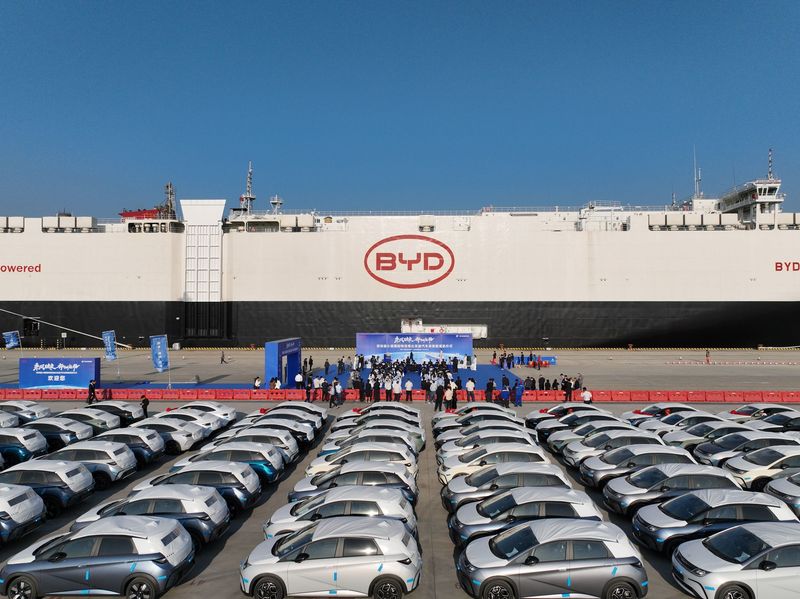
[Financial News] The government tightened its review of EV subsidy payments, but the Chinese-made onslaught in South Korea’s EV market has instead intensified. At least four out of every 10 EVs newly registered in the third quarter this year were made in China, and their share of the passenger-car market grew to effectively one in two. By contrast, Chinese-made vehicles’ share of the commercial-vehicle market, including electric trucks and buses, plunged, showing that the impact of the subsidy policy varied by vehicle type.
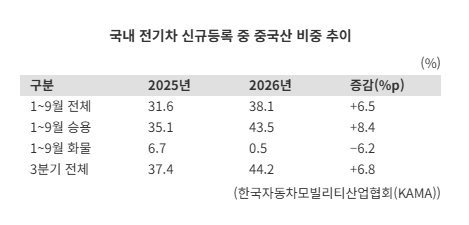
On the 25th, this newspaper analyzed January-September new-registration figures from the Korea Automobile & Mobility Association (KAMA) and found that Chinese-made vehicles accounted for 44.2% of the 98,292 EVs newly registered in South Korea in the third quarter, at 43,455 units. That was up 9.2 percentage points from the first half (35.0%) and 6.8 percentage points from the third quarter of last year (37.4%).
The share rose further after the government introduced an “evaluation of operators of the EV deployment program” this July. Looking at passenger cars alone, about half of the passenger EVs newly registered in the third quarter were made in China, a larger share than in the first half.
Sales also rose for BYD, which failed the assessment and became ineligible for subsidies starting in July. An average of 2,528 BYD vehicles were registered per month in the third quarter, up 30% from the first half’s 1,945.
From January through September, 296,801 EVs were newly registered in South Korea, up 74.8% from the same period last year. Of these, 112,968 were made in China, an increase of 110.5%. Chinese-made vehicles’ share of all EVs rose 6.5 percentage points, from 31.6% to 38.1%. The growth was concentrated in passenger cars. Of the 258,284 passenger EVs, 112,417 (43.5%) were made in China, 8.4 percentage points above the 35.1% recorded in the same period last year. Chinese-made vehicles accounted for 84.9% of imported passenger EVs.
A considerable number of Chinese-made EVs are Teslas produced at the company’s Shanghai factory. According to KAMA, 89,131 Teslas were registered from January through September, putting the brand in second place behind Kia, which had 101,472 registrations, and ahead of Hyundai Motor, with 54,981. Given that just 4,690 EVs of all brands were made in the United States during the same period, about three-quarters of Chinese-made EVs were Shanghai-built Teslas.
Under the Korea-China Free Trade Agreement (FTA), South Korea excluded passenger cars and cargo trucks from tariff concessions and imposes base tariffs of 8% on Chinese-made passenger cars and 10% on cargo trucks. The maximum tariffs are 110% in India, 127.5% in the United States and 45.3% in the European Union (EU).
The commercial-vehicle market, where tariff levels are similar, shows the opposite trend. Of the 34,781 electric cargo trucks registered from January through September, just 191 were made in China, or 0.5%. That was down 86.4% from 1,402 (6.7%) in the same period last year. According to the Kaizyu Data Research Institute, 648 Chinese-made electric trucks were registered from January through September last year, but none were registered this year.
Buses show the same trend. According to Kaizyu figures, Chinese-made vehicles’ share of electric buses in the city- and village-bus classes fell from 34.6% in January-September last year to 21.6% this year. The share of Chinese-made mid-size village-bus-class vehicles, which had exceeded half last year at 56.6%, dropped to 26.0%, while registrations of domestically made mid-size electric buses rose from 222 to 382 over the same period. Based on KAMA figures, Chinese-made vehicles accounted for 4.8% of electric passenger vans in the third quarter, when the assessment was implemented—about a quarter of the first-half share of 21.0%.
KAMA cited the subsidy system as the reason for the divergent outcomes despite similar tariff levels.
In its first-half report, KAMA analyzed that “the government’s subsidy calculation system was restructured to strengthen technical and infrastructure requirements, including battery energy density, after-sales service networks and charging infrastructure, weakening the price competitiveness of some imported electric passenger vans and cargo trucks.”
[email protected] Kim Dong-chan Reporter