Drone AI Cuts False Detections by 39%, Improves Accuracy Without Retraining [Unboxing Lab]
- Input
- 2026-10-26 05:56:00
- Updated
- 2026-10-26 05:56:00
Do you remember the excitement of opening a delivery box? Even as we speak, amazing discoveries that could change our lives are emerging from university labs. They’re just wrapped in the thick packaging of “academic papers.” At Unboxing Lab, we’ll skip the complex equations and theories and bring you just the key ideas you want to know. So, shall we open the box? Today’s research feature is this study.
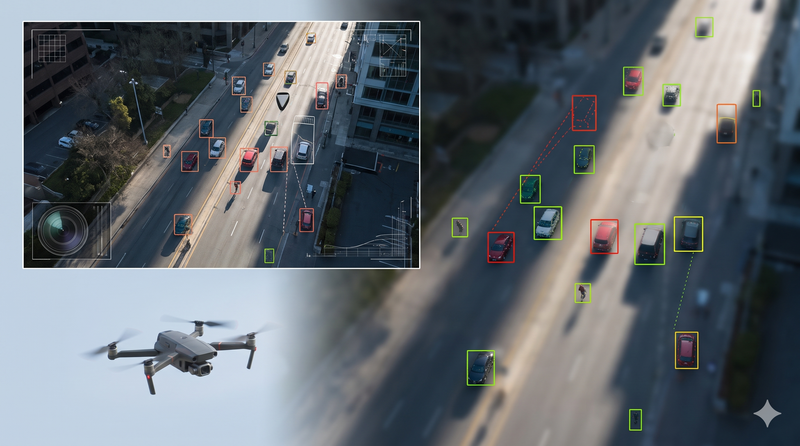
The research could be used in fields that require accurate identification of objects in footage, such as measuring road traffic with drones, monitoring urban hazards, and searching for people at disaster sites. Its distinguishing feature is that it offers a way to reduce errors by calibrating detection results without retraining existing AI models from scratch.
■ False detections surge when searching for small objects
When a drone films from high above, people and vehicles appear very small in the footage. As a result, AI may miss real objects or mistakenly identify the background as an object.
One way to address this is to divide the entire image into small segments for analysis. The segmented footage makes it possible to examine small objects in greater detail, but it also increases the chances of mistakenly identifying backgrounds or shadows as objects. In other words, searching for more small objects also leads to more false detections.
The research team devised SATTA to reduce these problems. The study involved Seo Hae-in, a student and its first author, and Kang Ye-eun, a student and co-author.
SATTA re-scores detection results by considering factors such as where the AI detected an object, the object’s size, and how close it is to the edge of an image segment. In particular, it assigns low scores to results that lie across the edge of a segment and may therefore be incorrect, filtering out false detections. It adjusts detection results without retraining the existing AI model.
■ False detections down 37.5%... but more real objects are missed
The research team compared performance on 1,610 test images from the drone-footage dataset “VisDrone2019-DET.” It tested seven configurations in total: three from the YOLO family and four other AI detection models, including RT-DETR-L, DINO-R50, Cascade R-CNN, and Faster R-CNN.
When SATTA was applied to the representative model YOLO11n-960, the number of false detections per image fell 37.5%, from 140.8 with the existing SAHI method to 88. Tiny-object precision—the proportion of objects identified by AI that are real objects—also rose from 0.055 to 0.082. XS AP50, a metric for evaluating how accurately tiny objects are detected, increased from 0.105 to 0.119.
Across all the test images, false detections fell by 84,878, from 226,601 to 141,723. In particular, the number of cases where backgrounds were mistakenly identified as objects dropped from 131,801 to 75,179.
By contrast, the number of real objects that the system failed to detect increased by 1,793, from 21,782 to 23,575. Recall—the proportion of real objects detected by AI—also fell from 0.480 to 0.459. In other words, reducing false detections meant that more real objects were missed. The approach may therefore be useful when reducing false detections is important, but this trade-off should also be considered when the goal is to detect as many real objects as possible.
Undergraduate students from Duksung Women’s University’s Department of Data Science played a leading role in the research. The paper was accepted for the evaluation and datasets track at WACV 2027 (Winter Conference on Applications of Computer Vision), an international conference in computer vision.
[email protected] Kim Man-gi Reporter