One in Two Vocational High School Graduates Go on to College... “Negative Perceptions of High School Graduates and Mismatched Aptitudes Cited as Reasons”
- Input
- 2026-10-25 10:04:21
- Updated
- 2026-10-25 10:04:21
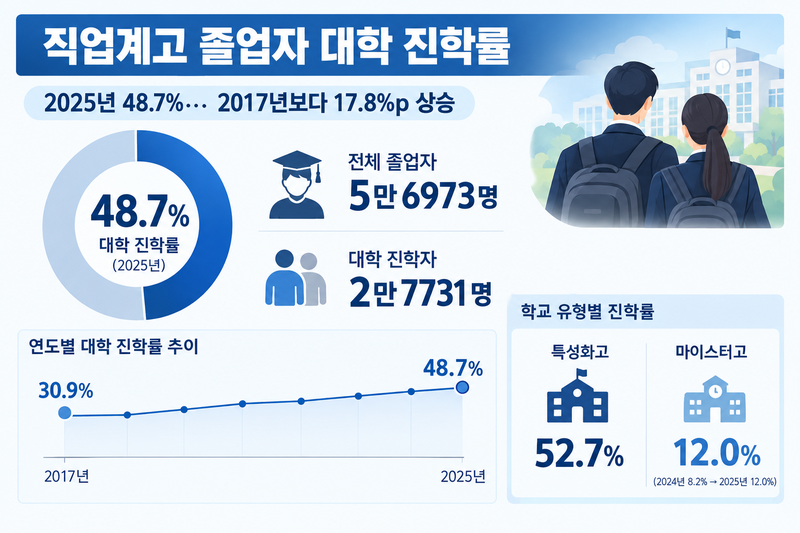
According to the Korea Research Institute for Vocational Education and Training on the 25th, the college enrollment rate for vocational high school graduates stood at 48.7% in 2025. Of the 56,973 graduates, 27,731 went on to college. The rate fell to 30.9% in 2017, then rose, reaching a 10-year high in 2025.
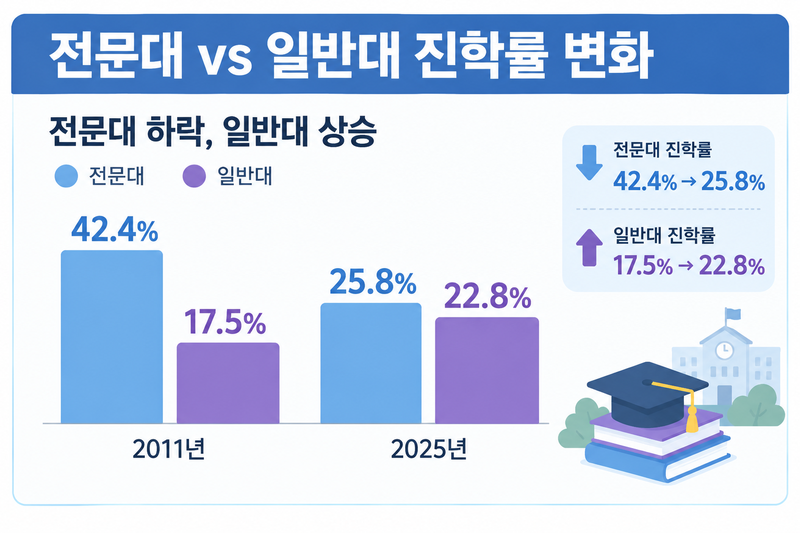
By type of institution, enrollment pathways shifted from junior colleges to universities. The junior college enrollment rate, which stood at 42.4% in 2011, fell by 16.6 percentage points to 25.8% in 2025. Over the same period, the university enrollment rate rose by 5.3 percentage points, from 17.5% to 22.8%. However, the university rate first overtook the junior college rate outside the capital region. Among vocational high school graduates outside the capital region, the university enrollment rate has surpassed the junior college rate since 2024; in 2025, the rates were 24.4% for universities and 23.3% for junior colleges.
An analysis tracking career pathways over the five years after graduation also found that people moved between employment and further study. Using data from the Korean Education and Employment Panel II, researchers analyzed the 60 months after the February 2018 graduation of 1,930 vocational high school graduates. Those in the “employment first, further study later” pathway—who entered college after getting a job—accounted for the largest share, at 32.1%. However, this is the result of tracking a specific graduating cohort for five years and should be distinguished from the career-pathway proportions for all 2025 graduates.
Some students also went on to college in fields unrelated to their high school majors, presenting a challenge. In the survey of current college students, 60.4% said their fields of study in high school and college matched, while 39.6% said they did not. Students whose majors matched rated learning related theories and knowledge, as well as the latest technologies, positively, but gave relatively lower ratings to the connection with the high school curriculum and the extent to which their studies matched their expectations before admission.
Kim Nam-hee, a research fellow at the Korea Research Institute for Vocational Education and Training, said, “With one in two vocational high school graduates going on to college and their pathways diversifying into options such as pursuing aligned or different majors and getting a job first before continuing their studies, we need to move beyond the binary choice between employment and further study at graduation and instead ask whether vocational high schools are providing education that fulfills the essential purpose of vocational education.”
The research team recommended coordinating and consolidating the post-learning systems currently dispersed across ministries into “company-linked” and “individual-choice” models, and incorporating ways to assess practical experience, such as portfolios and interviews, into university admissions. The team also stressed the need to strengthen major exploration and career counseling at vocational high schools so students can make concrete plans for their paths after graduation.
[email protected] Kim Man-gi Reporter