Last year, 1,728 medical school early-admission students gave up their places ... equivalent to 95% of total intake
- Input
- 2026-10-25 09:06:27
- Updated
- 2026-10-25 09:06:27
[Financial News] In early admissions for the 2026 academic year, held last year, the number of successful applicants who gave up their places—after also being admitted to other universities, among other reasons—reached 95% of the total intake. As successful applicants declined their places, waitlisted applicants were admitted to fill the vacancies, with the number of additional admissions approaching the total number of available places. Lim Seong Ho, head of Jongno Academy, predicted, “As in last year’s admissions, the number of places left unfilled in early admissions for the 2027 academic year and carried over to regular admissions could increase.”
An analysis conducted by Jongno Academy on the 25th, of additional admissions in the academic-record and holistic tracks for the 2026 academic year at 39 medical schools nationwide, based on general admissions, found that 1,728 applicants—95.4% of the total 1,812 places—gave up their places and were replaced by waitlisted applicants. The figure excludes special tracks, such as the equal-opportunity track. On average, each successful early-admission applicant had been admitted to 2.0 universities.
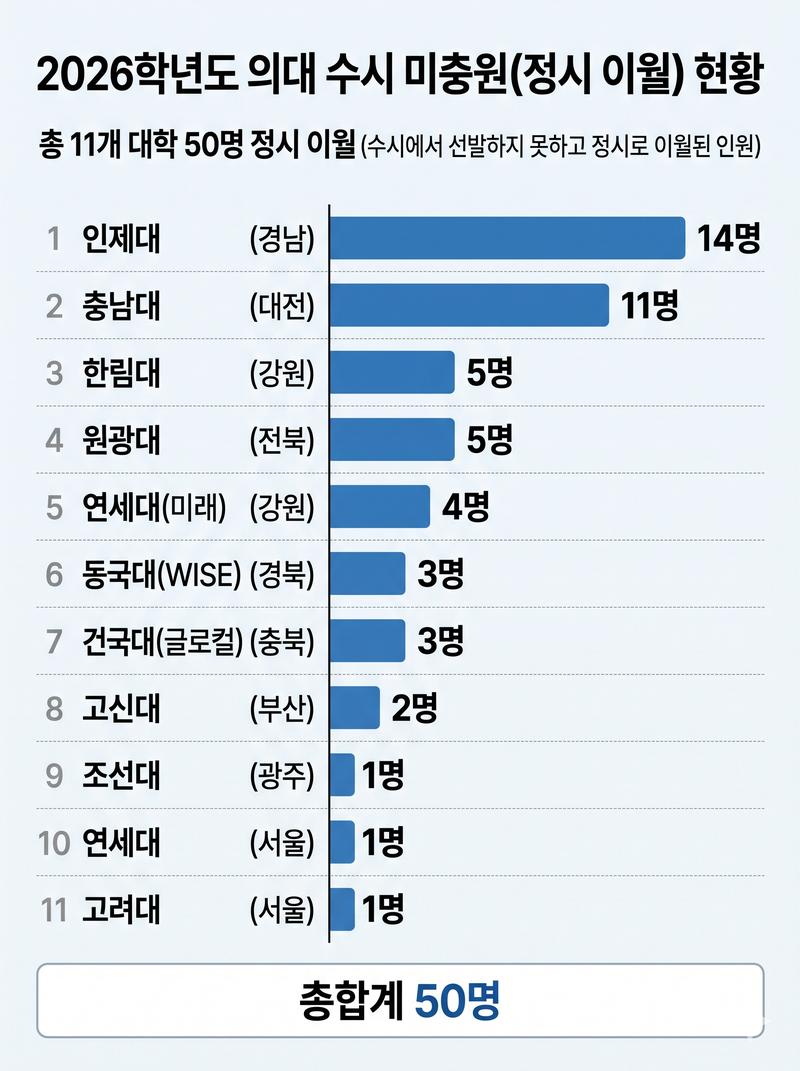
A total of 50 places at 11 universities nationwide went unfilled in early admissions and were carried over to regular admissions. Inje University had the most, with 14, followed by Chungnam National University with 11; Hallym University and Wonkwang University with five each; and Yonsei University’s Mirae Campus with four. Yonsei University and Korea University (KU), both in the Seoul area, each had one place carried over from early admissions.
Lim said he believes successful applicants to nationwide-selection tracks at medical schools in non-capital regions left for medical schools in the capital region, while successful applicants to medical schools in the Gyeongin region left for Seoul-area medical schools after receiving concurrent offers.
For the 2027 academic year, medical school quotas will increase by 490 places, all of which will be filled by selecting regional physicians. Lim predicted, “As a result, early-admission applicants may be accepted by an even greater number of universities, potentially leading to more successive withdrawals and a further increase in places carried over to regular admissions.”
By admissions track, withdrawals were more numerous in the student-record academic track, which focuses mainly on school grades. The academic track had 920 places and 1,039 additional admissions, for a fill rate of 112.9%. This does not mean the number of places increased; rather, as successful applicants repeatedly declined their places, the number of additional admission offers exceeded the intake. By contrast, the student-record holistic track had 689 additional admissions for 892 places, a fill rate of 77.2%.
By region, the nationwide-selection track—which is open to applicants from across the country—had a high fill rate of 146.4% among academic tracks at universities outside the capital region. There were 325 additional admissions for 222 places. By area, the rates were 183.3% in Chungcheong, 181.8% in Daegu-Gyeongbuk, and 177.8% in Honam. The regional-talent track, open only to students from the respective region, had 607 additional admissions for 624 places, a fill rate of 97.3%.
Fill rates were also high at universities in the capital region. The academic track at medical schools in the Gyeongin region had 48 additional admissions for 16 places, a fill rate of 300.0%. Although the intake was small, Jongno Academy’s analysis found that successful applicants had been admitted to an average of 4.0 universities. The Seoul-area academic track also had 59 additional admissions for 58 places, a rate of 101.7%.
By contrast, at Seoul National University’s medical school, one of the most sought-after, not a single student withdrew from early admissions in either the 50-place general track or the 39-place regional-balance track.
[email protected] Kim Man-gi Reporter