Inje County residents head to Seoul for rally outside National Assembly as anger erupts: ‘Population is shrinking, yet we’re being grouped with Chuncheon and Wonju?’
- Input
- 2026-10-25 09:37:58
- Updated
- 2026-10-25 09:37:58
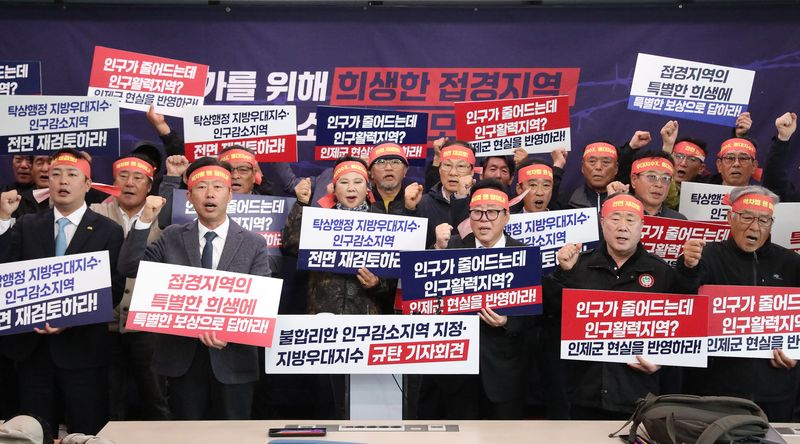
【Financial News, Inje = Kim Gi-seop】Angry residents of Inje County, a rural border area in Gangwon State whose population has fallen by more than 1,500 in five years and whose underdevelopment ranks among the worst nationwide, plan to converge outside the National Assembly for a protest after the county was placed in the same Tier 2 category as Chuncheon and Wonju under a newly devised Regional Preferential Support Index intended to vary support by region.
According to Inje County on the 25th, the emergency committee on the Regional Preferential Support Index and Population Vitality+ area designations will hold its first rally in Inje on the 27th, followed by a second protest outside the National Assembly in Seoul. Members of civic groups and residents from all six towns and townships in Inje County will take part in large numbers.
Residents have taken to the streets in response to a series of government announcements. On the 7th, the Ministry of the Interior and Safety redesignated 92 population-decline areas and 18 areas of concern for population decline for the first time in five years. It removed Inje County from the population-decline list and classified it as a Population Vitality Plus area, a designation for places whose conditions have improved. Then, under the Regional Preferential Support Index approved at a Cabinet meeting on the 20th, Inje was placed in Tier 2 alongside Chuncheon, Wonju, Gangneung and Sokcho.
◇ Government yardstick ignores realities of border areas
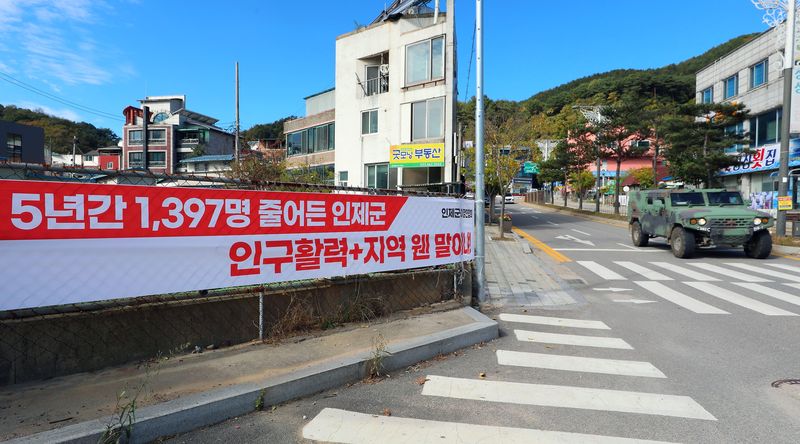
Residents denounce the government for turning a blind eye to the realities of Inje County. The county’s registered population fell by 1,529, from 32,165 at the end of 2021 to 30,636 in September this year, while its level of regional underdevelopment ranked 151st among 167 cities and counties nationwide. In other words, as the population shrank and underdevelopment deepened, the government’s scorecard gave the county the exact opposite assessment: ‘recovery of vitality.’
Critics say the results stem from indicators that ignore the distinctive circumstances of border areas. Including military personnel and their families in the registered population obscures the real risk of population decline, reflected in falling numbers of young people and children and an aging population. The newly introduced ‘living population’ indicator may also have overstated vitality by including transient populations associated with military bases, such as service members and visitors. There are growing calls to assess access to everyday services such as healthcare and education comprehensively, since the straight-line distance from Seoul used to calculate the index cannot capture winding mountain roads or poor transport conditions.
The inequity of the tier classifications is even more glaring. Of Gangwon State’s 18 cities and counties, five—Chuncheon, Wonju, Gangneung, Sokcho and Inje—were placed in Tier 2; eight, including Donghae and Hongcheon County, in Tier 3; and five—Taebaek, Samcheok, Jeongseon County, Goseong County and Yangyang County—in Tier 4. While the other four places in Tier 2 are all cities, Inje is the only county included. As a result, a border county of 30,000 people was grouped with Chuncheon City, with 280,000 residents, and Wonju City, with 360,000.
The government has also invited criticism by failing to disclose the calculation basis and weights for individual indicators used to designate population-decline areas and calculate the Regional Preferential Support Index. Inje County does not even know which criteria lowered its score, prompting widespread criticism that support tiers were assigned through a black-box assessment with no explanation of the basis.
◇ Disadvantages become reality, from gift certificates to child-welcome support payments
The tier classification is more than a simple administrative distinction. Starting next year, when the Regional Preferential Support Index is fully implemented, support will vary by tier across 23 government programs, including support for issuing Local Love Gift Certificates and the Youth Employment Leap Subsidy. A plan is also being pursued to vary the amount of the child-welcome support payment given to families welcoming a new child by region, further increasing residents’ anxiety.
Inje County now faces lower levels of preferential support than neighboring counties such as Hongcheon, Jeongseon and Goseong. Having been left off the population-decline area list and then assigned an unfavorable tier under the Regional Preferential Support Index, the county could see support disparities widen across residents’ lives and the local economy, the community fears. The prospect of expanded support that residents had hoped for through designation as a population-decline area has effectively been shut off.
The government maintains that support will not be cut off. The Ministry of the Interior and Safety has decided to maintain existing support for Population Vitality+ areas for five years. Last year, when Inje County was classified as an area of concern, it received an excellent grade in the investment plan evaluation for the Local Extinction Response Fund and secured 3 billion won, the highest amount available to an area of concern. Residents, however, are protesting that simply maintaining the status quo will not slow population decline and that there is no guarantee support will continue after five years.
◇ Inje residents take their protest to Seoul: ‘Full reconsideration of Tier 2 classification’
Inje County and the local community went on high alert immediately after the government’s announcement. After an emergency meeting on the 21st, Inje County Governor Choi Sang-gi, Inje County Council Chair Kim Do-hyeong and others held a press conference at the Gangwon State Government Office on the 22nd to call for policy changes. On the 23rd, a subcommittee of the emergency committee decided to take the protest to Seoul. Of the roughly 1,000 people who will gather at the Inje grass field for the first rally at 9 a.m. on the 27th, about 600 will move to the National Assembly for a second protest from 12:30 p.m. to 2:30 p.m.
At the rally, the emergency committee plans to call for a full review of the Tier 2 classification plan, the addition of more population-decline areas and improvements to evaluation criteria to reflect the distinctive circumstances of border areas. After the rally, it plans to continue its joint response by having civic groups put up banners and submit opinion letters and a joint petition signed by residents.
A representative of the emergency committee emphasized, “The population is falling and Inje ranks 151st nationwide for underdevelopment, yet the government has grouped it with major cities without even disclosing its reasons. If things continue this way, disadvantages will inevitably become entrenched across county residents’ lives. That is why we decided to stand outside the National Assembly, and we will fight to the end until reasonable criteria are established.”
[email protected] Kim Gi-seop Reporter