Student mental health a top priority in ‘Geun-sik Chung’s second term’; teacher rights protections also to be strengthened
- Input
- 2026-10-25 09:00:00
- Updated
- 2026-10-25 09:00:00
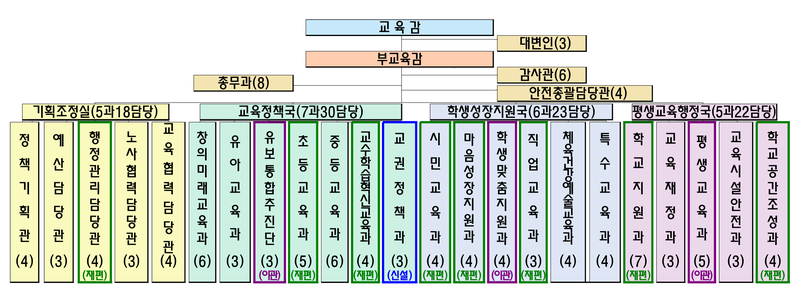
[Financial News] SMOE will bring student mental health support work together in a single department at each district education office and establish a new Teacher Rights Policy Division dedicated to protecting teachers’ rights. SMOE said on the 25th that it is pursuing an organizational restructuring effective January 1 next year.
According to SMOE, following the Mind Recovery Campus—which was the first initiative approved by Superintendent Geun-sik Chung in his second term and is scheduled to open in 2028—the reorganization will make support for students facing emotional crises and the restoration of their mental health its top priorities.
Under the reorganization, the headquarters will retain its structure of one office and three bureaus, while the number of divisions will rise from 14 to 18 and the number of teams from 110 to 114. SMOE explained, “We have improved organizational efficiency by transferring and consolidating overlapping and dispersed functions, keeping staffing increases to a minimum, and changing a structure that led departments to pass work off to one another.”
Superintendent Geun-sik Chung said, “I hope this reorganization will serve as a stepping stone to advance ‘Basic Education for All, Happy Cooperative Education,’ enable schools to focus on their core educational role, and give the education office the momentum to vigorously pursue policies centered on schools and students.”
The headquarters will reorganize by separating the Mind Growth Support Division from the former Democratic Citizenship Education Division. District education offices will bring mental health, respect for life, and tailored integrated student support—previously scattered across multiple departments—together under the Student-Centered Cooperation Division. The aim is to handle everything within a single system, from identifying students in crisis to providing tailored support and responding to cases. The offices also plan to add staff, including dedicated education supervisors.
New units will also be established to handle teacher rights protections and legal support for schools. SMOE will create a Teacher Rights Policy Division under its Education Policy Bureau and assign it responsibility not only for responding to violations of teachers’ rights, but also for policies to improve teachers’ status, including support for early-career and disabled teachers and improvements to working conditions. The aim is to pursue policy at a more fundamental level, rather than stopping at responding to individual cases.
The reorganization also reflects a trend of increasing legal disputes in schools. SMOE will establish a School Legal Support Team under the Administrative Management Office, broadening comprehensive guidance and support to cover school-related legal matters beyond violations of teachers’ rights.
The headquarters’ structure will also be rearranged around students. The Student Customized Support Division, currently under the Planning and Coordination Office, will move to the Student Growth Support Bureau, which includes the Mind Growth Support Division and the Civic Education Division. The Lifelong Career Education Bureau will be renamed the Student Growth Support Bureau. SMOE said that functions serving overlapping groups—such as welfare, emotional-crisis support, student guidance, dropout prevention, and support for students from immigrant backgrounds—have been grouped around students and arranged to work in coordination with one another.
The curriculum and career and college-admissions systems will also be revised to reflect rapidly changing artificial intelligence (AI) and digital environments and changes in assessment methods. The former Student Competencies and Innovative Education Division will be reorganized as the Teaching and Learning Innovation Division, while career and college-admissions work at the Education Research and Information Institute will be integrated with the headquarters’ career education function and transferred. The plan is to develop new models for teaching, learning, assessment, career guidance, and college admissions in preparation for the expansion of constructed-response and essay-based assessments. The Elementary Education Division will establish a Basic Academic Skills Team and continue efforts to ensure foundational academic skills, including expanding Learning Diagnosis and Growth Centers in all 25 autonomous districts to identify and help address learning gaps early.
The former Democratic Citizenship Education Division will be split to create a Civic Education Division and adjust the scope of work handled by a single department. Education on history, the constitution, and student self-governance will be linked with and expanded to include global citizenship and ecological citizenship education. To strengthen the public role and accountability of private schools, a Private School Policy Team will be established within the School Support Division. The Education Research and Information Institute will strengthen its policy research function and serve as a think tank for Seoul education policy.
[email protected] Kim Man-gi Reporter