“They say the KOSPI is up, so why are only my stocks down?” ... The startling reason 8 in 10 retail investors got crushed [Money Signal]
- Input
- 2026-10-24 19:00:00
- Updated
- 2026-10-24 19:00:00
[Financial News] News of a stock market rebound sends you eagerly reaching for your brokerage app (MTS). But something looks off on the ticker board.
The KOSPI is supposedly flashing a gain signal, but the stocks in my account are all blue with losses. The cheers over gains in Samsung Electronics and SK hynix are just someone else’s party to ordinary investors stuck holding other stocks.
Why on earth does this happen? Am I just unlucky, or did I pick the wrong stocks? The short answer is that it’s not your fault. Incredibly, on the 23rd, at least four times as many stocks fell as rose in the domestic market. The KOSPI was up, but nearly 8 out of every 10 stocks moved lower—a distorted market that amounted to a “fake rebound.”
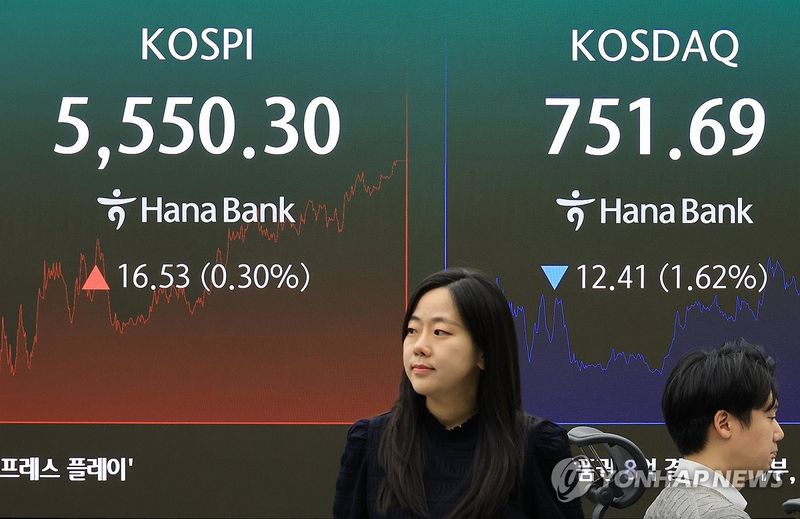
According to the Korea Exchange (KRX) on the 24th, the KOSPI closed at 5,550.30 on the 23rd, up 16.53 points (0.30%) from the previous trading day. It had managed to rebound in a single day after the shock of a 3.52% plunge the day before.
But a look at individual stocks tells a grim story. On the main board, just 173 stocks advanced. By contrast, a whopping 717 declined, while 23 were unchanged. About 78.5% of all 913 stocks fell. This is clear evidence that a rising index alone does not mean warmth is spreading across the market.
So how did the KOSPI manage to close higher even as more than 700 stocks tumbled? The answer lies in how the index is calculated: it is weighted by market capitalization.
The KOSPI does not divide every stock’s gain equally by 1/n. The larger a company’s market capitalization, the greater its influence on the index. Even if a company worth 100 trillion won and one worth 1 trillion won both rise by 1%, their impact on the market differs by a factor of 100.
In fact, the KOSPI was hauled higher that day by a handful of giant large-cap stocks, including the “semiconductor duo.” SK hynix surged 4.42% from the previous day to close at 1,277,000 won, while Samsung Biologics (7.71%), SK Square (3.20%) and Samsung Electronics (0.47%) led the gains. In particular, SK hynix said it would halt plans to take its U.S. subsidiary Solidigm public (IPO), easing concerns about a valuation discount resulting from a duplicate listing and strongly boosting investor sentiment.
Meanwhile, leading stocks in other sectors slid one after another, including Hyundai Motor (-1.99%), KB Financial Group (-3.29%), Samsung Electro-Mechanics (-2.01%) and LG Energy Solution (-1.79%). A few giant companies soared, lifting the entire KOSPI and creating a massive “illusion effect.”
The underlying supply-and-demand picture in the market was even more precarious. Foreign investors dumped nearly 1 trillion won worth of shares on the KOSPI that day. Institutions bought 870 billion won and individuals 50 billion won in an effort to hold the line, but amid a massive wave of selling, buying was concentrated in just a few large caps. That was also why the market swung wildly: after plunging as much as 4.12% to 5,305.98 early in the session, the index recovered a staggering 244.32 points in the afternoon.
Market experts advise investors to look at “market breadth” when the index and individual stocks move in opposite directions like this. When the index rises, the number of advancing stocks should also increase, indicating that genuine buying is spreading across the market. Conversely, if only the index rises while decliners vastly outnumber advancers, the market is likely distorted, with a handful of large caps artificially propping up the index.
In a market like this, investors who do not own certain large-cap stocks are bound to be left completely behind.
If the stocks in my diversified portfolio fall by an average of 2%, then even as the news trumpets a rise in the KOSPI, 600,000 won of the 30 million won in my account has already vanished.

Ultimately, investors need to stay clear-headed and avoid becoming fixated solely on the “index” displayed on the ticker board.
Behind that single figure showing a 0.30% gain lie the tears of shareholders in a staggering 717 stocks. The money individuals invest—saved bit by bit from their salaries, set aside for their children’s education, or intended for retirement—carries a different weight for everyone.
We must not forget that even when we hear news that spring has come to the stock market, a bitter winter wind may still be blowing through our own accounts. Rather than rushing in, misled by the index’s illusion, focusing on the true value of the stocks we hold and on shifts in supply and demand is the only way to survive in this harsh market.
[email protected] Jeon Sang-il Reporter