European politics... Centrism vanishes, liberal democracy in peril [Yoon Jae-joon’s World View]
- Input
- 2026-10-26 05:00:00
- Updated
- 2026-10-26 05:00:00
[Financial News] The pillar of centrist politics that has supported the European continent is shaking badly.
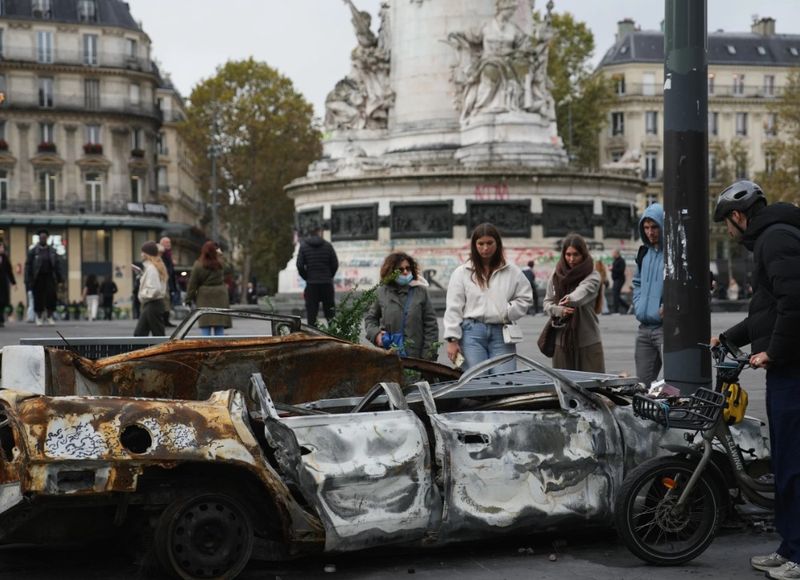
Protests and unrest have recently spread across Europe, including France. The New York Times (NYT) recently reported that public anger in Europe over slow growth, high inflation, massive national debt and bleak future prospects for young people is fueling far-right and far-left populist parties.
The large-scale unrest in France, which began over inadequate education funding and spread nationwide, is a prime example of this situation. But this phenomenon is nothing new: it is seen as the result of years of mounting despair and distrust as liberal democracy, which promised a “better future” to young people and wage earners, failed to do its job.
A growing number of Europeans believe that established mainstream parties, from the center-left to the center-right, can no longer offer practical alternatives. Critics say that mainstream politics, led by highly educated elites, has lost touch with ordinary people, workers and young people. With fiscal deficits and spending surging and the burden of high interest rates mounting, governments’ ability to respond with policy measures is limited as well.
■Far-right and far-left populism draws voter supportAgainst this backdrop, voters are gravitating toward the extremes. In France, Marine Le Pen’s far-right National Rally (RN) is leading polls for the next presidential election, with Jean-Luc Mélenchon’s far-left France Unbowed (LFI) close behind. In Germany, voters are also increasingly defecting to the far-right Alternative for Germany (AfD) and the Left Party (Die Linke).
With major elections approaching in four of Europe’s most populous countries—Spain, France, Italy and Poland—the challenge from extremist parties is intensifying. In Italy, right-wing Prime Minister Giorgia Meloni is seeking to turn the tide amid weekend protests and other developments, while former general Roberto Vannacci, who holds even more hardline right-wing views, is setting himself up in opposition.
Hardline right-wing parties are already part of coalition governments in the Czech Republic, Finland, Slovakia and Croatia, while Slovenia’s government also relies on outside support from the hard right. Alberto Alemanno, a professor at HEC Paris, noted that competition with more extreme right-wing forces is pushing even established parties to take more hardline policy positions.
According to the Pew Research Center, public satisfaction with how democracy is functioning has fallen sharply. In this year’s survey, 69% of people in France, 68% in Spain and 62% in Italy said they were dissatisfied with democracy in their countries. The figure reached 47% in Poland, which adopted democracy after a long period of Soviet occupation, while 69% in the United States also expressed dissatisfaction.
Asked why trust in centrist politics and democracy has declined, 2024 Nobel Prize in Economic Sciences laureate Daron Acemoglu, a professor at the Massachusetts Institute of Technology (MIT), said, “It’s because we began to take democracy for granted.” Liberal democracy, he said, has failed to keep its promises to ordinary citizens, especially the broad working class. He stressed, “For liberalism to rise again, it must put the working class at its center.”
The protests and unrest that have recently spread across France vividly illustrate the anger of workers and pensioners suffering from high prices and high interest rates. They point not only to the failure of the center-right policies of Emmanuel Macron’s government but also to the failure of liberal democracy as a whole. The violence in cities across the country is expected to create a political climate favorable to Le Pen, who advocates anti-immigration policies and tougher law and order measures.
In his recent book, *What Happened to Liberal Democracy?*, Professor Acemoglu identifies two key sources of failure that have built up over the past half-century.
The first is the failure to deliver “shared prosperity” to wage earners hit by automation, globalization and rapidly growing polarization. Employment insecurity caused by the rise of artificial intelligence (AI) has added to the problem. Professor Acemoglu said policymakers had forgotten their basic responsibility to ensure that everyday infrastructure, including roads, education and healthcare, works properly.
The second is “cultural politics from above.” Across the West, highly educated elites have monopolized even traditional socialist and workers’ parties, dismissing the concerns and voices of ordinary people—once their core supporters—as something to be corrected or simply ignored.
Ultimately, workers who no longer felt they had a political home shifted their support to far-left and, above all, far-right populist parties. This threatens the traditional values of Western societies, weakens mainstream parties and undermines the functioning of parliamentary democracy itself. In the 2024 UK general election, the combined vote share of the two major parties, the Labour Party and the Conservative Party, hit its lowest level in 100 years.
■German politics shaken to its core... Europe’s political landscape set for a major reshuffleGermany, too, starkly illustrates the decline of centrist parties and political fragmentation. The two major “people’s parties” (Volksparteien)—the center-right Christian Democratic Union/Christian Social Union (CDU/CSU) and the center-left Social Democratic Party (SPD), which have taken turns leading Germany since World War II—have weakened considerably. This is because workers and young people have defected in large numbers to the far-right AfD and far-left Die Linke.
During the tenure of former Chancellor Angela Merkel, the Christian Democratic Union (CDU) strengthened its centrist course, but lost many traditional conservative supporters amid challenges including the expansion of refugee admissions, declining exports to China and rising tensions with Russia. The AfD filled the void and drew in working-class voters. The Social Democratic Party (SPD), too, drifted away from its traditional base as intellectual elites came to dominate the party.
According to the latest average of German opinion polls, the far-right AfD leads with about 28% support, followed by the CDU/CSU bloc at 19.8%, the Green Party at 15%, the SPD at 13.1% and Die Linke at 11.3%. The political landscape makes it virtually impossible to form a stable centrist coalition government.
Ivan Krastev, chairman of Bulgaria’s Centre for Liberal Strategies, predicted that as elections in major countries continue, European politics will undergo a “major transformation” toward fragmented governments. Even if a right-wing coalition is formed, smaller far-right parties could seize the initiative and push politics as a whole further to the right.
The French presidential election, scheduled for next spring, is expected to be the biggest turning point. If Marine Le Pen wins, the repercussions are expected to be enormous across Europe’s security and economic landscape, affecting the European Union (EU) framework, the euro, the North Atlantic Treaty Organization (NATO) and support for Ukraine.
Professor Acemoglu proposed “big-tent populism,” which draws on inclusiveness to absorb public anger, as an alternative. “The key is to provide people without college degrees with opportunities for jobs, higher wages and career advancement,” he said. He added, “Policies that allow everyone to share in prosperity are urgently needed, and how we put AI technology to use will be a decisive factor.”

[email protected] Yoon Jae-joon Reporter