[Interview] Lee Kwang-jae: “In the AI era, the people should become shareholders in wealth; let’s create a ‘national spoon,’ not a golden spoon”
- Input
- 2026-10-24 14:13:15
- Updated
- 2026-10-24 14:13:15
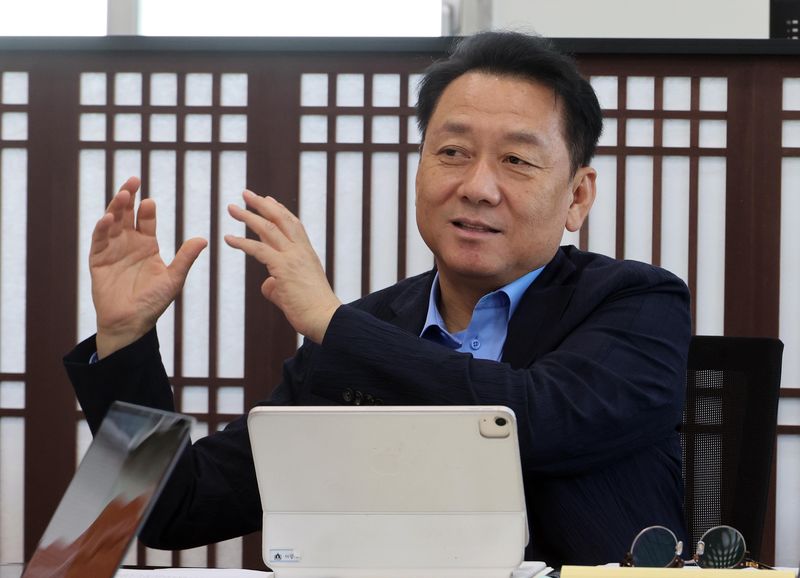
[Financial News] “Now it’s not about getting a leg up from Dad or Mom; it’s about getting one from the nation. We should create a ‘national spoon,’ not a golden or silver spoon.”
Lee Kwang-jae, chair of the National Assembly Budget and Accounts Committee and a member of the Democratic Party of Korea, argued in an interview with Financial News at the National Assembly in Yeouido, Seoul, on the 7th that the role of the state must be fundamentally changed. His argument stems from the concern that even if the AI revolution brings a sharp rise in productivity and wealth, people’s lives will be unlikely to improve if the gains are concentrated in a handful of companies and capital.
The solution he proposed is an “investment state.” Rather than stopping at drawing up budgets and providing subsidies, the state would actively invest using sovereign wealth funds, pension funds and public assets, then share the returns with the people.
Lee stressed that the government should “shift from one that spends money to one that makes money, and from a subsidy economy to an investment economy,” adding that the people should become the original shareholders in wealth in the AI era.
To that end, he proposed a “National Lifetime Basic Asset,” under which the state would invest 100 million won at birth to provide funds for housing, education and starting a business in young adulthood, as well as retirement assets. Other policies arising from the same concern include expanding equity-accrual housing in new towns, investing part of the National Pension Service’s assets in domestic housing, using AI to review budgets, and establishing regional investment corporations.
Below is a question-and-answer session with Lee.
“From a government that spends money to one that makes money”
—Why do you argue that the state’s role needs to change in the AI era?
▲The AI revolution will bring enormous productivity and wealth, but big tech companies and capital will take most of it. The people must become the original shareholders in wealth in the AI era to protect their livelihoods. We must shift from a government that spends money to one that makes money, and from a subsidy economy to an investment economy. Now it’s not about getting a leg up from Dad or Mom; it’s about getting one from the nation. We should create a national spoon, not a golden or silver spoon.
—What specific policies would create a national spoon?
▲I’m considering a National Lifetime Basic Asset funded through a sovereign wealth fund. When a child is born, the state would invest 100 million won and manage it over the long term. Assuming an annual return of 7%, it would grow to about 386 million won by age 20. If 100 million won of that were used for education, housing or starting a business, and the rest continued to be invested, it would grow to about 6 billion won by age 65. The idea is to use 4 billion won as an individual’s retirement assets and return 2 billion won to the state for investment in the next generation.
—If the state invests 100 million won for each newborn, the fiscal burden would be considerable.
▲There needs to be thorough debate over whether the amount should be 100 million won or 50 million won, and whether to assume a 7% or 6% return. Possible funding sources include part of the national budget, funds left unspent, dividends on shares held by public institutions, and investment returns. We plan to hold a seminar at the National Assembly in early November to start the discussion.
—Isn’t it optimistic to assume an annual return of 7% can be maintained over the long term?
▲The outcome will vary depending on how the rate of return is set. We also need to discuss what would happen if the fund earned 6% rather than 7%. What matters is building a system through which the state supports people in accumulating assets through long-term investment.
—Do you think the state has enough funds to invest?
▲We shouldn’t look only at the government budget. The government budget is about 800 trillion won, pension funds total 1,500 trillion won, state-owned and public assets amount to 3,500 trillion won, and funds in the market total about 8,000 trillion won. The state has these four pools of money. Even for housing alone, the general account, pension funds, state-owned and public assets, and financial instruments could all be used together, but there is no national system that considers them in an integrated way.
“You can’t spend your life held hostage by a house”
—Can the investment-state approach also be applied to housing?
▲You can’t spend your life held hostage by a house. We need to expand equity-accrual housing. For example, for a home worth 1 billion won, an individual would pay 200 million won upfront, while a public institution such as the Korea Land and Housing Corporation (LH) or Gyeonggi Housing and Urban Corporation (GH) would hold the remaining equity. The owner could then buy additional shares as their income rises.
—What scale of supply do you think is possible?
▲I’m proposing that about 10–15% of all homes in newly developed cities be supplied as equity-accrual housing. I’ve made the proposal to the government several times as well.
—You have also proposed investing National Pension Service assets in domestic housing.
▲The National Pension Service must be stable as a basic principle, but we could consider investing about 1%. Given the choice between investing in overseas real estate for a 7% return and investing domestically for a 3–4% return, the latter is certainly worth considering too.
—There are concerns among National Pension Service contributors that returns could fall.
▲We need to discuss this on the premise that the stability of the National Pension Service is important. The point is that we should also consider using pension assets to address domestic housing problems.
“Don’t hand out money just because a budget is labeled ‘AI’”
—Which areas will you focus on when reviewing the 2027 budget proposal?
▲I think more public funds need to be directed to housing, commuting and transport, small and medium-sized venture businesses, childcare, and culture. These areas are directly connected to people’s lives and can also create future growth drivers.
—How do you plan to address inefficiencies in public spending?
▲About 40 trillion won in unspent funds accumulates each year. A considerable amount goes unused in local government and education budgets. This problem needs fundamental surgery.
—What is your plan to use AI in budget reviews?
▲I suspect there are many budgets handing out money simply because they carry the label “AI.” Using AI to examine budgets in specific areas could help identify overlapping or wasteful projects. We’re going to try conducting this kind of review in this round for the first time.
“Regions need investment, not subsidies”
—How can the gap between the Seoul metropolitan area and the regions be narrowed?
▲We need to move away from distributing budgets to the regions and instead create growth drivers through investment. Busan, Ulsan and South Gyeongsang Province have strong manufacturing bases in industries such as automobiles, shipbuilding and aviation. Combining these with physical AI could help develop new industries. We need an organization such as a Southeast Regional Investment Corporation to support this.
—How would a Southeast Regional Investment Corporation operate?
▲It would invest in companies with growth potential and ties to the region’s industrial base. One possible structure would have the public sector provide seed funding and draw in private investment as well. The key is not to stop at allocating money to regions, but to link investment with industrial development.
—How should the weakening competitiveness of regional universities be addressed?
▲We need to create “university cities” where universities, companies and research institutions grow together. Supporting universities on their own makes it difficult to create regional industries and jobs. Each region has assets that can be connected, such as the Daedeok Research and Development Special Zone and KAIST, Gyeongsang National University in Jinju and LH, and universities in Jeonju and the National Pension Service. We need to bring these assets together to create regional growth hubs.
From U.S. investment and nuclear power to Korea-Japan cooperation
—How should the funding and risks of large-scale investment projects in the United States be managed?
▲One option would be to use capital from multilateral development banks such as the Asian Development Bank (ADB). We need to consider ways to raise the funds required for investment projects in the United States while sharing the risks. I think this approach could also be considered for major projects such as the Alaska LNG project.
—What role should Korean companies play in U.S. nuclear power projects?
▲It is important to increase the participation of APR-1400, a Korean-designed nuclear reactor. Korean companies should be able to take on broader roles in U.S. nuclear power projects, including design and construction, rather than merely supplying equipment.
—Do you think the earned income tax system also needs to change?
▲The tax brackets for earned income have remained unchanged for a long time, increasing the burden on salaried workers. In particular, the 88-million-won bracket has remained in place since 2007. We need to consider ways to ease the tax burden, including expanding deductions for wage earners.
—How should economic cooperation between South Korea and Japan be expanded?
▲South Korea and Japan could consider jointly purchasing energy. They also need to expand cooperation in digital fields such as AI and data. The two countries should identify areas where they can work together in terms of economic security and industrial competitiveness.
[email protected] Kim Kyung-min Reporter