“Mom, can you watch the little one again tomorrow?” ... Parents’ twilight years crumbling under 26 hours a week of “unpaid labor” [People Who Cross the Line]
- Input
- 2026-10-24 12:41:41
- Updated
- 2026-10-24 12:41:41
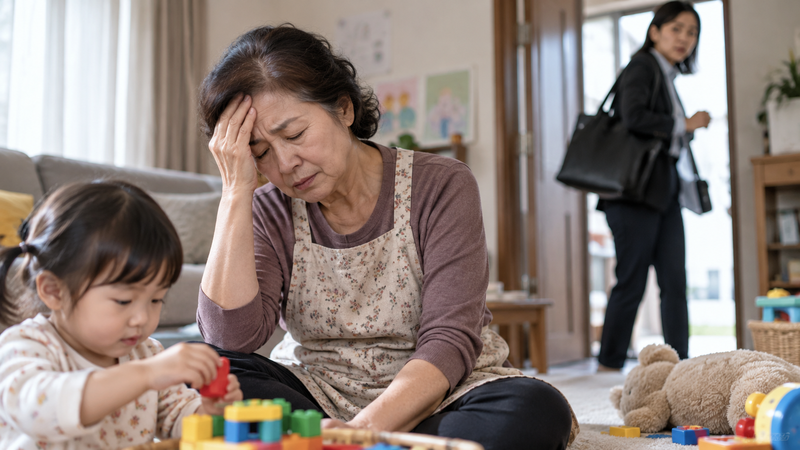
[Financial News] It’s 7 a.m. A daughter, rushed as she gets ready for work, leaves her child with her mother and hurries out the door.
For the maternal grandmother, the real day starts then. By the time she’s fed and dressed the child, cleaned up, and played with them, she’s already exhausted by the time the workday ends.
“Mom, please help me out again tomorrow.” At her daughter’s desperate plea, the mother can’t bring herself to answer right away. It’s not that she doesn’t adore her grandchild. She longs for her own lost routine and some time to rest. This is no exception confined to a particular family. It is the all-too-common, unvarnished reality of “grandparent childcare in later life” that helps sustain South Korea.
■ A grueling 26.8 hours a week... “I can’t say no, even when I don’t want to”
The statistics lay bare the structure of the reality. According to a survey of 1,063 grandparents aged 55 to 74 by the Korean Women’s Development Institute, published in May, 53.3% care for their grandchildren because, “although they don’t want to, they can’t refuse due to their children’s circumstances.”
Their average weekly caregiving time is a staggering 26.83 hours. On weekdays, they devote at least six hours a day to the demanding work of childcare. This is clearly heavy labor, far beyond simply “watching them for a little while.” The toll is borne out by the numbers: 73.7% reported increased physical fatigue, and 60.4% reported mental stress. As many as 47.8% said their chronic illnesses had worsened. Nearly half (46.8%) of the grandparents had thought, “I want to stop”—and that is no exaggeration.
■ A monthly allowance of 300,000 won, and divided opinions
Compensation adds another flashpoint.
A 2022 survey (by Korea Research and others) found that 54% of respondents care for their grandchildren without separate pay. But the real cause of conflict is not “money” itself. The main sources of resentment toward their children were disagreements over childrearing (36.1%), an attitude that takes childcare for granted (28.1%), and disregard for grandparents’ opinions (26.2%).
Financial dissatisfaction (8.3%) ranked lower. It is the insensitivity of treating parents’ devotion as “free labor with zero cost” that drives a wedge into relationships.
Local governments, too, recognize the seriousness of the situation.
Gyeonggi Province’s “Gyeonggi-style Family Care Allowance” is one example. If a relative cares for a child for at least 40 hours a month, the program provides 300,000 won per month (for one child). It is encouraging that society has, to some extent, recognized the value of caregiving labor. But 300,000 won a month cannot fully compensate grandparents for the retirement years they have lost.
The fundamental questions remain. Does paying money make it acceptable to demand unlimited devotion from parents? Conversely, does the absence of financial compensation mean that their sacrifice can be treated as an obligation to be taken for granted?
■ Devotion should not be taken for granted... It’s time for family “rules”
Of course, at least 80% of grandparents said that caring for their grandchildren had improved their relationship with them. More than 68% also said their relationship with their children had improved.
But love and the fatigue of labor must be kept entirely separate. Affection for a grandchild does not guarantee boundless energy or require grandparents to give up their entire retirement.
Children can ask for help, but parents have the right to say no, too. That is why clear-eyed, transparent discussions in advance are essential—about the days and hours of care, the limits on last-minute requests, and how the child will be raised. When grandparents say, “I want to stop,” the first thing they deserve is respect: their words should be understood as a limit to their labor, not as a betrayal.
When sacrifice is imposed as a matter of course in the name of family, where do you think the reasonable limits lie? This weighty question remains unresolved.
[email protected] Jeon Sang-il Reporter