Nuclear power expansion amid AI electricity-demand surge... IAEA: “At least triple by 2060”
- Input
- 2026-10-24 10:39:33
- Updated
- 2026-10-24 10:39:33
[Financial News] A surge in electricity demand driven by the spread of artificial intelligence (AI) data centers is expected to push global demand for nuclear power to at least three times its current level by 2060. Analysts say nuclear power is becoming increasingly important because it can reduce carbon emissions while providing a stable electricity supply.
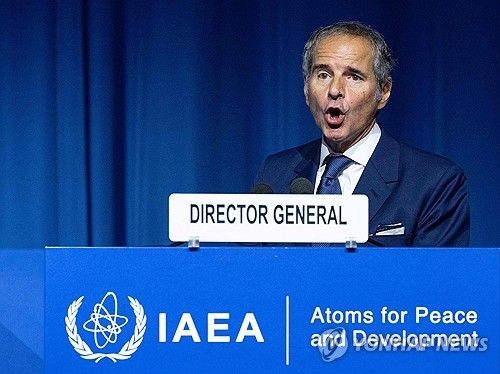
International Atomic Energy Agency (IAEA) Director General Rafael Mariano Grossi formally presented the 2025 annual report, which includes these findings, at the United Nations General Assembly in New York on the 23rd (local time).
According to the report, projections for global nuclear generating capacity have been revised upward for five consecutive years. The increase reflects a combination of rising electricity demand, particularly from AI data centers, carbon-neutrality policies, and expanding electricity use across industries.
Under the IAEA’s high-growth scenario, global operating nuclear capacity is projected to expand by 2050 to 992 gigawatts (GW), 2.6 times its 2024 level. To achieve this, an additional 676 GW of nuclear capacity will need to be brought online over the next 25 years. By 2060, global demand for nuclear power is projected to be at least three times its current level.
A total of 413 reactors are currently operating in 31 countries worldwide, producing about 10% of global electricity and 25% of carbon-free electricity. Another 72 reactors, with a combined capacity of 77.2 GW, are under construction in 15 countries.
Small modular reactors (SMRs) are expected to lead the expansion of nuclear power. Director General Grossi projected that SMRs would account for about 24–28% of the additional nuclear capacity brought online in the future. Big tech companies are showing growing interest in existing large-scale nuclear plants and SMRs to ensure a stable, 24-hour electricity supply for AI data centers.
Director General Grossi also strongly criticized North Korea’s nuclear development. He warned of the risks posed by violations of United Nations Security Council (UNSC) resolutions, saying North Korea was expanding its nuclear program without IAEA monitoring or oversight.
The IAEA has been unable to draw safeguards conclusions regarding nuclear material and activities because it has been denied on-site access to North Korea’s nuclear facilities. It said, however, that it continues to monitor activity at key facilities, including Nyongbyon, through satellite imagery and open-source information.
He also urged the resumption of inspections of Iran’s nuclear facilities. Director General Grossi said the IAEA had completed technical reviews to support a diplomatic agreement concerning Iranian nuclear facilities attacked by the United States and Israel last year, stressing, “No agreement can be sustained without the IAEA’s essential verification.”
He also said inspectors should return as soon as possible to verify nuclear material that has yet to be verified, including highly enriched uranium.
He also raised safety concerns about Ukraine’s Zaporizhzhia nuclear power plant. Director General Grossi said the plant remains in a dangerous state because of nearby military activity, repeated disruptions to its external power supply, and shortages of fuel for emergency generators.
He said there had been progress in investigating allegations of past secret nuclear activities in Syria. The IAEA said it had reaffirmed that the former regime of Bashar al-Assad had sought to build a secret reactor to produce weapons-grade nuclear material, and that it was conducting further investigations in cooperation with the current government.
[email protected] Kim Gyeong-min Reporter