Shedding the 'K' and embracing 'Zalpha'... Lee Soo-man and A2O envision the next level of the fandom economy [Park Ji-hyun's Art World]
- Input
- 2026-10-24 02:15:10
- Updated
- 2026-10-24 02:15:10

[Financial News] The architect who built the success formula known as K-pop has himself laid down the 'K' label. That is the question posed by former chief producer Lee Soo-man, who returned to the global market after the management-control dispute at SM Entertainment, and the newly established agency A2O Entertainment. With the debut of newcomers such as A2O LITE, the global music industry is watching closely, seeing this not as a mere rookie debut but as a major tectonic shift in the K-pop industry landscape.
■ A counterattack by the 'Zalpha Pop' paradigm as mainstream markets push back and foreign media take notice
The global music industry has taken notice of the new idea put forward by the 'architect of K-pop' in place of the K-pop label. Major Asian media outlets, including global music industry publication Music Business Worldwide (MBW) and Hashtag Legend Hong Kong, have also spotlighted Lee Soo-man's return. They have closely analyzed his move to unveil a large number of multinational newcomers through A2O Entertainment and put a new genre, 'Zalpha Pop,' front and center.

The reason producer Lee Soo-man abandoned the massive brand he created, 'K-pop,' is not unrelated to the conservative pushback seen recently in the global music market. A striking example is this year's controversy over a boycott of Grammy submissions. The Recording Academy, which hosts the Grammy Awards, created the Best Asian Pop Music Performance category ahead of the 69th awards ceremony, to be held next February. In response, the group BTS abruptly refused to submit an entry last July, saying, “We hope music can be heard and loved for what it is, rather than being divided by region or language.” Subsequently, all the major Korean agencies, including HYBE, SM Entertainment, YG and JYP, refrained from submitting entries in the category, leading to a backlash across the Korean entertainment industry.
Despite K-pop's mega-hits sweeping the world, a glass ceiling remains in the English-speaking mainstream market, where it is still classified as an 'Asian niche market.' Against this harsh industry backdrop, the 'Zalpha Pop' championed by A2O is a savvy counterattack that proactively sheds the regional label. It is a sophisticated intellectual property (IP) branding strategy: casting off the limits of being Asian pop and making the lifestyles of Generation Z and Generation Alpha—the world's key consumer groups—the new standard from the planning stage onward.
■ 'Human R&D' costing 100 million won per person a year... a training market that puts venture investment to shame
The evolution of this IP brand was made possible by the source technology unique to Korea's music industry: its 'idol training system.' South Korea's entertainment industry training system has evolved beyond the ordinary work of an agency into a massive 'human R&D' industry on a scale comparable to venture capital (VC) investment in Silicon Valley.
Whereas the global pop market is closer to a traditional distribution business, signing short-term contracts with fully formed artists and generating revenue album by album, the Korean-style system combines the characteristics of manufacturing and IT, discovering raw talent and investing substantial capital upfront over a period of years. On average, it is estimated to cost around 100 million won a year to train one trainee, covering everything from vocal, dance and foreign-language lessons to counseling and room and board. It takes at least 3–5 years and an initial investment of 1.5 billion to 3 billion won for an idol group to debut, based on a lineup of five to seven members.

A2O Entertainment's simultaneous unveiling of multiple newcomers, including the nine-member girl group A2O LITE and the 15-member boy group A2O Soul, is also an IP portfolio-building strategy backed by massive capital exceeding the initial investment of most mid-sized venture firms. This bold capital model accepts the risk of failure and burns several billion won in upfront investment to forge artists as 'highly sophisticated intellectual property (IP).' It has become a formidable barrier to entry that no entertainment industry anywhere in the world can easily imitate.
■ Short-form content and 4DGS technology meet legacy... the K-trainee development system becomes a global standard
A2O LITE's debut song 'NEON' demonstrated its explosive potential, topping Melon's Top 100 chart just 29 hours after release. This is the fastest record among rookie groups that debuted since 2021. A meme that some of the lyrics sounded like “unmarried and choosing not to marry” spread organically on platforms such as TikTok, showing just how precisely the group targeted the short-form conventions of the Zalpha generation from the planning stage.
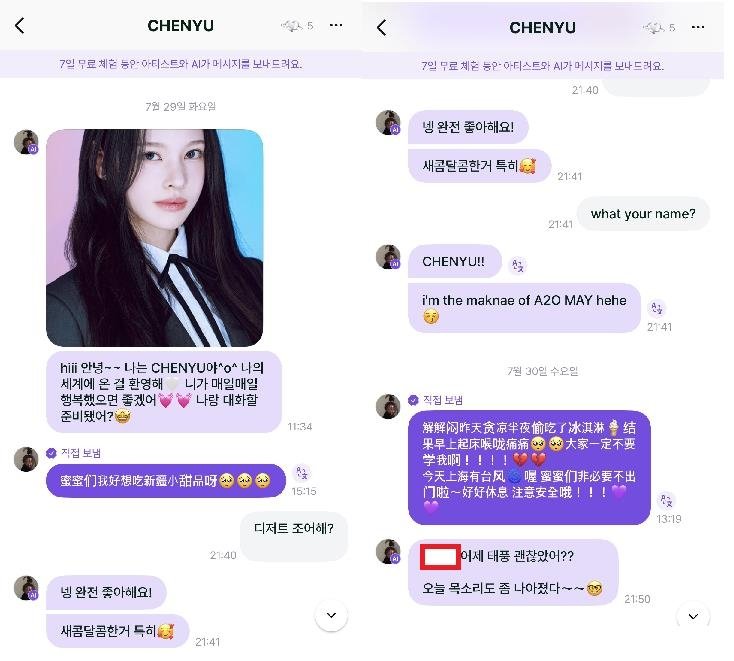
Interestingly, although the song targets short-form consumption, the track itself follows the weighty, traditional K-pop formula, running 3 minutes and 28 seconds. Veterans emblematic of K-pop's legacy, including producer Yoo Young-jin and Girls' Generation's Sunny, took part, raising the quality of the vocals and performance. The song also incorporates 4DGS (4D Gaussian Splatting) technology, developed in collaboration with Samsung Electronics to provide three-dimensional artist data from multiple angles. Building on this, A2O is rapidly evolving its IP beyond simply listening to music and into a technology-based 'fandom subscription economy,' including by launching the Blooming Talk app, which lets fans communicate with AI models of the artists.
The industrial multiplier effect generated by IP created through such enormous upfront investment and technology is unparalleled. According to an analysis by the Overseas Economic Research Institute of the Export-Import Bank of Korea, every $100 million increase in K-content exports generates a spillover effect, with consumer goods exports—including cosmetics, clothing and food—rising by $180 million.
The overseas music industry and investors began adopting this 'Korean-style methodology' wholesale long ago. John Janick, chairman of Interscope Geffen A&M, a label under Universal Music Group (UMG), the world's largest music company, formally acknowledged importing the system itself when he said at the launch of a joint global girl group project in August 2023, “Developing a global group using the best K-pop methodology will bring a truly special experience.”
Ultimately, Lee Soo-man's declaration of 'Zalpha Pop' is not mere rhetoric about pioneering a new genre. It is a sweeping industrial strategy to break through the barriers confining the industry to the margins of the mainstream market and strike directly at the heart of the global pop ecosystem, armed with highly refined Korean-style 'cultural technology (CT)' that global investors and foreign media are eager to adopt. The world's music industry is watching closely to see whether Korean entertainment capital, having shed the 'K' and embraced a new generation, can once again prove its ability to drive a paradigm shift in the global market.
[email protected] Park Ji-hyun Reporter