“Why did interest rates rise even after the spread was lowered?” Banks face pressure to disclose rate-setting process
- Input
- 2026-10-25 17:11:06
- Updated
- 2026-10-25 17:11:06
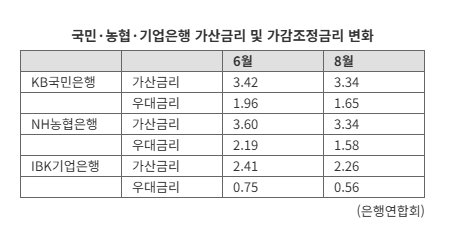
An analysis of interest rates on newly issued household loans for June and August, disclosed by the Korea Federation of Banks on the 25th, found that 10 of the 18 banks covered had lowered their spreads. Of those, three—KB Kookmin Bank, NH NongHyup Bank and IBK Industrial Bank of Korea—cut adjustment rates, which function as preferential rates, by more than they lowered their spreads, increasing the “banks’ share.”
KB Kookmin Bank lowered its spread from 3.42% in June to 3.34% in August, a decrease of 0.08 percentage points, but cut its adjustment rate from 1.96% to 1.65% over the same period, a decrease of 0.31 percentage points. NH NongHyup Bank also cut its adjustment rate by 0.61 percentage points while lowering its spread by 0.26 percentage points. IBK Industrial Bank of Korea likewise lowered the two rates by 0.15 and 0.19 percentage points, respectively, effectively raising lending rates.
This approach to adjusting rates also came under fire at a recent audit by the National Assembly’s National Policy Committee. The revised Banking Act, which took effect in July, bars banks from including certain statutory costs—such as reserve requirements, deposit insurance premiums and contributions to the Korea Inclusive Finance Agency—in loan spreads. The act was amended to ease consumers’ interest burden on loans, but concerns were raised that some banks were offsetting the effect of spread cuts by reducing preferential rates.
Financial authorities are therefore considering expanding disclosure of the rate-setting process. At a National Policy Committee audit on the 22nd, Financial Supervisory Service Governor Lee Chan-jin said, in response to calls for greater disclosure of loan rates and how they are determined, “We are preparing measures to strengthen consumers’ ability to choose, including disclosure and a form of ‘naming and shaming’ (publicly identifying and shaming).”
Banks are concerned about the burden of expanded disclosure. They currently publish base rates, spreads and adjustment rates through the Korea Federation of Banks, but say that revealing detailed calculations could expose business secrets, including each bank’s cost structure and pricing strategy. They also point out that simple comparisons have limitations because banks use different methods to set rates, and average rates vary depending on the creditworthiness of borrowers taking out new loans and the composition of loan products.
Since 2021, K Bank has removed preferential-rate conditions for some loan products and applied a uniform rate cut of 0.5 percentage points to all customers. This differs from the structure at other banks, where customers must meet specific conditions, such as having their salary deposited into an account, to receive a rate discount.
A banking industry official said, “Banks apply preferential rates in different ways, so it is difficult to make uniform comparisons based only on disclosed figures,” adding, “Disclosing the detailed calculation process could increase the business burden.”
Questions have also been raised about whether expanded disclosure would be effective. With limits on the amount of household lending restricting how much each bank can lend, customers may be unable to get a loan from a bank even after finding that it offers a low rate. Another banking industry official said, “There was a lot of interest when disclosure of the deposit-and-lending rate spread was first introduced, but it has attracted less attention over time,” adding, “Right now, whether you can get a loan is more important than choosing a bank with a lower rate.”
[email protected] Lee Hyun-jung Reporter