“A Denture Swallowed Five Years Ago, Thought to Be Gone” ... The Horrifying Thing That Happened in a 30-Year-Old Man’s Esophagus [Warning Signs]
- Input
- 2026-10-23 19:03:28
- Updated
- 2026-10-23 19:03:28
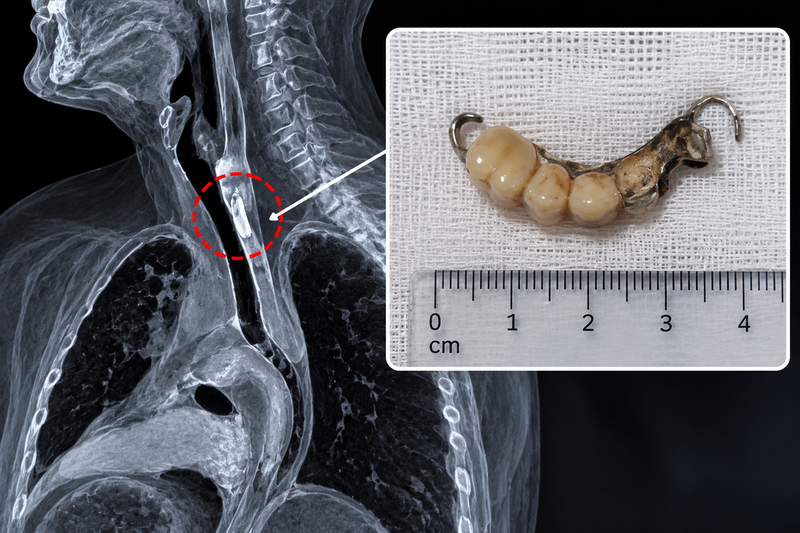
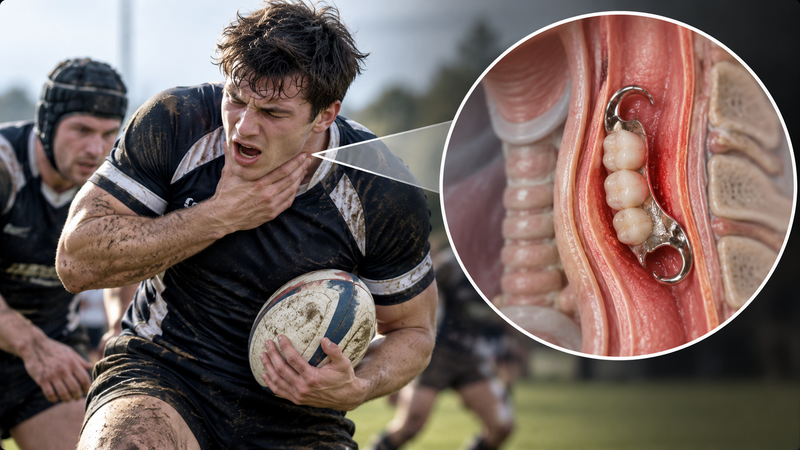
[Financial News] A dental prosthesis he accidentally swallowed while playing rugby five years ago. Nothing showed up on the X-ray at the emergency room he rushed to immediately after the accident.
The medical team concluded that it had already passed out of his body, and the man, too, returned to his daily life without giving it much thought. But that small prosthesis had remained grotesquely lodged in his esophagus for five years, shredding the surrounding tissue.
A recent issue of the international journal Journal of Surgical Case Reports featured a disturbing case of esophageal injury in a man in his 30s, reported by medical staff at Leicester Royal Infirmary in the UK.
The man, who was injured in the accident at around age 25, endured the painful sensation of his throat gradually tightening over the next five years. At first, he sometimes had difficulty swallowing food; then, at some point, food began getting stuck in his esophagus and would not go down at all. His coughing would not stop, and eventually he even began coughing up blood, a condition known as hemoptysis.
Unable to bear it any longer, he returned to the hospital. Surprisingly, this time, too, a standard chest X-ray showed no abnormalities. But the results of more detailed tests—a chest computed tomography (CT) scan and an endoscopy—were grim.
The man’s esophagus had swollen abnormally, reaching a transverse diameter of 4.53 cm. A huge mass of inflamed tissue completely blocked the passage inside his esophagus, with the dental prosthesis he had swallowed five years earlier lodged at its center. His condition was serious. After the prosthesis irritated the surrounding tissue for a prolonged period, a gaping abnormal opening—a tracheoesophageal fistula—had formed between the esophagus and the airway (trachea). It was an emergency: food or saliva could enter his airway and cause life-threatening aspiration pneumonia.
The medical team had initially suspected even esophageal cancer, but a biopsy revealed chronic inflammation and extensive fibrosis (a condition in which tissue turns into hard scar tissue).
It was already too late to solve the problem simply by removing the prosthesis. Through a thoracotomy, opening the right side of his chest, the medical team removed the irreversibly damaged esophagus entirely. Major surgery followed: they repaired the opening between the esophagus and airway with stitches and pulled the stomach upward to create a new esophagus. Even after surgery, the man had to undergo endoscopic vacuum therapy and repeated procedures to widen narrowed areas; only after several such treatments was he finally able to return to work.
Why, then, did the X-ray fail to detect the prosthesis five years earlier? The researchers pointed to the material of the dental prosthesis. Prostheses containing substantial amounts of nonmetallic materials such as plastic or ceramic, as well as irregularly shaped foreign objects, often do not show up clearly on standard X-rays, which produce two-dimensional images.
The researchers issued a strong warning: “A normal X-ray after swallowing a foreign object does not mean you are 100% safe. In particular, if you have difficulty swallowing food, feel as if something is stuck in your throat, or develop persistent coughing or cough up blood, do not dismiss it as a minor inconvenience. You must undergo a thorough evaluation with a CT scan or endoscopy.”
The consequences of brushing off the body’s subtle warning signs with “It’ll probably be fine” were severe.
[email protected] Jeon Sang-il Reporter