Two major labor confederations press for withdrawal of super-regional special zones bill, raising fears of cracks in ruling party's support base
- Input
- 2026-10-23 17:59:31
- Updated
- 2026-10-23 17:59:31
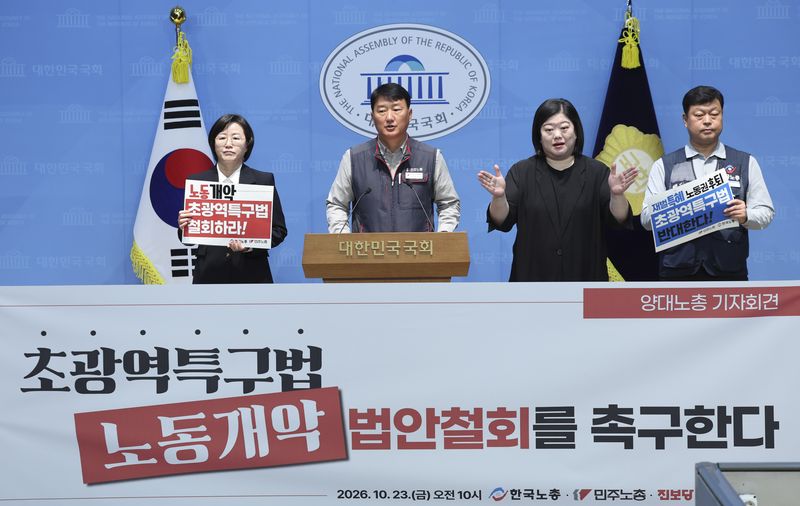
The Federation of Korean Trade Unions (FKTU) and the Korean Confederation of Trade Unions (KCTU) held a joint press conference with Rep. Hye-kyung Jung of the Progressive Party at the National Assembly on the 23rd, calling for the immediate withdrawal of the super-regional special zones bill. The two confederations demanded, “The government and ruling party must reaffirm the principle that the Mega Special Zones Bill will be discussed through dialogue and consensus, and withdraw the unilateral bill on super-regional special zones that rolls back labor protections.”
At the heart of the controversy is the Democratic Party's simultaneous introduction of bills both with and without special labor provisions. A bill introduced by Democratic Party lawmaker Sang-hyeok Park includes an exemption to working-hour limits for R&D personnel, an extended settlement period under the selective working-hours system, and an extension of the period for employing fixed-term workers. By contrast, the related special provisions were excluded from the bill introduced by lawmaker Ki-sang Choi.
FKTU Secretary-General Gi-seop Ryu criticized the move, asking, “Does introducing bills both with and without special labor provisions show respect for social dialogue?” He added, “They pushed a bill containing special labor provisions that had not even been agreed upon.” The two confederations warned that they would launch a strong campaign if the bill is not withdrawn.
Amid this, at a meeting of the Regulatory Rationalization Committee that day, President Lee instructed officials to consider using existing systems, such as the special extended working-hours system, rather than creating a separate system in response to calls for an exemption from the 52-hour workweek for semiconductor research and development (R&D) personnel. The idea is that differences between labor and management could be reconciled through revisions to enforcement decrees or streamlined procedures.
Voices within the Democratic Party are also expressing concern that trust with labor groups could be damaged. On the 21st, Democratic Party Supreme Council member Mi-kyung Kwon said the two major labor confederations viewed the introduction of the special labor provisions bill as a breach of trust, and stressed the need for sufficient consultation.
As it pursues key legislation to promote balanced regional development and advanced industries, the Democratic Party now also has to address opposition from labor groups, a traditional part of its support base, and the Progressive Party. In particular, Minister of Trade and Industry Kim Jung-kwan has previously stressed the need to include special labor provisions in the bill, making coordination between the party and government another challenge. With a labor-management-government working-level consultative body scheduled to meet on the 28th, followed by party-government talks on the 29th, whether the special labor provisions are revised or withdrawn is expected to be a key factor in the bill's path forward.
[email protected] Jiwon Song Reporter