President Lee: “Is a new system needed for an exemption to the 52-hour workweek? ... Discuss revising enforcement decrees, etc.”
- Input
- 2026-10-23 17:29:03
- Updated
- 2026-10-23 17:29:03
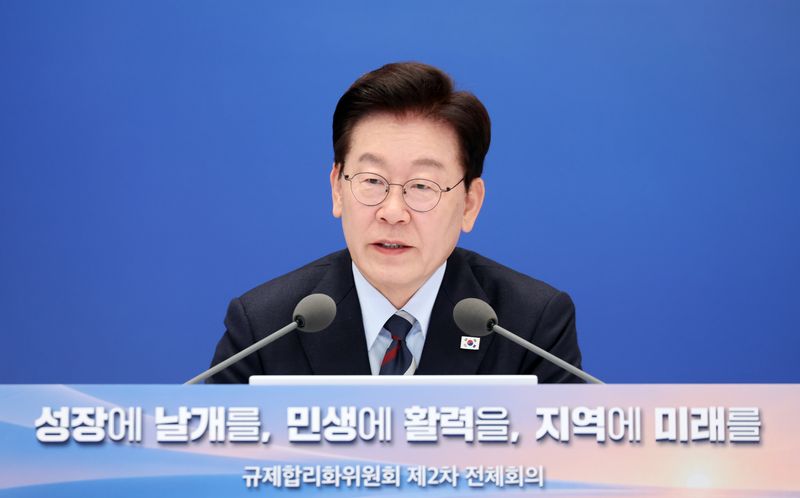
[Financial News] President Lee Jae Myung on the 23rd called for considering ways to improve the existing system rather than pursuing separate legislation amid controversy over exempting semiconductor research and development (R&D) personnel from the 52-hour workweek. The aim is to find a compromise that protects workers’ right to health while addressing companies’ difficulties, on the condition that overtime is fairly compensated.
At the second plenary meeting of the Regulatory Rationalization Committee at the Blue House that day, President Lee heard the semiconductor industry’s request for an exemption from working-hour rules and said, “Is it really necessary to create a new system for that?” He added, “Let’s discuss in depth whether there are ways to revise the enforcement decree under the existing system or make the procedures easier.”
At the meeting that day, representatives of the Korea Semiconductor Industry Association said that an exception to working-hour rules for core semiconductor R&D personnel was a long-standing industry priority and called for the system to be improved within the year. They argued that, unlike general manufacturing processes, semiconductor R&D requires concentrated research during certain periods, making flexible working hours necessary.
President Lee stressed that fair compensation for overtime must be guaranteed as an absolute prerequisite for discussing an exception to working-hour rules. He emphasized, “You must not contemplate making some kind of special law and leaving workers uncompensated for labor—additional labor.” He added, “Absolutely not. That would be a step backward, really.” The discussions can move forward only if labor and management clearly accept, as a prerequisite, the payment of premium wages for overtime under the current system.
When the semiconductor industry explained that it faced procedural difficulties in using special extended work, including having to apply in advance and obtain approval from the Ministry of Employment and Labor, President Lee said, “If the procedures are inconvenient, it can be approved comprehensively in advance. Is it really necessary to create a new system for that?” He added, “Even if a new system were created, it would require the individual’s consent, and there would be an approval process. I think most of the problems could be addressed if the Ministry of Employment and Labor acted more proactively and swiftly.”
President Lee identified workers’ right to health as the key issue surrounding an exception to working-hour rules. He said, “The last remaining issue seems to be the right to health, not compensation,” and asked rhetorically, “For example, could a person survive if they researched for 20 hours a day for five days?”
President Lee also recalled his experience, while serving as leader of the Democratic Party of Korea, of bringing labor and management together to discuss an exemption from the 52-hour workweek.
President Lee also urged them, saying, “I don’t think the differences are serious enough for us to be so sharply opposed. We need to trust each other. Ministry of Employment and Labor, please make an effort.”
Minister of Employment and Labor Kim Young-hoon replied, “We will carefully examine the difficulties companies face in using the existing system, build trust, and make sure we achieve a result.”
[email protected] Choi Jong-geun Reporter