Criminal acquittal, administrative loss leave GC Biopharma Corp. (GC Biopharma) with split outcomes; Supreme Court’s ‘dismissal without further review’ debated at Constitutional Court of Korea
- Input
- 2026-10-23 18:08:07
- Updated
- 2026-10-23 18:08:07
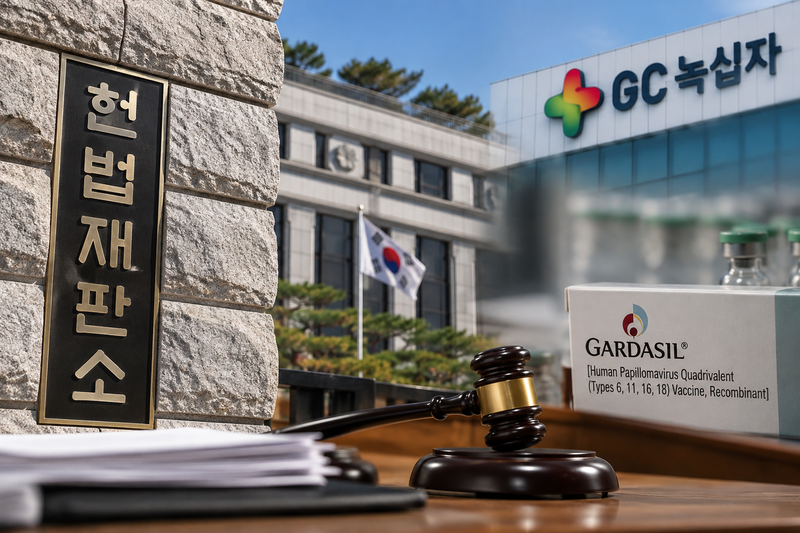
[Financial News] With the outcomes of criminal and administrative proceedings diverging in the same vaccine bid-rigging case, a debate unfolded at the Constitutional Court of Korea over whether the Supreme Court’s dismissal of an appeal without giving separate reasons violated the constitutional right to a trial.
The Constitutional Court of Korea held a public hearing in its Grand Courtroom in Jongno-gu, Seoul, on the afternoon of the 23rd in a constitutional complaint filed by GC Biopharma seeking to overturn the Supreme Court’s ruling dismissing its appeal without further review.
The case stemmed from a tender for the purchase of Gardasil, a vaccine to prevent cervical cancer, issued by the Korea Disease Control and Prevention Agency from April 2017 through January 2019. GC Biopharma stood trial on charges of violating the Fair Trade Act in connection with a concerted action in which it arranged for wholesalers to act as cover bidders and secured the contract. In August 2023, the Korea Fair Trade Commission (KFTC) also ordered the company to take corrective measures and pay a surcharge over the conduct.
In the criminal case, the Seoul High Court acquitted GC Biopharma in July 2024, finding it difficult to establish that the concerted action restricted competition or that GC Biopharma employees acted intentionally. The Supreme Court also dismissed the appeal last December, making the acquittal final.
In the administrative lawsuit challenging the KFTC’s measures, by contrast, the Seoul High Court recognized that the conduct restricted competition and dismissed GC Biopharma’s claim last October. The Supreme Court also dismissed the appeal without further review in February, making GC Biopharma’s loss in the administrative case final.
Yulchon, the law firm representing claimant GC Biopharma, argued that the Supreme Court’s failure to explain its reasons—despite the criminal and administrative courts reaching different conclusions on the same concerted action—violated the right to a trial.
GC Biopharma’s position was that, since the criminal acquittal had become final first and the Supreme Court then dismissed without further review an appeal in the administrative case that had reached the opposite conclusion, the Court should have examined the differences between the two rulings and provided its legal assessment.
Yulchon attorney Seo Hyeong-seok pointed out, “The fact that contradictory factual findings in the same case were each finalized means that, in itself, one of them involved a factual error and an incorrect application of law. If that is not the case, the reasons must be properly explained.”
The KFTC, an interested party in the case, countered that a violation of law cannot be inferred merely because the criminal and administrative proceedings reached different conclusions. It said the two types of proceedings apply different standards of proof and assess evidence differently, so they can reach different conclusions even in the same case.
The KFTC also stressed that dismissal without further review does not mean the Supreme Court fails to examine a case at all. Rather, it is a procedure under which the Court reviews the grounds for appeal and the lower court’s ruling, then dismisses the appeal if it finds no legal grounds to proceed with a full review.
Park Si-jun, an attorney with the Government Legal Service Corporation representing the KFTC, stressed, “Dismissal without further review is not a system in which no examination takes place. The Supreme Court reviewed the lower court’s ruling and the grounds for appeal, among other things, and GC Biopharma also submitted the criminal judgment during the appeal proceedings and had ample opportunity to present its views.”
Attorney Park said the criminal acquittal became final 49 days after the lower court issued its ruling in the administrative case. “A ruling issued later cannot retroactively create a defect that did not even exist in the lower court’s judgment,” he said. “If a judgment could be overturned solely because the conclusions differ, the Constitutional Court would effectively become another appellate court, inevitably undermining the judicial hierarchy and the legal stability of court judgments.”
At the public hearing, questions also focused on whether the differing conclusions in the two cases reflected a dispute over fact-finding or over the interpretation of law.
The justices referred to the nature of the agreement to jointly sell the vaccine and the possibility of issuing supply commitment letters to third parties, and asked whether interpreting the same agreement differently amounted merely to a difference in the assessment of evidence.
The extent to which the standards of proof should differ between criminal punishment and administrative sanctions was also discussed. The justices examined how the level of proof required to establish anticompetitive conduct might differ, given that both procedures involve the state imposing adverse consequences on the public.
The discussion also turned to how much reasoning the Supreme Court should provide in cases where statutory grounds for proceeding with a full review are at issue, even if the need for the dismissal-without-further-review procedure is accepted.
In particular, given that the criminal acquittal became final after the lower court ruling in the administrative case, the justices raised whether the Supreme Court needed to separately explain how that final criminal judgment related to its dismissal of the administrative appeal.
The Constitutional Court of Korea plans to determine, based on the arguments presented by both sides and the views of witnesses at the hearing, whether the Supreme Court’s dismissal of the appeal without further review violated the Constitution and the law, thereby infringing GC Biopharma’s right to a trial.
[email protected] Yoo Seon-jun Reporter