“A drunk-driving tip alone is not enough to convict for refusing a breath test”... What impact will this have on roadside enforcement? [Seocho Three-Way Intersection]
- Input
- 2026-10-25 15:39:24
- Updated
- 2026-10-25 15:39:24
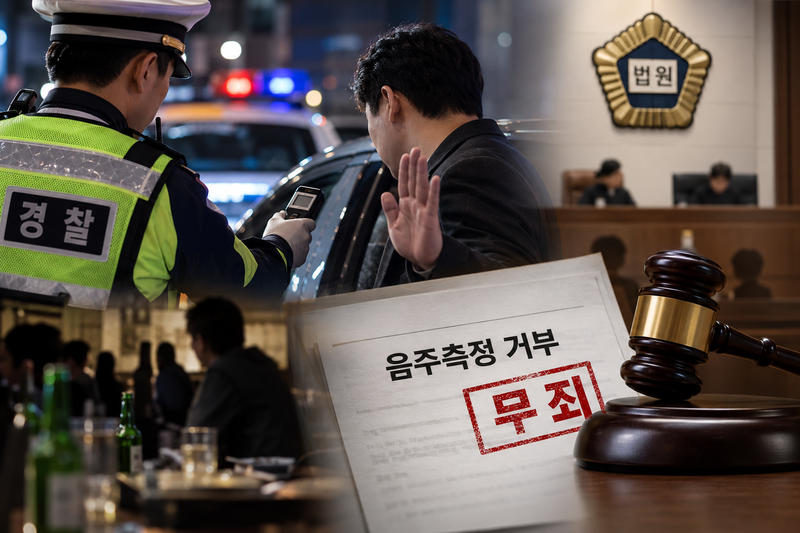
[Financial News] An appeals court upheld a ruling that a driver cannot be punished for refusing a police officer’s request for a breath test in response to a suspected drunk-driving report if there are insufficient objective grounds to believe the driver was intoxicated at the time of driving. Legal experts say the ruling reaffirms established legal principles on refusing a breath test while highlighting the importance of police judgment at the scene and the collection of evidence. They caution, however, that it should not be taken to mean that drivers may refuse a breath test.
According to legal circles on the 25th, a panel of the Daejeon District Court’s Criminal Division 4, presided over by Judge Gu Chang-mo, recently dismissed the prosecutor’s appeal and upheld the original acquittal in the appeal of A, 58, who had been indicted for violating the Road Traffic Act by refusing a breath test.
A had previously been put on trial for allegedly refusing a police officer’s request for a breath test outside a restaurant in Asan, South Chungcheong Province, on June 20 last year, after the officer responded to a report of suspected drunk driving. B, who was at the restaurant, reported suspected drunk driving, saying A’s behavior was threatening. A, however, claimed to have drunk alcohol after finishing driving.
The court focused on the time elapsed between the drive and the request for a test. A finished driving at around 8:12 p.m. The report was received at about 10:01 p.m., and the request for a test was made at around 10:30 p.m. About two hours and 18 minutes had passed since A stopped driving.
The Road Traffic Act allows police to conduct a breath test when there are substantial grounds to believe that someone drove while intoxicated. Refusing a lawful request without a valid reason can be punishable, but the first question is whether the request itself met the legal requirements.
The court of first instance ruled that a third party’s speculative report and the fact that A was seen drinking at a restaurant a considerable time after driving were not, on their own, sufficient grounds to suspect that A had been drinking while driving. It also noted the risk that recognizing a duty to take a test based solely on subjective suspicion could allow malicious reports to force innocent citizens to undergo testing. The appeals court likewise rejected the prosecutor’s appeal, finding that specific and objective circumstances were necessary.
Legal experts interpret the ruling not as recognizing a new exception but as reaffirming existing legal principles. The point is that applying the offense of refusing a breath test requires examining not only whether the driver refused, but also whether police had substantial grounds at the time to suspect drunk driving.
Kang Seong-sin, managing attorney at Haena Law Office, called the ruling “a significant case confirming that citizens cannot be compelled to submit to testing by investigative authorities based solely on a third party’s subjective and malicious report.” He said it “struck a balance in the criminal justice system by robustly protecting citizens’ right to defend themselves, which could otherwise be infringed under the pretext of discovering the substantive truth, and by setting strict limits on the exercise of police power.”
At the scene, the specificity of the report and signs directly observed by police are important. The assessment may vary depending on whether the person reporting saw the driver drinking, witnessed erratic driving, and how much time passed between the report and the police response, according to experts.
Attorney Park Sun-beom of law firm JR, who specializes in drunk-driving and traffic-accident cases, explained, “If someone directly saw the driver drinking just before driving, or witnessed erratic driving and reported it immediately, and the responding police officers confirmed signs such as the smell of alcohol, substantial grounds may be found.”
Some experts, however, say that if a considerable amount of time passed after the drive and the person drank in the interim, it is difficult to determine the person’s condition while driving based solely on their state of intoxication observed at the scene. Attorney Park said, “If, as in this case, a considerable amount of time passed after the drive and there is evidence that the person actually drank during that time, additional evidence supporting drinking before driving—such as CCTV footage, payment records, or statements from people who were with the person—would likely be needed.”
The same applies when someone follows a vehicle suspected of drunk driving, records it, and then reports it. The act of recording itself does not determine whether the request for a breath test was lawful; the scenes captured and the time between filming and the enforcement action must also be considered.
Attorney Park emphasized, “The legality may be called into question depending on how much time passed between when the video was recorded and when the enforcement action took place,” adding, “Police should accurately establish when the driving ended and record separately what the person reporting directly saw and what they merely inferred.” This is because evidence collected at the time may serve as a basis for a decision if the legality of the test request is later challenged.
The ruling does not mean that drivers can refuse a lawful request for a breath test, experts say. Attorney Park emphasized, “This is an unusual case in which a long time elapsed between the end of the drive and the request for a test. It would be wrong to take this ruling as meaning that people can refuse a breath test.” He added, “The so-called practice of drinking additional alcohol after driving to interfere with a breath test can also be punished if the legal requirements are met, so each case must be assessed on its individual circumstances.”
A lawyer who previously served as a senior police official predicted, “Ultimately, this ruling shows that, irrespective of the need to enforce drunk-driving laws, police requests for breath tests must also meet legal requirements.” The lawyer added, “In future similar cases, a key issue will be what objective circumstances can support the legitimacy of a request for a test when a report of suspected drunk driving has been received.”
[email protected] Yu Seon-jun Reporter