Brazil's presidential runoff two days away: ‘Lula or Bolsonaro?’ Race too close to call
- Input
- 2026-10-23 16:22:38
- Updated
- 2026-10-23 16:22:38
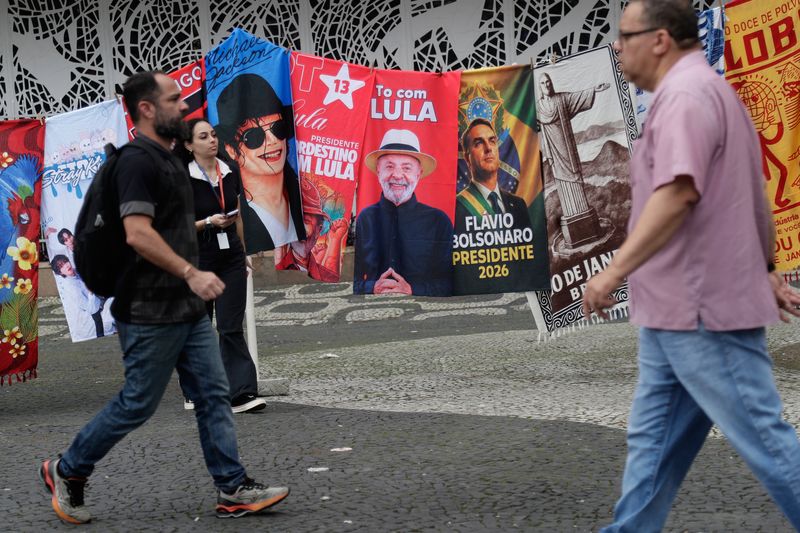
[Financial News] With two days to go before Brazil's presidential runoff on the 25th (local time), incumbent President Luiz Inácio Lula da Silva, who is seeking a fourth term overall, and right-wing candidate Flávio Bolsonaro remain locked in a close race.
Bolsonaro, who won the first round, was initially expected to have the advantage. But Lula has mounted a late surge, making the race so tight that its outcome is difficult to predict.
According to a presidential candidate preference poll released on the 22nd (local time) by polling firm Datafolha, Liberal Party (PL) candidate Bolsonaro had 47% support, just one percentage point ahead of President Lula (46%), the Workers' Party (PT) candidate.
In a poll last week, Bolsonaro and President Lula had 47% and 45%, respectively. The gap in support has thus narrowed further in just one week, from two percentage points to one.
The two candidates were therefore effectively tied, with their support levels within the margin of error (±2 percentage points).
The poll found that just 2% of voters had yet to decide which candidate to support. Five percent of respondents said they would cast a blank ballot.
Bloomberg reported that, excluding invalid and blank ballots, support for the two candidates was roughly 50-50.
On October 4, Bolsonaro defied expectations in the first round of the presidential election by defeating incumbent President Lula, emerging as a strong contender for victory.
Lula, however, has mounted a strong comeback by drawing on the advantages of incumbency. The Brazilian government recently decided to increase benefits under Bolsa Familia, a welfare program for low-income households, by 15% and distribute the payments before the election.
Brazil's Senate passed a five-day workweek bill, as promised by President Lula, reducing the workweek from 44 to 40 hours.
At the same time, Lula's supporters have rallied in the final stretch, leaving the outcome uncertain until the very end.
However, soaring prices and worsening public safety are seen as weaknesses for President Lula. He also faces personal legal risks, including corruption allegations involving his son.
Bolsonaro has gained momentum by attacking the failures of left-wing governments amid the recent conservative wave in Latin America.
Since Brazil's return to democracy in 1989, no candidate who won the first round of a presidential election has ever lost in the runoff.
However, critics say Bolsonaro's rise to power could prompt voter resentment over what they see as ‘dynastic succession by the wealthy.’
Bolsonaro is the son of former President Jair Bolsonaro, who was sentenced to 27 years in prison on charges of plotting a coup and is under house arrest. He has also pledged to pardon his father immediately if elected president.
Bolsonaro has also been embroiled in several corruption allegations. Recently, during a televised debate, he appeared with the word ‘corruption’ written on his palm to attack President Lula, triggering a fierce backlash.
The candidates' showdown is also significant because it could signal the direction of Latin America's ‘Blue Tide’ (the wave of right-wing governments coming to power).
If Bolsonaro wins, Brazil, Latin America's largest economy, will join the Blue Tide, following Argentina, Ecuador, Bolivia, Chile, Colombia, Peru and others.
The two candidates will face off in their final TV debate on the 23rd.
[email protected] Lee Seok-woo, International Affairs Correspondent Reporter