Investor in 60s asks, “Are dividends from high-dividend stocks subject to separate taxation also excluded from health insurance premiums?” [Tax and Investment Q&A]
- Input
- 2026-10-24 08:00:00
- Updated
- 2026-10-24 08:00:00

Q. Every November, eligibility for health insurance and the amount of premiums payable change in response to changes in income and assets. A, an investor in their 60s, heard that dividends from high-dividend companies qualify for separate taxation and increased their investment in related companies this year. They sought advice to find out whether dividend income subject to separate taxation is also included in the calculation of health insurance premiums.
A. According to KB Securities, health insurance premiums for November this year will reflect comprehensive income for 2025 and the property tax assessment base for real estate owned as of June 1, 2026.
For workplace-insured subscribers, if income other than salary exceeds 20 million won a year, a separate income-based monthly premium is levied on the excess. Regional subscribers pay health insurance premiums adjusted to reflect changes in income or assets. Dependents of workplace-insured subscribers may lose dependent status and switch to regional coverage if their annual income exceeds 20 million won, so the assessment criteria for each enrollment category should be checked.
Among financial income, income subject to separate taxation has been a source of controversy whenever a new separately taxed product is introduced, because the relevant health insurance rules and their practical application do not align. Dividend income from high-dividend companies, Productive Finance ISAs, the National Growth Fund, and publicly offered real estate funds and REITs are among the products that offer tax benefits by taxing income separately rather than adding it to comprehensive income.
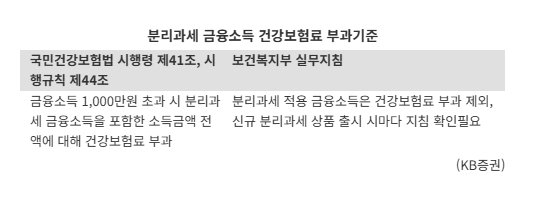
Article 41 of the Enforcement Decree of the National Health Insurance Act and Article 44 of its Enforcement Rule explicitly state that non-taxable financial income is excluded from the income subject to health insurance premiums. However, there is no provision excluding separately taxed financial income. The rules stipulate that if annual financial income exceeds 10 million won, health insurance premiums are levied on the full income amount, including separately taxed financial income.
For example, if financial income amounts to 10.01 million won, premiums are assessed on the full 10.01 million won—not just the 10,000 won remaining after deducting the 10 million won threshold. For regional subscribers, health insurance premiums are levied on that income, and it is also included in annual income when dependent eligibility is assessed.
In practice, however, separately taxed financial income is excluded from the income subject to health insurance premiums. Although the legal basis for levying premiums remains in the regulations, the Ministry of Health and Welfare’s working guidelines direct that no premiums be levied. This is why the relevant guidelines must be checked separately whenever a new separately taxed product is launched.
The separate taxation of dividend income from high-dividend companies is also affected by this gap between the regulations and their practical application. The Insurance Policy Division of the Health Insurance Policy Bureau at the Ministry of Health and Welfare says that, in practice, no health insurance premiums will be levied on dividend income from high-dividend companies that is subject to separate taxation.
The issue is that the separate taxation method for dividend income from high-dividend companies differs from that for existing separately taxed financial income. For existing separately taxed financial income, separate taxation is finalized when the financial institution withholds tax at the time of payment.
By contrast, taxpayers choose whether to apply separate taxation to dividend income from high-dividend companies and apply for it through their comprehensive income tax return the following May. Taxpayers also choose whether to apply separate taxation to all of their dividend income or only to part of it. In other words, whether separate taxation applies is determined after the fact, based on the taxpayer’s filing, rather than when the dividends are received.
Accordingly, the National Health Insurance Service will likely need to request income data from the National Tax Service (NTS) using a different process from the existing one in order to exclude separately taxed dividend income from high-dividend companies from the income subject to health insurance premiums. A process will be needed to collect separate data on high-dividend income that taxpayers report as separately taxed after filing their comprehensive income tax returns, and then exclude it when calculating their premiums.
The filing issue for investors with financial income of 20 million won or less also remains unresolved. Those with financial income exceeding 20 million won must file a comprehensive income tax return, but those with 20 million won or less generally do not. Investors with financial income of 20 million won or less may also have to submit a separate comprehensive income tax return in order to have dividend income from high-dividend companies excluded from their health insurance premiums.
If advance notice is insufficient, investors who have not applied for separate taxation could face confusion: they may be charged health insurance premiums in November and then have the premiums recalculated after filing an amended comprehensive income tax return. This is why calls are being made for clear advance guidance on how to apply for separate taxation of dividend income from high-dividend companies and how to have it excluded from health insurance premiums.
With regular dividends at the beginning of the year and interim and quarterly dividends throughout the year, interest is growing in the tax and health insurance premium savings on high-dividend income. If separately taxed dividend income from high-dividend companies is to be excluded from the income subject to health insurance premiums, a system for sharing data among the NTS, the Ministry of Health and Welfare, and the National Health Insurance Service should be established in advance.
Kim Hee-sung, a tax specialist at KB Securities, said, “Unlike existing separately taxed financial income, whether dividend income from high-dividend companies is subject to separate taxation is determined after the fact based on the taxpayer’s filing,” and advised, “To ensure investors are not disadvantaged, the application process for separate taxation and the policy on levying health insurance premiums should be clearly explained before next year’s comprehensive income tax filing.”
If there is a policy decision to exclude separately taxed financial income from the income subject to health insurance premiums, the relevant laws should also be amended to clarify the basis for doing so. The point is that, since a legal basis for levying premiums remains in place, the relevant provisions of the National Health Insurance Act should be revised to bring the regulations and practice into alignment.
The [Tax and Investment Q&A], based on consultations with tax experts at KB Securities, is published in the fourth week of every month.
[email protected] Lee Jeong-hwa Reporter