National Assembly climate and labor committee inspects Jeju virtual power plant... Reviews AI power-market bidding and ESS operations
- Input
- 2026-10-23 16:00:16
- Updated
- 2026-10-23 16:00:16
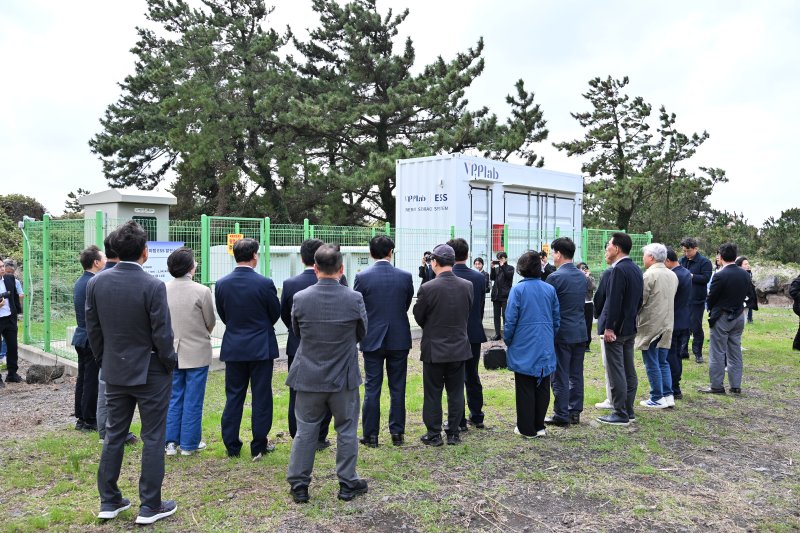
【Financial News, Jeju—Reporter Jeong Yong-bok】The National Assembly Committee on Climate, Energy, Environment and Labor inspected a virtual power plant (VPP) in Jeju that centrally manages solar and wind power generation. Lawmakers from both parties, including committee chair Kim Jeong-ho, reviewed AI-based power generation forecasts, the power market bidding system, and the operation of energy storage systems (ESS).
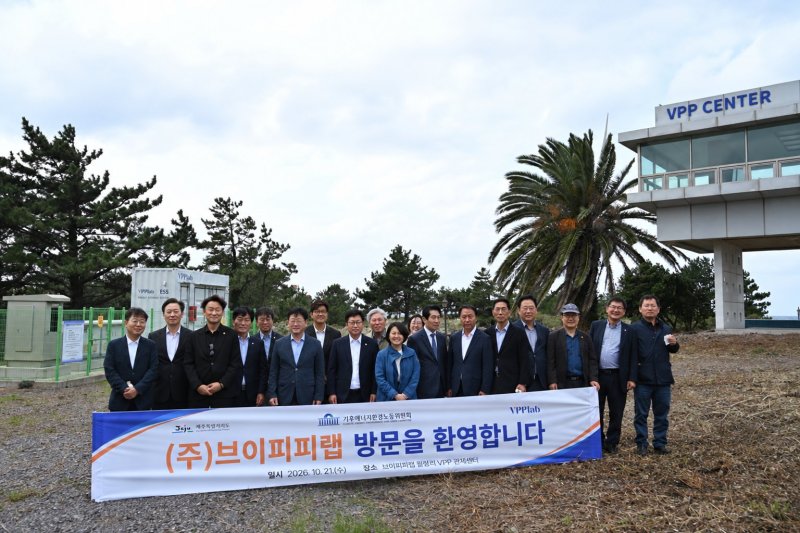
According to energy information technology (IT) company VPPlab on the 23rd, committee members visited the company’s VPP control center in Wollyeong-ri, Hallim-eup, Jeju City, on the 21st.
The visit was part of a field inspection of the energy transition in Jeju Province conducted by the National Assembly Committee on Climate, Energy, Environment and Labor on the 20th and 21st. Lee Chang-heum, Jeju Province’s deputy governor for climate and the economy, and officials from the Ministry of Climate, Energy and Environment also attended.
A virtual power plant is a system that connects solar and wind power facilities and energy storage systems scattered across different areas using information and communications technology, managing them as if they were a single power plant. It forecasts generation, which varies with the weather, and bids to sell electricity in the power market.
VPPlab demonstrated AI-based power generation forecasting, power market bidding, and real-time monitoring and control using its proprietary renewable energy integration platform, flow-V. After reviewing examples of its operations at the control center, the lawmakers toured ESS facilities connected to the distribution grid.
As the share of renewable energy generation has increased in Jeju, the province has faced curtailment issues, in which generation is reduced when electricity supply exceeds demand. This has created a need for technology that can accurately forecast solar and wind power generation and centrally manage distributed generation facilities.
A renewable energy bidding system has been in operation in Jeju since June 2024. Under the system, power generators submit their forecast generation and prices to the power market, then adjust output according to dispatch instructions from the Korea Power Exchange. Alongside day-ahead trading, a real-time market operating in 15-minute intervals is also in place.
On the 13th of this month, the Korea Power Exchange released a proposal to improve the calculation criteria for capacity settlement payments under Jeju’s renewable energy bidding system and began soliciting feedback. Capacity settlement payments are compensation provided based on an assessment of factors such as how much generation facilities contribute to electricity supply, and are also linked to power generators’ profitability. The proposal has not yet been finalized.
The VPP technology operated by VPPlab is a means of responding to these power market systems. It can collect data from individual generation facilities to forecast output and manage bidding and operations, but its actual impact on reducing curtailment and stabilizing the power grid must be verified through separate operational results.
In particular, as renewable energy generation facilities increase nationwide, the potential use of Jeju’s bidding system and its approach to integrated management of distributed energy resources is also drawing interest.
VPPlab plans to expand its business if a related bidding system is introduced in the mainland power market in the future, drawing on the operational experience it has built up in Jeju.
VPPlab CEO Cha Byeong-hak said, “We will continue to advance our VPP operating technology and, drawing on the experience we have accumulated in Jeju, contribute to the development of Korea’s distributed energy industry and the energy transition.”
At the field inspection, the National Assembly reviewed power generation forecasting, power market bidding, and ESS integration technology currently in operation in Jeju. The operational results of Jeju’s pilot project and the outcomes of improvements to the system are expected to become key materials for consideration as the system is expanded to power markets nationwide.
[email protected] Jeong Yong-bok Reporter