KOSPI Composite Index tumbles on fears of an 'AI bubble'... “Recent correction is noise”
- Input
- 2026-10-23 16:02:36
- Updated
- 2026-10-23 16:02:36
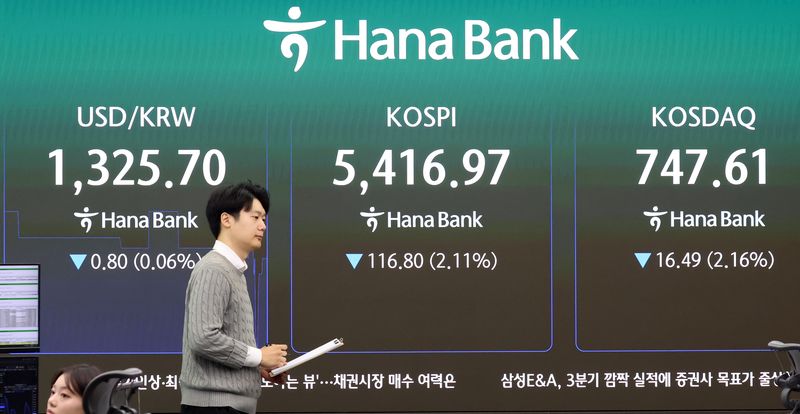
According to the financial investment industry on the 23rd, an analysis has emerged that it is difficult to view the recent sharp market decline as the bursting of an AI bubble. The explanation is that semiconductor companies have actually been increasing their earnings, unlike a situation in which only share prices had been inflated. The assessment is that market anxiety is focused on whether major technology companies can continue to secure the funds they will need for future investment.
Ryu Seung-min, a research fellow at Samsung Securities Co., Ltd., said, “The debate right now is over whether there is more money to invest and, therefore, whether investment can continue,” adding, “This is the question of whether there is money to create a bubble even before one has formed.”
Actual demand is also growing. As major cloud companies’ order backlogs increase, AI investment is not confined to competition to capture future markets. With investment to meet customer orders also continuing, demand for South Korean semiconductors could likewise remain robust.
Of course, large-scale investment is depleting cash and increasing the burden of raising external financing. However, investment plans continue to expand and profitability in core businesses is being maintained, so it is too early to interpret this as a sign that AI investment is about to stop or that a bubble is about to burst.
The sharp decline in South Korea’s stock market is linked to how much the market considers the enormous profits semiconductor companies are expected to earn sustainable. The KOSPI Composite Index’s 12-month forward return on equity (ROE) is forecast at about 25%. However, investors are unsure whether the high earnings this year and next will be a temporary boom or a structural change.
Ryu Seung-min, a research fellow at Samsung Securities Co., Ltd., said, “The question is whether the enormous profits South Korean semiconductor companies will earn through next year will prove temporary or reflect a structural change,” noting, “This very question is directly connected to the sharp decline in the South Korean stock market in the second half of the year.”
A clue to where the market may bottom was found in the price-to-book ratio (PBR). During the sharp decline over the past several months, the KOSPI Composite Index has been attempting to rebound at around 1.2 times its 12-month forward PBR. The estimate is that this is a valuation level consistent with a sustainable ROE of 12–15%, even if the market does not fully recognize the outlook for future earnings.
The accumulation of profits earned by semiconductor companies, which increases their capital, is also seen as a factor supporting a floor for share prices. The assessment is that, if some premium for the semiconductor boom is also factored in, the market can attempt to find fair value at around 1.2 times PBR. If confidence in the sustainability of AI investment recovers, the undervaluation of South Korea’s stock market could also ease.
Ryu said, “The South Korean stock market, too, has seen the rainbow of excessive expectations disappear, but is finding a solid floor with strong support,” adding, “We expect the bull market in global and South Korean equities to continue, and view the recent correction as noise.”
[email protected] Bae Han-geul Reporter