Oh Se-hoon Acquitted in 2nd Trial Over ‘Payment of Opinion Poll Costs’... Court: ‘Myeong Tae-gyun’s Testimony Hard to Believe’ (Roundup 2)
- Input
- 2026-10-23 15:38:12
- Updated
- 2026-10-23 15:38:12
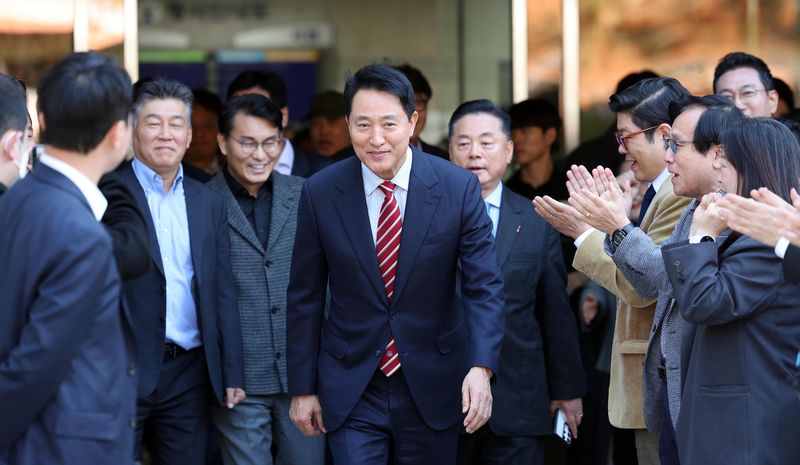
Legal sources said on the 23rd that the Seoul High Court’s 7th Criminal Division, presided over by Judge Koo Hoe-geun, overturned the guilty portion of the 1st trial and acquitted Oh, who had been indicted on charges of violating the Political Funds Act, at 2 p.m. that day. Kang Cheol-won, a former Seoul deputy mayor for political affairs, and businessman Kim Han-jung, who were indicted alongside him, were also acquitted. The court dismissed the appeal by the Kim Keon Hee Special Prosecutor Team, led by Special Counsel Min Joung-kie, against the portion that the 1st trial had found not guilty. At the final hearing on the 2nd, the special counsel team sought a sentence of one year and six months in prison for Oh. He was accused of commissioning Myeong to conduct 10 opinion polls ahead of the April 7, 2021 Seoul mayoral by-election and having his supporter Kim pay the 33 million won cost.■ 1st trial convicted him, crediting only Myeong’s testimony that matched objective evidenceOn July 22, the Seoul Central District Court’s 22nd Criminal Division, the 1st-trial court presided over by Judge Cho Hyung-woo, sentenced Oh to a 10 million won fine and ordered him to forfeit 21 million won. It fined former Deputy Mayor Kang 3 million won and Kim 5 million won. The court found that Oh had commissioned five of the 10 opinion polls and that Kim had paid 21 million won on his behalf. It acquitted him of the remaining 12 million won portion.
The 1st trial also said Myeong’s testimony was inconsistent and did not accept it wholesale. However, it found that the parts consistent with objective evidence, including ChatGPT for Kakao conversations and opinion poll materials, could be trusted. Based on this, it concluded that Oh contacted Myeong first and met him on January 20, 2021, and that the first opinion poll was conducted two days later. It also rejected the claim that Kim had commissioned the polls voluntarily. The court reasoned that Kim and Oh had not even met by February 1, 2021, when Kim first sent 10 million won, making it difficult to conclude that he had given the money out of friendship.
The 1st trial ruled that Kim’s payment on Oh’s behalf constituted a political contribution to Oh, under a provision of the Political Funds Act that treats a third party’s payment of political activity expenses as a donation. If a conviction for illegally receiving political funds becomes final and the fine is at least 1 million won, the person cannot hold public office for five years and must leave any office already held. The 1st-trial panel said, “We impose a sentence that strips him of eligibility for public office, commensurate with the gravity of the offense.”■ 2nd trial: If the testimony as a whole is shaky, its individual parts cannot be trusted eitherThe key issues on appeal were whether Oh had personally commissioned Myeong to conduct opinion polls and whether he had asked Kim to pay the costs on his behalf. The panel noted that “Myeong’s testimony is the only direct evidence on the key issues.”
The panel first took issue with the 1st trial’s approach of believing only some of Myeong’s testimony. It said that if important parts cannot be trusted, the credibility of the testimony as a whole is weakened, and that there must be grounds to support any part used as evidence on its own.
The panel found Myeong’s testimony as a whole difficult to believe. It said it was hard to distinguish what he had experienced directly from speculation and exaggeration, and that his account became more specific as investigators presented him with evidence. Myeong did not mention allegations against Oh during the investigation into the case involving former lawmaker Kim Young-sun; he began giving testimony only after Oh moved to sue him. The panel also noted that around that time Myeong made a threatening remark about how Oh would be implicated.
Myeong testified that Oh called him four times in tears, asking him to conduct opinion polls that would help defeat candidate Na Kyung-won. The panel pointed out that this testimony did not match the file transmission times recorded by the Mirae Hankuk Research Institute, and that Myeong himself had testified that the first poll was for Kim Chong-in, former emergency committee chair of the People Power Party. It also found it implausible that Oh would have discussed illegal expenses in tears with someone he had met only recently.
The alleged request to pay the costs on Oh’s behalf was also not established. The panel said it appeared Kim had obtained Myeong’s contact information through former Deputy Mayor Kang, not Oh, and that the transcripts of calls between the two reflected this. This contradicted Myeong’s statement to investigators that Oh had directly introduced Kim as someone who could provide funds. On appeal, a recording of a call between the two, submitted by Kim’s side, was admitted on the 16th of last month as impeachment evidence. Impeachment evidence is not used to directly prove guilt or innocence, but to challenge the credibility of another person’s testimony.
The panel also found it unusual that someone would openly request a payment that should have been made discreetly, and that the money was transferred through a bank account with value-added tax added. It said it was also difficult to conclude that the five payments Kim made corresponded to 10 opinion polls, as the special counsel team claimed.
The panel emphasized that criminal facts must be proven by evidence that establishes them beyond reasonable doubt, and that the burden rests with the prosecutor. Reasonable doubt means a legitimate question that a person exercising common sense could have. The panel said, “The fundamental principle of criminal law is to ensure that no one is unjustly punished through investigation and prosecution.”
Given that Oh and Myeong met several times and that Kim’s money was transferred to Myeong, the panel said, “It is not that there is no suspicion of guilt.” However, it ruled that “it is difficult to give credibility to Myeong’s sole testimony, and the remaining fragmentary facts are insufficient to find Oh guilty.” The ruling follows the same panel’s acquittal of former President Yoon Suk Yeol on the 7th in the appeal of the case involving “free opinion polls associated with Myeong Tae-gyun.”■ Difficult to overturn as a matter of law... political pressure and other factors could play a roleIf the special counsel team appeals to the Supreme Court of Korea, it will deliver the final ruling. Legal experts largely expect the acquittal to stand on appeal. That is because the Supreme Court is a “court of law” that examines whether the 1st and 2nd trials correctly applied the law, while findings of fact are, in principle, the responsibility of the lower courts. One presiding judge said, “It’s not impossible for the Supreme Court to overturn the 2nd-trial ruling, but it is not common,” adding, “It is unusual for the Supreme Court to intervene in a 2nd trial’s factual findings in a case like this, where the facts are at issue.”
Some, however, say external pressure, including from the political sphere, could be a factor regardless of the judiciary’s internal decision-making process. A lawyer who previously served as a deputy chief prosecutor said, “Given that Mayor Oh is a prominent presidential candidate for the opposition camp, the Supreme Court could hear the case before a full bench rather than a small panel,” adding, “We also need to consider the possibility of external factors affecting the trial, such as the ruling camp submitting a motion to impeach Chief Justice Cho Hee-dae.” The full bench consists of the chief justice and all Supreme Court justices, and hears cases involving changes to precedent or major social repercussions.
Meanwhile, the Kim Keon-hee Special Counsel Act stipulates that the 1st-trial ruling must be delivered within six months of indictment, and 2nd- and 3rd-trial rulings each within three months of the preceding ruling. Under the schedule set by the law, the Supreme Court is expected to reach a decision around January 23 next year.
[email protected] Kim Dong-gyu Reporter