Oh Se-hoon acquitted in second trial over alleged proxy payment of opinion-poll costs; retains mayoral post (comprehensive)
- Input
- 2026-10-23 14:49:05
- Updated
- 2026-10-23 14:49:05
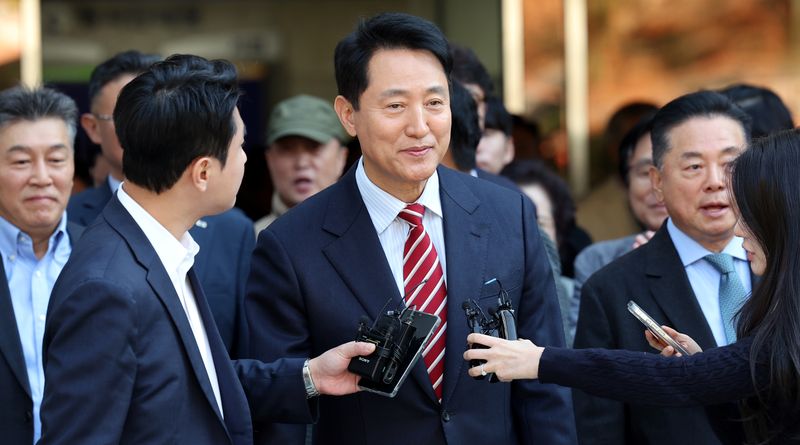
Legal sources said on the 23rd that the Seoul High Court’s Criminal Division 7, presided over by Judge Koo Hoe-geun, overturned the guilty portion of the first-trial ruling and acquitted Oh, who had been indicted on charges of violating the Political Funds Act, at 2 p.m. that day. Kang Cheol-won, a former Seoul deputy mayor for political affairs, and businessman Kim Han-jung, who were indicted alongside him, were also acquitted. The court dismissed the appeal by the Kim Keon Hee special counsel team, led by Special Counsel Min Joung-kie, against the portions the first trial had found not guilty.
Oh was indicted on charges of commissioning opinion polls from Myeong ahead of the April 7, 2021, Seoul mayoral by-election and having his supporter Kim pay the 33 million won cost on his behalf. On July 22, the Seoul Central District Court’s Criminal Division 22, presided over by Judge Cho Hyung-woo, found him guilty in the first trial of arranging five of the polls, involving 21 million won, and sentenced him to a fine of 10 million won.■ “The only direct evidence was Myeong Tae-gyun’s testimony”The issues in the appeal were whether Oh had directly commissioned opinion polls from Myeong and whether he had asked Kim to pay the costs on his behalf. The panel noted that “Myeong’s testimony is the only direct evidence on the key issues.”
The first and second trials viewed the same testimony differently. The first trial also found Myeong’s testimony inconsistent, but found Oh partly guilty, saying that portions that matched KakaoTalk conversations or opinion-poll materials could be trusted. The appeals court held that if important parts of testimony cannot be trusted, its overall credibility is undermined. To use only part of it as evidence of guilt, there must be a basis for believing that part alone or other evidence to support it.
The panel found Myeong’s testimony difficult to believe overall. It said it was hard to distinguish what he had experienced firsthand from speculation and exaggeration, and that his account became more detailed as investigators presented evidence. Myeong testified that Oh had called him while crying and asked him to conduct an opinion poll. But the panel found it inconsistent with common sense that Oh would have discussed illegal costs while crying with someone he had only met recently.■ “Preventing wrongful punishment is a fundamental principle of criminal law”The alleged request to have the costs paid on his behalf was also not established. The panel said it appeared Kim had obtained Myeong’s contact information through former Deputy Mayor Kang, not Oh. It also found it unusual that a payment that should have been made secretly was requested openly, and that the money was transferred through a bank account with value-added tax added.
The panel emphasized that criminal charges must be proven with evidence sufficient to establish guilt beyond a reasonable doubt, and that the burden rests with the prosecution. A reasonable doubt is a legitimate question that a person exercising common sense might have. The panel said, “A fundamental principle of criminal law is to ensure that people are not wrongfully punished through investigation and prosecution.”
In light of the fact that Oh and Myeong had met several times and that Kim’s money had gone to Myeong, the panel said, “It is not that there is no suspicion of guilt.” However, it ruled that “it is difficult to give credibility to Myeong’s sole testimony, and the remaining fragmentary facts alone are insufficient to find guilt.”
[email protected] Kim Dong-kyu Reporter