Korean-Style AI Screening Reaches Out to Africa, Where Doctors Are in Short Supply
- Input
- 2026-10-23 14:38:04
- Updated
- 2026-10-23 14:38:04
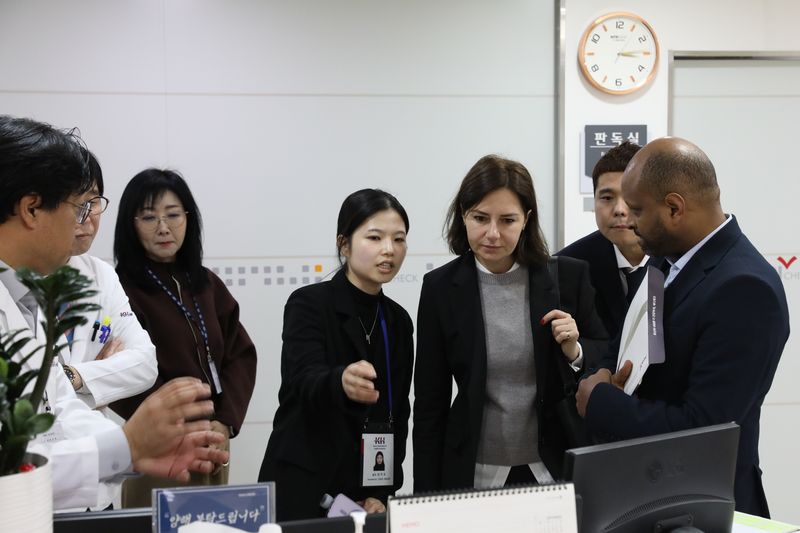
[Financial News] World Bank experts got a firsthand look at a Korean health screening operation where AI first screens chest images for tiny nodules.
The Korea Association of Health Promotion said officials from the World Bank’s East and Southern Africa (AFE) team in its Digital and AI sector visited the association’s headquarters in Gangseo-gu, Seoul, on the 22nd to discuss cooperation on AI-based early disease detection and the use of AI in health screenings.
The delegation visited Korea to attend the Global AI & Digital Summit, held in Seoul from the 19th to the 22nd. The event is a high-level international forum discussing ways to create jobs and improve productivity and access to services through AI and digital technologies in fields such as agriculture, healthcare, education, tourism and administrative services. The World Bank, an international financial institution that supports poverty reduction and economic development in developing countries, is pursuing the AFE Ready 4 AI project to strengthen AI capacity in Africa with support from the Korean Trust Fund, while identifying opportunities for cooperation between African countries and Korean institutions.
The visit was arranged to draw on the association’s experience in AI-based early disease detection, medical image interpretation and health screening operations as a reference for developing AI policies in the health sector in East and Southern Africa, and to explore future exchanges and cooperation projects. The delegation visiting the association comprised Senior Digital Specialist Elena Gabriela Ardelean and Digital Specialist Binyam Mesfin Shiferaw.
At the meeting, the association introduced Korea’s national health screening system and AI-assisted interpretation technology, examples of AI use in work processes and customer service, and plans for AI research using screening data from its 17 centers nationwide.
The association operates an AI-assisted interpretation solution at its screening centers that initially screens for early lesions, including tiny nodules, pneumonia and tuberculosis lesions in chest images, and microcalcifications in mammograms. It also has noninvasive testing infrastructure, including patch-type wearable electrocardiographs and AI-based cardiovascular assessments using fundus photographs, and provides personalized health management services through its self-developed MediCheck and MediWork apps. Going forward, it plans to combine AI technology with its accumulated large-scale screening data to complete a “predictive screening” system that links everything from pre-screening data collection and identifying at-risk groups to lifestyle management.
The two sides exchanged views from various angles on ways to use AI in African healthcare settings and opportunities for cooperation. The delegation then moved to a nearby health screening center at the association’s Seoul Western Branch, where it examined the screening system—from examinee registration through testing and results management—as well as the actual AI image interpretation process.
Senior Digital Specialist Ardelean said, “Recently, Ethiopia and other countries have been actively exploring the application of AI in healthcare, and we plan to develop cooperation on the use of AI in healthcare in Central Africa, including Cameroon.” She added, “I hope we can establish ways to introduce Korea’s excellent know-how, technology and experience in developing countries and continue cooperating.”
An association official said, “It is highly meaningful to be able to share with the World Bank the data and experience in using AI that we have accumulated over about 60 years in the field of national health screenings.” The official added, “With this exchange as an opportunity, we will strengthen cooperation with African regions that lack medical resources and work to ensure that the Korean-style AI screening model can make a practical contribution to healthcare settings overseas.”
Founded in 1964, the association operates health screening centers at 17 city and provincial branches nationwide and carries out a range of health promotion programs, including national and personalized health screenings. It currently has clinical care agreements with around 300 medical institutions, including tertiary general hospitals and general hospitals.
[email protected] Jung Myung-jin, Medical Affairs Specialist Reporter