President Lee to personally address licensing and permitting hurdles for mega-projects and super-regional special zones
- Input
- 2026-10-23 14:39:55
- Updated
- 2026-10-23 14:39:55
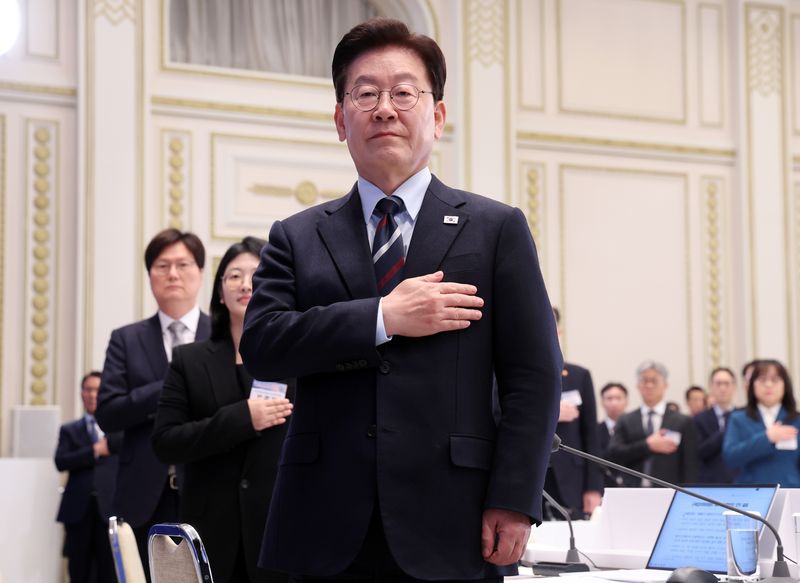
[Financial News] President Lee Jae-myung said on the 23rd that he would personally oversee licensing and permitting issues arising in the implementation of the Three Mega-Projects, a key national growth strategy, and super-regional special zones. He stressed his determination to speed up regulatory rationalization by boldly overhauling unreasonable regulations that hinder the development of new industries and regional growth, while strengthening regulations designed to protect the lives and safety of the public.
At the second plenary meeting of the Regulatory Rationalization Committee, held that day at the Blue House guesthouse, President Lee said, "Mega-projects and super-regional special zones are key issues whose progress the president reviews personally, so I will also personally oversee on-the-ground difficulties, such as licensing and permitting, to be discussed at this meeting."
President Lee stressed that "regulatory rationalization is an essential task in making Korea irreplaceable," adding, "We must continue to introduce and strengthen regulations that protect the lives, safety and property of the people, as well as fairness and transparency in our social order. At the same time, we must swiftly and boldly improve inconvenient regulations that hinder the development of new technologies and new industries or have become outdated."
President Lee emphasized the importance of the Three Mega-Projects and super-regional special zones as a strategy for breaking the vicious cycle of concentration in the capital region and regional decline. In the past, concentrating limited capital and opportunities in the capital region and a handful of large corporations was effective for economic growth, but he believes the time has come to spread the benefits and opportunities of growth to regions.
President Lee said, "We have entered an era in which dispersing and fairly distributing opportunities and capital, rather than concentrating them, greatly boosts efficiency. That is why we are pursuing strategies for balanced national development and regional development as a priority." He added, "A deeply entrenched structure of vested interests has already taken shape, benefiting from this concentration, so efforts to change it may face considerable resistance and backlash. To ensure long-term national development and a better future for our people, we must boldly pursue a strategy for balanced regional development."
He also called for building a foundation for growth that would help young people settle in their regions. President Lee said, "We must ensure that young people born and raised in our regions do not leave for the capital region for jobs, but can work in their respective regions, start families and plan their futures."
He also called for overhauling regulations that can be improved immediately, separately from legislation on super-regional special zones. President Lee said, "The recently introduced bill on super-regional special zones reportedly contains around 300 regulatory exemptions, the most ever included in a single law. I think there are things we can do even before the law is enacted." He urged the Regulatory Rationalization Committee to make regulatory improvements swiftly and proactively.
He also raised the need to overhaul regulations to promote startups. President Lee said, "We are now in an era of entrepreneurship across the country. It is an opportunity for anyone with a fresh idea to succeed, and it can also help drive economic growth and create jobs nationwide." He went on, "But when you actually try to start a business, information is scarce, regulations are complicated, and there is so much paperwork to submit. These are some of the difficulties people face. Among these, customary regulations imposed for administrative convenience that are not truly necessary need to be boldly removed."
He stressed that the criteria for evaluating the results of regulatory reform should also change. What matters is not simply how many regulations have been repealed or improved, but whether the changes lead to actual investment, startups and job creation. President Lee said, "The number of regulations improved matters too. But it is also important to see how much investment has been generated, how many startups have been launched and how many jobs have been created by changing regulations."
However, he cautioned against regulatory rationalization leading to indiscriminate deregulation. President Lee urged, "We must also take great care to ensure that it does not fundamentally undermine the lives and safety of the people, the environment, or other important values we should uphold."
[email protected] Choi Jong-geun Seong Seok-woo Reporter