Government support for startups forced to suspend operations for reasons such as childbirth to be extended by up to five years
- Input
- 2026-10-23 16:13:14
- Updated
- 2026-10-23 16:13:14
The process for quickly lifting transfer limits on bank accounts opened by early-stage startups will also be improved.
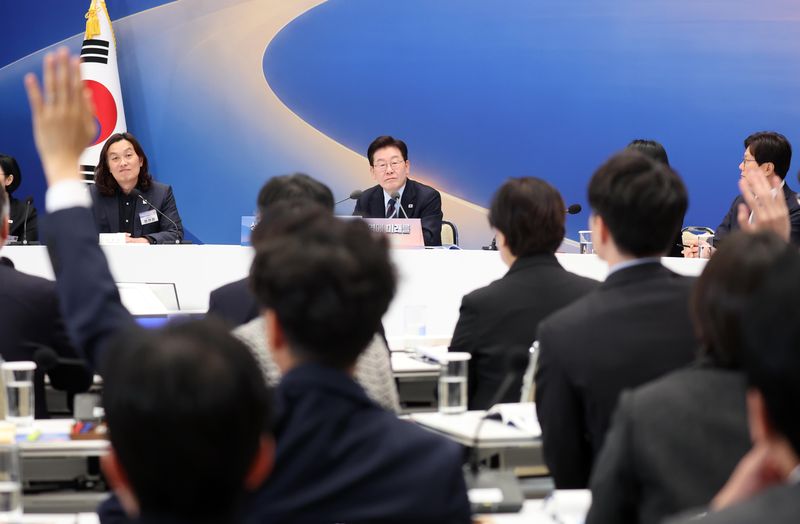
On the 23rd, the Ministry of SMEs and Startups presented a set of measures to the second plenary meeting of the Regulatory Rationalization Committee for discussion. The core of the plan is to pursue 10 tasks across three areas: adapting uniform startup-support criteria to startups’ growth stages, improving the environment for financial transactions and investment, and promoting second chances by leveraging startup experience.
First, the government will introduce a special provision extending the period of government support for startups that suspend operations because of military service, childbirth or similar reasons. The current Support for Small and Medium Enterprise Startups Act defines a startup as a business less than seven years old, meaning that the period is counted toward the business’s age even if its founder temporarily suspends operations for military service or other reasons. As a result, startups could be excluded from government support even if they had operated for only a short time before a business interruption.
The Ministry of SMEs and Startups plans to revise the system so that startups facing unavoidable business interruptions can use startup-support programs for up to five additional years.
The requirements for lifting restrictions on limited-transaction bank accounts will also be improved to facilitate financial transactions for early-stage startups. Currently, when a new account is opened at a bank, daily transfer limits are imposed to prevent financial fraud such as voice phishing: 1 million won each for ATM and electronic financial transactions, and 3 million won for transactions at a bank counter. To have the restrictions lifted, customers must submit documents proving the purpose of the transactions, but startups have faced difficulties because the required documents and assessment criteria vary by bank and branch.
The Ministry of SMEs and Startups plans to revise the banking sector’s joint guidelines in consultation with the Financial Services Commission and strengthen the documentation requirements for lifting account restrictions. In particular, it plans to allow restrictions to be lifted quickly when a startup has been verified by a credible institution, for example through a record of being selected for a government startup-support program.
The financial soundness criteria that prevent startups from applying for research and development (R&D) support programs will also be relaxed. Currently, government R&D programs restrict applications from companies with high debt ratios or whose capital is completely eroded.
Going forward, for early-stage startups that have been in business for less than three years, these financial soundness requirements will be applied as criteria in the selection evaluation rather than as grounds for barring applications in advance. The aim is to give startups with strong technical capabilities but a longer path to generating sales an opportunity to apply for R&D support programs.
Rules that prevent existing business owners from starting new businesses will also be changed. Until now, a new venture by an existing business owner was considered a continuation or expansion of the existing business and excluded from government startup support. Going forward, the government plans to recognize a business as a startup when a sole proprietor launches a business in a different industry from their existing one, or when an executive of an existing corporation establishes a corporation as its sole founder.
A system will also be introduced to issue a certificate, provisionally titled the “Challenge and Startup Career Certificate,” so that experience preparing to start a business or running a company as a corporate representative can be officially recognized. The service will be linked with the Ministry of Employment and Labor’s Integrated Career Certification Service, allowing startup experience to count as work experience during the job search process.
[email protected] Kim Hyun-chul Reporter