“Accelerating the three mega-projects” ... Korea Customs Service expands bonded construction sites offshore
- Input
- 2026-10-23 14:41:42
- Updated
- 2026-10-23 14:41:42
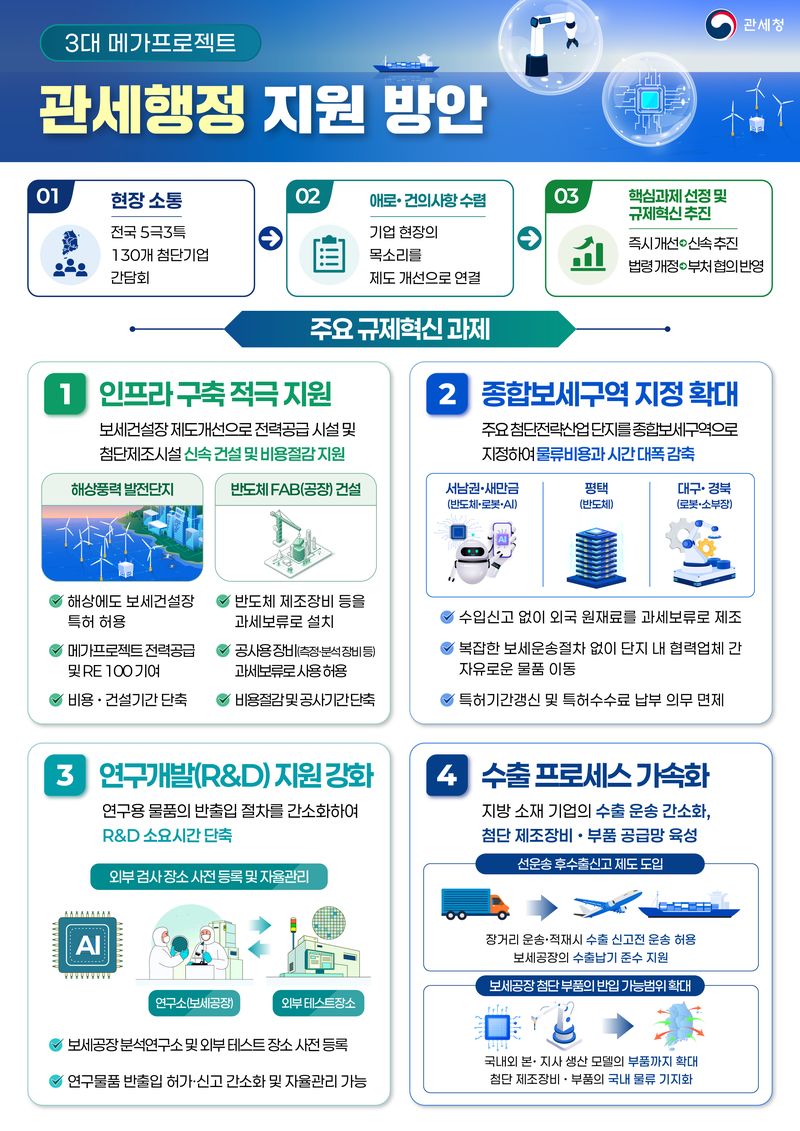
The Korea Customs Service said it would pursue six top-priority regulatory reform measures to support the mega-projects and the development of advanced-industry infrastructure discussed at the second plenary meeting of the Regulatory Rationalization Committee, chaired by the president and held on the afternoon of the 23rd. The measures reflect feedback gathered at on-site meetings with 130 advanced strategic companies in the “five hubs and three special regions”—Chungcheong, Honam, Daegu-Gyeongbuk, Busan-Ulsan-Gyeongnam, and Gangwon—by the Service’s Bonded Industry Division and its One-Stop Customs Administration Support Team for Advanced Strategic Industries.
First, the bonded system will be revised to support the development of advanced-industry infrastructure. To ensure a steady power supply to semiconductor fabrication plants (fabs) and artificial intelligence (AI) data centers, bonded construction sites, previously permitted only on land, will also be allowed offshore. This will enable foreign-made key equipment—including generators, blades, and hubs—needed to build large offshore wind farms to be brought in and installed under duty suspension, significantly reducing companies’ initial costs and shortening construction periods. The system will also be improved to allow foreign construction equipment used for measurement and analysis, which could not previously be used under duty suspension at bonded construction sites, to be used under duty suspension.
The designation of “comprehensive bonded areas” at advanced-industry hubs will also be expanded. Major strategic-industry complexes in the Honam region (semiconductors, robotics, and AI), Daegu and Gyeongbuk (robotics and materials, components, and equipment), and Pyeongtaek and Yongin (semiconductors) are among those targeted. Once designated as a comprehensive bonded area, companies can use raw materials under duty suspension without filing import declarations, receive exemptions from license fees, and move goods freely among partner companies within the area, reducing logistics costs and time.
The global advanced-technology market has recently become a “speed race,” in which the pace of investment in facilities and construction of new factories—not just product performance—determines market share. In particular, concerns have been raised that delays in building infrastructure for facilities requiring large amounts of electricity, such as semiconductor plants and AI data centers, could directly weaken the competitiveness of national advanced industries. The easing of regulations on bonded construction sites and comprehensive bonded areas is expected to serve as a catalyst for accelerating domestic advanced-industry companies’ investment plans amid the restructuring of global supply chains.
Measures have also been prepared to accelerate research and development (R&D) and export processes. Procedures will be streamlined so that, once research and testing facilities outside a bonded factory are registered with customs in advance, companies can manage foreign raw materials for R&D on their own without separate permits for off-site operations or declarations for bringing the materials in or out.
A “transport first, file the export declaration later” system will also be introduced to support export logistics for advanced-industry companies outside major cities. It will allow goods from regional bonded factories—which need to travel long distances to reach export loading sites—to be transported to those sites first while the export declaration is processed, helping ensure timely transport. In addition, the range of spare and repair parts that can be brought into bonded factories for advanced semiconductor manufacturing equipment will be expanded to cover parts for equipment models produced by domestic and overseas headquarters and branches, enabling a rapid response to sudden equipment failures.
“For advanced strategic industries vying to secure leadership in global markets, timely investment and uninterrupted support are key to success,” said Korea Customs Service Commissioner Lee Jong-wook. “As uncertainty at home and abroad grows, we will proactively identify and address on-the-ground challenges so that our advanced-industry companies can fully demonstrate their global competitiveness.”
[email protected] Kim Won-jun Reporter