“Sell Republicans, Buy Democrats” ... U.S. Midterms Put South Korea’s Stock Market on Edge, Too
- Input
- 2026-10-23 14:00:14
- Updated
- 2026-10-23 14:00:14
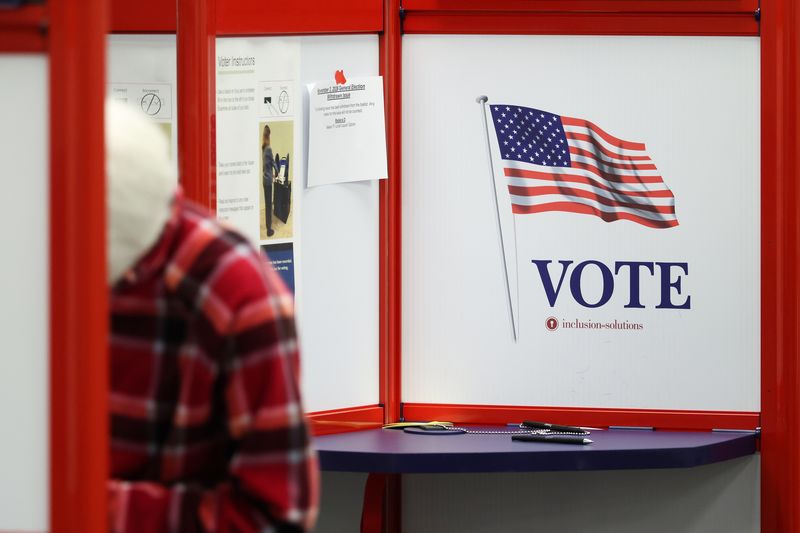
[Financial News] A strategy of “selling Republicans and buying Democrats” is gaining traction on Wall Street, prompting keen interest in whether it will also affect South Korea’s stock market.
With the likelihood of Democrats taking control of Congress growing ahead of the U.S. midterm elections on November 3, investors are adjusting their asset allocations in anticipation of policy changes after the election.
Analysts say the election could produce different winners and losers across sectors in South Korea’s stock market, as the results could bring changes to U.S. industrial policy, artificial intelligence (AI) regulation and energy policy.
Korea Investment & Securities said in its “U.S. Strategy Note” on the 23rd that market expectations of Democrats taking control of the Senate are growing. It said that amid continued tariffs and geopolitical uncertainty since the start of the second Trump administration, the midterm results have emerged as a key indicator of the direction of future policy.
Researcher Jeong Jeong-young of Korea Investment & Securities said, “It is worth noting that the probability of Democrats taking control of the Senate began to exceed 50% after August.” Since October, the breadth of stocks posting gains in the U.S. market has held up, while small- and mid-cap stocks have also strengthened relative to large caps.
Jeong said this “could be seen not simply as a result of falling U.S. long-term interest rates or concerns about a recession, but as a process in which expectations about the midterm election results are being reflected in stock prices.”
In particular, Jeong pointed out that after the probability of Democrats taking control of the Senate topped 50%, some stocks tied to major policies of the Trump administration and the Republican Party weakened.
Notable examples include the weakness of DTCR, an exchange-traded fund (ETF) related to data centers, and shifts in the relative performance of DEMZ, a Democratic-themed ETF, and MAGA, a Republican-themed ETF. However, movements in any one ETF alone are not enough to conclude that investors’ political outlook is settled; other factors, including interest rates and corporate earnings, must also be considered.
Will funds shift to policy-beneficiary sectors in South Korea’s stock market?
The impact of the U.S. midterm elections could vary by sector in South Korea’s stock market, as changes in U.S. policy could affect South Korean companies’ exports, orders and investment plans.Sectors highly dependent on the U.S. market—particularly power equipment, batteries, renewable energy, biotech and health care, and defense and nuclear power—should pay close attention to policy changes stemming from the election results.
If Democrats take control of both the House and the Senate, discussions on regulating power use by AI data centers and sharing the associated costs could intensify. This could increase costs for Big Tech companies, but if construction of substations and standalone power grids to address bottlenecks in the power grid expands, it could create new order opportunities for South Korean power equipment companies supplying equipment to the United States.
However, the possibility cannot be ruled out that a slowdown in data center investment itself could negatively affect demand for related equipment.
Renewable energy and health care could also be affected by policy changes. If Democrats gain control of Congress, they may pursue measures to support clean energy and expand health insurance assistance.
On the other hand, if Republicans retain their majority in Congress, the current administration’s pro-business, deregulatory approach and its policies on defense and nuclear power could continue. Whether South Korean companies actually benefit is expected to depend not only on policy direction but also on the details of budgets and tax incentives, as well as their competitiveness.
Semiconductor and AI stocks: Watch both regulation and the sustainability of investment
Semiconductor and AI-related stocks, key sectors in South Korea’s market, could also be affected by the midterm elections. If Democrats take control of Congress, discussions on regulating AI data centers’ power use and their environmental and community impacts could gain momentum.Delays in Big Tech’s data center construction or grid connections could also affect expectations for demand for semiconductors and AI infrastructure.
However, tighter regulation does not necessarily mean an immediate reduction in AI investment. If competition in AI among U.S. Big Tech companies continues and data center investment is sustained, demand for high-bandwidth memory (HBM) and server DRAM could remain supported.
Therefore, when assessing South Korean semiconductor stocks, investors should look beyond the election results themselves and track how actual AI capital spending plans, cloud business growth and memory demand forecasts change.
Changes in financial markets resulting from the election are also a factor for South Korea’s stock market. The Bank of Korea said that if Democrats take control of both the House and the Senate, concerns about AI regulation and the possibility of slower growth could weaken U.S. long-term interest rates, stock prices and the value of the dollar.
Movements in U.S. interest rates and the dollar could also affect the won-dollar exchange rate and foreign investors’ trading in South Korean stocks. The actual impact, however, could depend on how far the election results differ from market expectations, as well as on the course of Federal Reserve System (Fed) monetary policy and inflation.
Researcher Jeong said, “It is difficult to build long-term positions by predicting the election results in advance, and investors should be alert to increased volatility until the actual results are known.”
The point is that South Korean investors, too, should look specifically at how changes in U.S. policy affect domestic companies’ orders, exports, cost structures and earnings outlooks, rather than relying solely on political themes.
[email protected] Kang Jung-mo Reporter