Ruling and opposition parties clash over Future Response Fund: “A bill for the future” vs. “Investment in an AI transformation”
- Input
- 2026-10-23 13:48:27
- Updated
- 2026-10-23 13:48:27
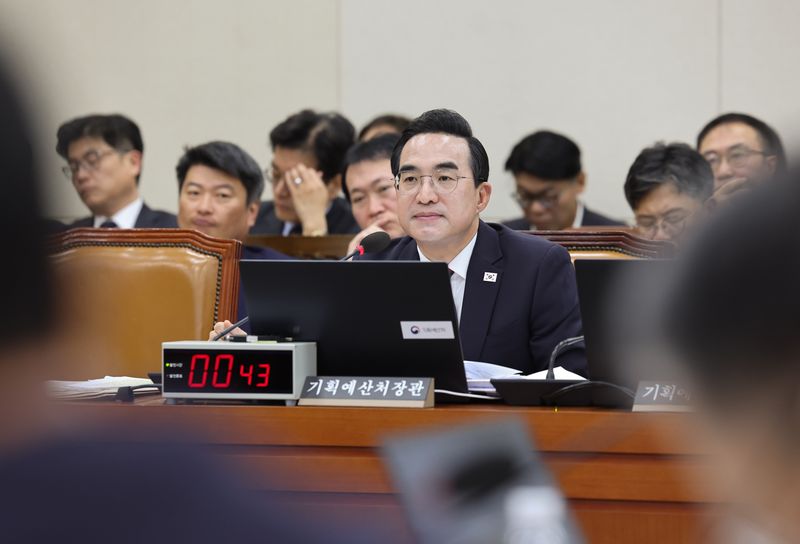
[Financial News] The ruling and opposition parties clashed on the 23rd over the effectiveness and fiscal soundness of the government’s proposed Future Response Fund during a comprehensive audit by the National Assembly’s Finance, Economy and Planning Committee. The People Power Party criticized the plan, warning that establishing the fund on the basis of uncertain tax revenue projections could ultimately burden future generations. The Democratic Party of Korea countered that proactive investment in future industries such as artificial intelligence (AI) was needed to boost the potential growth rate.
The Strategy and Finance Committee of the National Assembly conducted a comprehensive audit of the Ministry of Planning and Budget and the Bank of Korea, among others, at the National Assembly that day.
The People Power Party focused its criticism on the Future Response Fund’s financing methods and the procedures for moving it forward. Rep. Park Su-young of the People Power Party said, “The Ministry of Economy and Finance submitted a total of 10 comments—three on the National Finance Act and seven on the Future Response Fund Act—but not a single one was reflected,” adding, “I don’t understand how not a single word of the comments submitted by the deputy prime minister for economic affairs was taken into account.”
Rep. Park criticized the process, citing the absence of the Minister of Economy and Finance from the consultation between the ruling party and the government on introducing the Future Response Fund and the short legislative notice period. “The ministry was completely sidelined, both on substance and in procedure,” he said.
Rep. Im Lee-ja of the People Power Party challenged the uncertainty of the tax revenue projections. “Under the government’s formula, a contradiction arises: money would have to be added to the fund even while the economy is recovering from a downturn,” she said. “There will be no additional tax revenue in 2029 and 2030, so the fund may not contribute to fiscal stabilization, and future strategic investments may have to be financed through the general account.” She went on to quip, “Isn’t this becoming a bill for the future rather than an investment in the future?”
The Democratic Party of Korea countered that the Future Response Fund was needed to secure the competitiveness of the AI industry and raise the potential growth rate. Rep. Kim Young-hwan of the party pointed to weaknesses in domestic industry identified in international organizations’ digital competitiveness assessments, stressing, “South Korea must take the lead in riding the wave of transformation sweeping the AI industry.”
Minister of Planning and Budget Park Hong-keun said the Future Response Fund had two pillars: strategic investment to secure new growth engines and efforts to ease polarization. “It is geared toward strengthening growth and people’s livelihoods together,” he explained.
Concerns were also raised that local governments’ financial burden has actually increased even after firefighters became national civil servants.
Rep. Jung Tae-ho of the Democratic Party of Korea noted that the local-government share of the firefighting safety budget rose from around 85% in 2021 to 89.3% in 2026, while the national-government share fell from 14.9% to 10.7%.
“Given the purpose of making firefighters national civil servants, it makes no sense for national funding to decrease instead,” Rep. Jung said. “As personnel costs take up a larger share, essential projects such as expanding fire facilities and upgrading equipment are being scaled back or postponed.”
He urged the government to devise ways to secure stable funding, noting that the Fire Safety Grant Tax is expected to fall 27.6% in 2027, from 1.0503 trillion won to 760.5 billion won. Minister Park explained that a decline in individual consumption tax revenue due to reduced tobacco consumption was a major cause of the drop in firefighting funds.
[email protected] Kim Kyung-min Reporter