The wellness market is growing... Koreans’ focus shifts from the body to the mind
- Input
- 2026-10-25 09:00:00
- Updated
- 2026-10-25 09:00:00
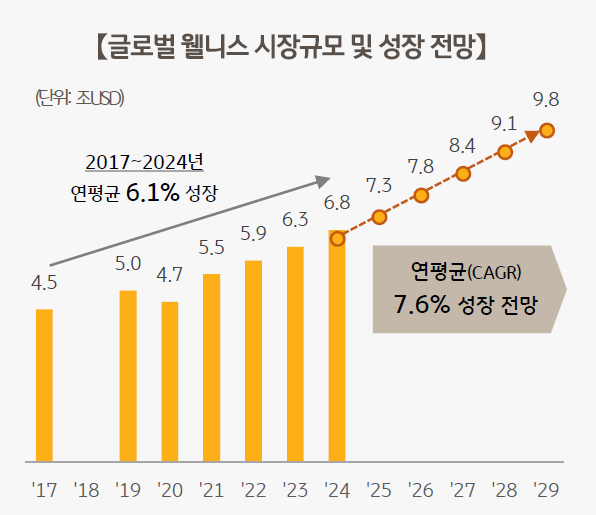
According to the ‘2026 Korea Wellness Report’ by the KB Financial Group Management Research Institute on the 25th, the global wellness market is projected to grow by an average of 7.6% annually from 2024 to 2029, reaching $9.8 trillion. The Korean market ranked 12th globally in 2024, at approximately $119 billion.
The ‘2026 Korea Wellness Report’ covers changing perceptions of physical and mental health among Koreans, as well as new health trends. It was based on an online and mobile survey and focus group discussions (FGDs) conducted last July and August with 2,000 men and women aged 25 to 69.
According to the report, sleep and stress management ranked first and second among areas of interest in health management, at 54.0% and 51.9%, respectively. Those figures were up 5.6 and 5.3 percentage points, respectively, from 2024. By contrast, diet management fell 2.7 percentage points to 44.3%, dropping to third place.
The reasons people exercise have also expanded to include managing their mental well-being. The share who cited ‘emotional relief,’ such as stress reduction, was 34.8%, up 13.3 percentage points from two years earlier and the second-highest reason after maintaining fitness and health.
The share who said that living healthily means ‘not pushing yourself, letting go, and getting enough rest’ was 48.0%, more than double the 20.8% who said people should ‘set goals and work diligently toward them.’
However, this interest did not translate into action. Average sleep per day was 6.3 hours, down 0.2 hours from 2024. The share of respondents who slept at least seven hours a day also fell by 8.8 percentage points, to 41.6%.
A higher share selected mental health as an area included in wellness than selected physical health: 90.7% versus 87.1%. By contrast, 35.7% said they managed their mental health, below the 50.6% who said they managed their physical health.
The same pattern was seen with ‘well-aging,’ or aging in good health. More respondents said they accepted aging and sought to age healthily (44.8%) than said they tried to slow or reverse aging (23.6%). While 59.9% said they were highly interested in well-aging, just 29.8% said they actively managed it.
Some 52.4% of respondents used digital devices or apps to manage their health, and 66.5% of those users used them at least three times a week.
The KB Financial Group Management Research Institute said, “South Korea’s life satisfaction falls short despite its ranking among the world’s highest in healthy life expectancy. The time has come to discuss health across life as a whole, encompassing the body, mind and social relationships, rather than simply living longer.”
[email protected] Ye Byung-jung Reporter