Hong Ji-sun: Response measures being prepared for both surges and plunges in home prices
- Input
- 2026-10-23 12:44:33
- Updated
- 2026-10-23 12:44:33
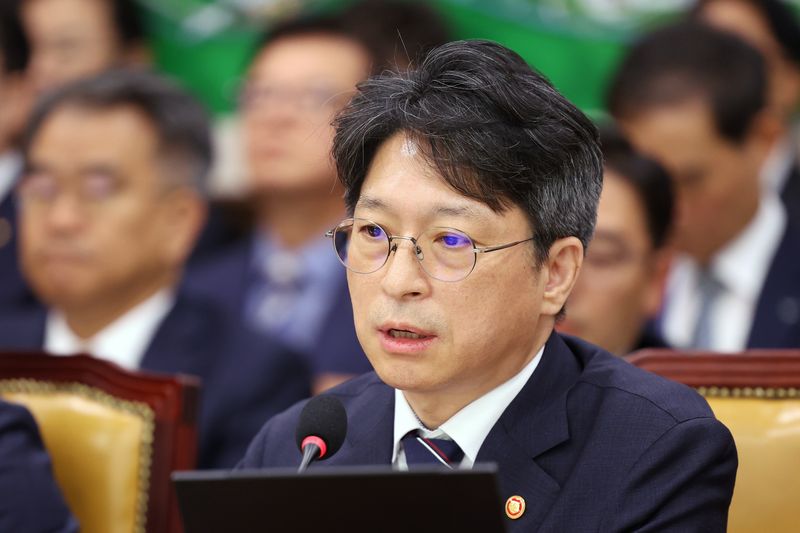
[Financial News] Land, Infrastructure and Transport Minister Hong Ji-sun said the government is preparing measures to address both sharp rises and steep falls in home prices.
According to the National Assembly on the 23rd, Minister of Land, Infrastructure and Transport Hong Ji-sun made the remarks that morning at the National Assembly’s Land, Infrastructure and Transport Committee’s comprehensive audit of the ministry. When People Power Party lawmaker Kang Dae-sik asked whether measures were being prepared to respond to rising apartment prices in the Seoul metropolitan area, Minister Hong replied, “We’re preparing them now,” adding, “We’re preparing measures to respond to various changes, whether a plunge or a surge.”
He discussed supply performance separately for the public and private sectors. People Power Party lawmaker Jung Hee-yong criticized the government’s housing supply plan for this year, saying it had reached only 81–88% of its target and that confidence in real estate policy overall was wavering. Minister Hong replied, “We seem likely to meet the target to some extent for the volume being pursued by the public sector, but the private-sector volume is not being delivered properly.” He added, “We’ve set out a five-year plan,” and said, “We’ll do our utmost to make up the shortfall next year.”
He also signaled improvements to the special housing allocation system. Independent lawmaker Jang Kyung-tae pointed to loopholes in special apartment allocations for winners of international arts and sports competitions and construction workers at overseas sites. Jang said, “As many as 10% of athletes received a special allocation with exactly one point, based solely on winning at least one medal at events such as the Universiade and the World Military Games, which are considered somewhat lower-tier competitions under the rules.” He criticized the fact that “housing allocations for construction workers who worked overseas during the Middle East construction boom are still available,” adding, “Even looking at just the past three years, [recipients] received special allocations for top-end apartments like those in Banpo and Daechi,” and called for improvements.
Minister Hong replied, “I’ll review once again what needs to be improved in the special allocation system for outstanding athletes and the system for overseas construction workers.” He also said vetting at the recommendation stage would be strengthened. “We’ll conduct additional checks on people recommended by [individual associations and others], and rather than relying solely on those recommending organizations, we’ll devise a way to conduct our own vetting,” he said.
He indicated that regulations alone were not to blame for the decline in jeonse listings. When Democratic Party of Korea lawmaker Jung Il-young cited regulations on private rental operators and tightened owner-occupancy requirements as reasons for the drop in jeonse listings, Minister Hong said, “Regulated areas and land transaction permit zones are limited to Seoul and parts of Gyeonggi Province. The problem is that even in other parts of the country without those regulations, listings for jeonse and monthly rentals are declining, and the shift toward monthly rent is intensifying.” His remarks suggest that it is difficult to view government regulations, including the Land Transaction Permit System (LTPS), as the sole cause of the jeonse crunch.
Whether to extend the Land Transaction Permit System is also drawing attention. All of Seoul and 12 areas in Gyeonggi Province are currently designated as land transaction permit zones, and the designation expires at the end of this year. At an audit on the 7th, Minister Hong said of the system, “I believe there is demand,” and said he would review whether to extend it after assessing market conditions. However, he took a cautious stance on expanding it to other parts of the Seoul metropolitan area, saying, “It’s not a situation where I can give a definitive answer.”
[email protected] Jung Kyung-soo Reporter