KAI struggles as Hanwha Ocean soars ... Did privatization change their fortunes?
- Input
- 2026-10-23 12:06:54
- Updated
- 2026-10-23 12:06:54
[Financial News] Korea Aerospace Industries (KAI), in which the Export-Import Bank of Korea (Korea Eximbank) and the National Pension Service hold a 34.7% stake, has grown much more slowly than its competitors in the same industry. Hanwha Ocean, by contrast, which KDB transferred to Hanwha Group, is on a steep growth trajectory. (Hanwha Ocean was formerly Daewoo Shipbuilding & Marine Engineering.)
On the 23rd, a comparative analysis by corporate research institute Leaders Index of the results of eight large companies in which KDB and Korea Eximbank hold or previously held stakes found that large companies remaining under state-run banks’ control are struggling.
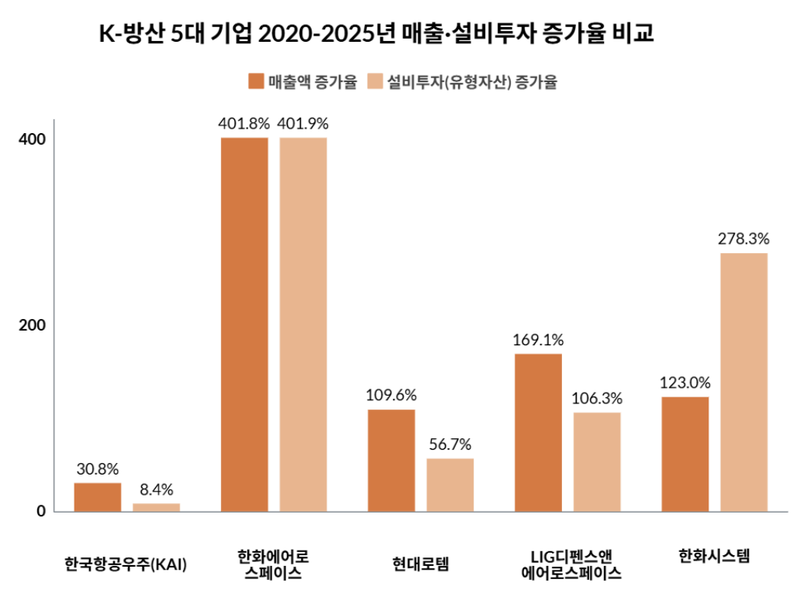
KAI is a prime example. While private-sector competitors have posted remarkable revenue growth amid a boom in the defense industry, KAI’s growth has been sluggish. Comparing revenue last year with 2020, Hanwha Aerospace surged 401.8%, Hanwha Systems grew 123%, LIG Defense & Aerospace (LIG D&A) increased 169.1%, and Hyundai Rotem rose 109.6%. KAI, however, managed just 30.8%.
The gap is even wider in operating profit. The average increase for companies in the same industry reached 680% over the same period, while KAI’s was 92.9%. Hanwha Aerospace, which posted the largest increase in operating profit, was up 1,166.4%—a gap of as much as 11 times.
The difference in capital investment growth, which influences future growth prospects, is also substantial. Compared with 2020, capital investment last year rose by 401.9% at Hanwha Aerospace and 278.3% at Hanwha Systems, whereas KAI’s increase was just 8.4%. LIG D&A was up 106.3%, and Hyundai Rotem 56.7%.
Hanwha Group holds a stake of more than 15% with the aim of acquiring KAI. It believes there would be significant synergies, given that it has companies in the same industry, including Hanwha Aerospace and Hanwha Systems. With KAI’s performance lagging far behind that of Hanwha Aerospace and others, Hanwha says partnering with KAI is also important to support its growth.
Hanwha Ocean is behind Hanwha Group’s confidence. When it was under KDB as Daewoo Shipbuilding & Marine Engineering, it fell behind while its competitors grew. During the shipbuilding industry’s recovery from 2018 to 2023, revenue at HD Korea Shipbuilding & Offshore Engineering and Samsung Heavy Industries rose 61.8% and 52.1%, respectively, while Daewoo Shipbuilding & Marine Engineering’s revenue instead fell by 23.2%. In 2022, it posted an operating loss of 1.6136 trillion won.
After Hanwha Group acquired it in 2023 and relaunched it as Hanwha Ocean, revenue and operating profit rose sharply. In 2023, revenue was 7.4083 trillion won and the operating loss was 196.5 billion won, a reduction of 1.4 trillion won from the previous year. The following year, revenue topped 10 trillion won and it returned to profit with operating income of 237.9 billion won. Last year, revenue reached 12.7835 trillion won and operating profit rose to 1.1676 trillion won, entering the 1-trillion-won range. This year, revenue is expected to be in the 15-trillion-won range, with operating profit projected to exceed 2 trillion won.
HMM, the country’s largest shipping company, in which KDB, the Korea Ocean Business Corporation, and the National Pension Service hold a combined 75% stake, is also underperforming. Recent natural and geopolitical factors have sent shipping rates soaring, boosting shipping companies’ profitability, but HMM’s profit growth has been relatively modest. For example, from the first half of 2021 through the first half of this year, Pan Ocean’s operating profit rose 107.9%, while HMM’s fell by as much as 74.1%.
From 2016, when KDB took control of management, to the present, HMM’s revenue has grown 69.8% and its operating profit 49%. Over the same period, however, companies in the same industry saw average revenue growth of 87.8% and operating profit growth of 187.6%. The increase in operating profit was more than three times greater. KDB plans to pursue a sale of its stake once HMM completes the relocation of its headquarters to Busan.
[email protected] Kim Yun-ho Reporter