Korean and Japanese business communities: “Let’s develop new markets together” ... discuss expanding cooperation on CPTPP, AI and energy
- Input
- 2026-10-23 11:51:39
- Updated
- 2026-10-23 11:51:39
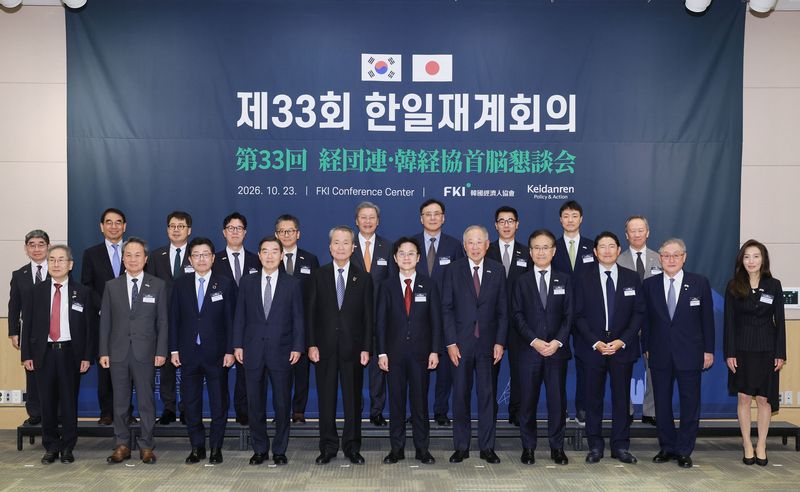
[Financial News] The business communities of Korea and Japan agreed to work together to address trade uncertainty and risks to energy supply chains, and to identify new business opportunities in advanced industries such as artificial intelligence (AI) and semiconductors. They plan to cooperate on Korea’s efforts to join the Comprehensive and Progressive Agreement for Trans-Pacific Partnership (CPTPP) and expand into third-country markets by combining the two countries’ technology and capital.
The Federation of Korean Industries and the Japan Business Federation (Keidanren) held the 33rd Korea-Japan Business Conference at FKI Tower in Yeouido, Seoul, on the 23rd and adopted a joint statement outlining these plans.
Held under the theme “The Dawn of a New 60 Years, a New Horizon for Korea-Japan Economic Cooperation,” the conference addressed international cooperation, energy and resource security, and regional revitalization as key agenda items.
In his opening remarks, FKI Chair Ryu Jin said, “If the past 60 years were mainly a time of crossing the Korea Strait back and forth, I hope the next 60 years will be a new period of cooperation in which we look beyond the horizon together.” The call was for the two countries to combine their strengths, address shared challenges, and develop new industries and markets.
Ryu identified three key areas for cooperation: international norms and economic security, stronger supply chain and energy security, and responses to shared social challenges. He stressed the need to jointly address U.S. trade policy and digital regulations, while assessing supply risks for key items and establishing a mutual assistance system for emergencies.
Keidanren Chair Yoshinobu Tsutsui also said, “As both Korea and Japan are highly dependent on external markets, we must work together to expand a free and open environment for trade and investment.” He emphasized the need to reform the World Trade Organization (WTO) and deepen and expand multilateral economic partnership agreements, and made no secret of his hopes for Korea’s application to join the CPTPP.
In his keynote address, Minister of Trade and Industry Kim Jung-kwan said, “Global supply chains are becoming increasingly unstable due to intensifying strategic competition between the United States and China and geopolitical uncertainty,” emphasizing the need for strategic ties between the two countries. He proposed cooperation on resource supply and supply chain stabilization, as well as exploring collaboration in physical AI that draws on each country’s strengths.
In trade, participants raised the need to cooperate on Korea’s CPTPP accession and on establishing international rules for cross-border data flows and AI. They also discussed expanding joint responses to supply chain and advanced-industry regulations imposed by the United States and the European Union (EU), and reviving the Korea-U.S.-Japan Business Dialogue to convey a shared position to the U.S. government and Congress. Developing joint projects in energy, semiconductors, and AI data centers by combining the three countries’ technology and capital was also on the agenda.
Energy cooperation focused on crisis response and joint projects. Participants discussed strengthening exchanges of emergency liquefied natural gas (LNG) supplies, building on cooperation between Korea Gas Corporation and Japanese energy company JERA Co., Inc., and expanding such exchanges to transactions with third countries. They also proposed cooperation on hydrogen certification, standards and safety criteria, as well as stockpiling critical minerals and responding to crises.
Participants also discussed ways to address the low birth rate, an aging population, and population decline in regional areas. The proposal was to use corporate data to connect financial support with regional companies that have strong growth potential, and to expand their sales channels through the two countries’ financial and distribution networks.
[email protected] Kim Hak-jae Reporter