“Report Counts Alone Cannot Fully Determine Public Safety Needs”... Police Discuss Tailored Response System
- Input
- 2026-10-23 15:00:00
- Updated
- 2026-10-23 15:00:00
[Financial News] Last year, the number of 112 reports in Incheon fell from the previous year, but reports of major and general crimes actually increased. Alongside an analysis that the burden on local police cannot be assessed based solely on the total number of reports, calls were made for a new public safety demand indicator that takes into account factors such as crime types and the share of emergency dispatches.
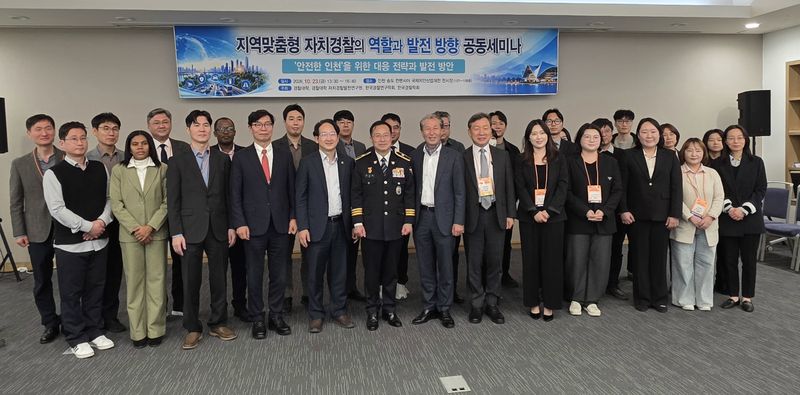
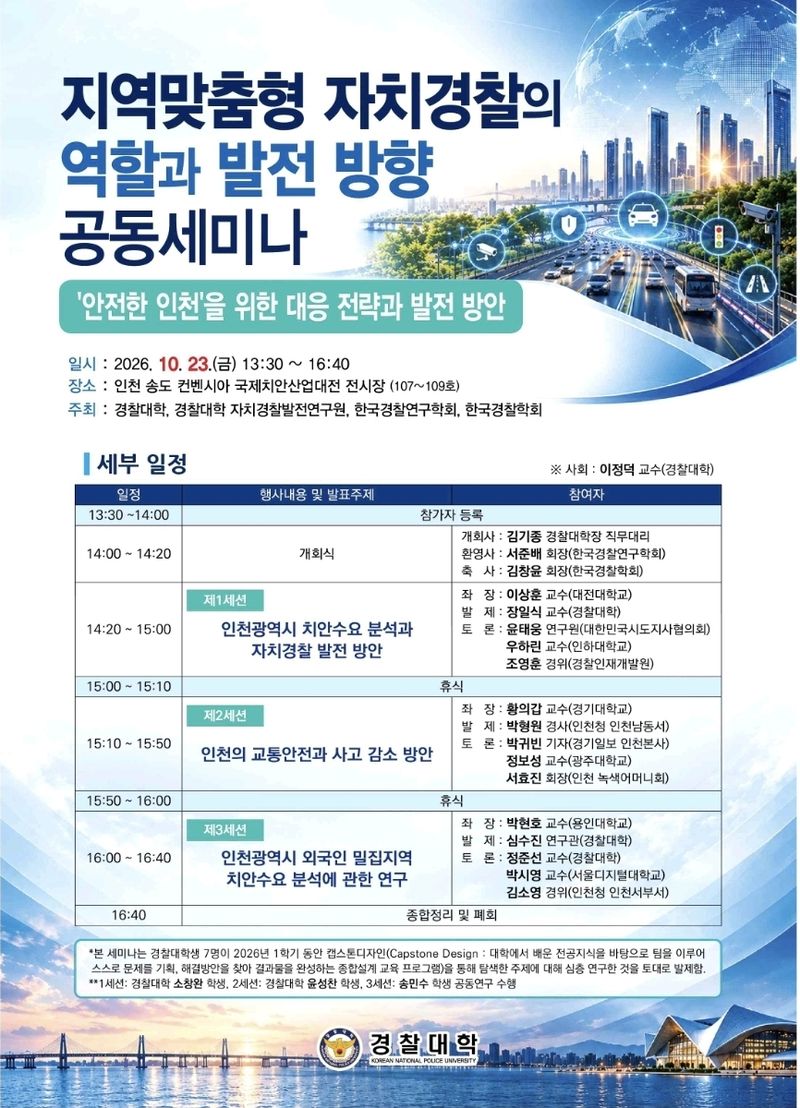
According to the National Police Agency on the 23rd, KNPU held a joint academic seminar that day at Songdo Convensia in Incheon under the title “The Role and Future Direction of Locally Tailored Autonomous Policing,” and presented these findings.
Jang Il-sik, a professor at KNPU, said in a presentation titled “Analysis of Public Safety Demand in Incheon Metropolitan City and Measures to Advance Autonomous Policing” that Incheon recorded 1,223,341 reports to 112 last year, down 3.9% from the previous year. By contrast, reports of major crimes rose 6.5% and reports of general crimes increased 1.9% over the same period.
Professor Jang said it was difficult to conclude that the burden on police responding to incidents had eased simply because the total number of reports had fallen. He said report types, urgency and local conditions for dispatching officers needed to be considered together.
He also proposed developing a “real-world public safety demand index” that reflects crime reports, the share of emergency dispatches, the extent to which reports are concentrated at particular times, and the floating population.
The analysis also took into account Incheon's regional characteristics, including its international airport and seaports, new towns and older downtown areas, and industrial and island regions. It assessed population, transportation conditions, crime and 112 report data, and residents’ perceptions of safety to determine public safety needs in each area.
Discussions also covered preventing traffic accidents and improving public safety conditions in areas with large concentrations of foreign residents.
Park Hyeong-won, a sergeant at Incheon Namdong Police Station, presented proposals under the title “Traffic Safety and Measures to Reduce Accidents in Incheon,” outlining ways to identify traffic hazards in each area and incorporate them into accident-prevention policies. Participants discussed the need for measures suited to local conditions, noting that traffic safety is an area where residents can directly experience the results of autonomous police activities in their daily lives.
Sim Su-jin, a research officer at KNPU’s Police Policy Research Institute, analyzed public safety needs in areas with large concentrations of foreign residents and proposed response measures that take into account local reporting patterns and living conditions.
Sim emphasized the need to consider residents who may have difficulty getting help from police because of language and cultural differences. The point, she said, was that an approach is needed to ensure the safety of both Korean and foreign residents and build trust in the police.
The seminar was jointly hosted by KNPU, its Institute for Autonomous Police Development, the Korean Association for Police Studies and the Korean Association of Police Science. A distinctive feature was that field research conducted by seven KNPU students as part of this year’s first-semester curriculum was developed into an academic discussion.
With support from the Incheon Metropolitan City Autonomous Police Commission and the Incheon Metropolitan Police Agency, the students visited field sites and analyzed related materials. They then examined local public safety issues and ways to improve policy together with professors, research officers and frontline police officers.
Kim Gi-jong, acting head of KNPU, said, “The value of autonomous policing must be evident in residents’ everyday lives.” He added, “KNPU, too, will make issues in the field subjects for education and research, and will work to help its students understand local communities and develop their capacity for collaboration and problem-solving.”
[email protected] Kim Ye-ji Reporter