Average equivalent monthly rent for apartments reaches 3.17 million won ... up 13% from last year
- Input
- 2026-10-23 10:42:12
- Updated
- 2026-10-23 10:42:12
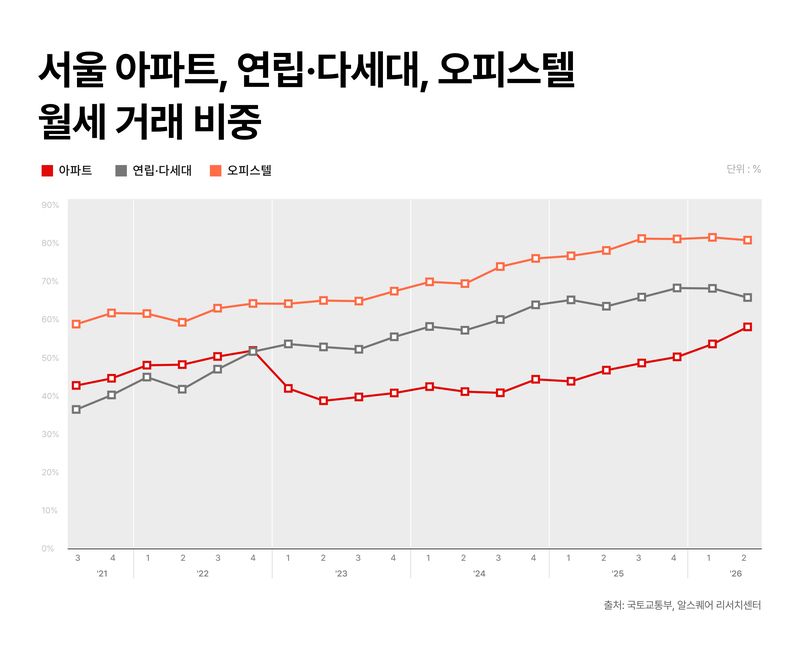
According to the ‘2026 Seoul Housing Jeonse and Monthly Rental Market Report’ published on the 23rd by RSQUARE, a comprehensive commercial real estate services company, new monthly-rental transactions for Seoul apartments totaled about 17,700 in the second quarter of this year, exceeding jeonse transactions (about 12,700). Monthly rentals accounted for 58% of new apartment leases. The share of monthly rentals also reached 66% for row houses and multi-family homes and 81% for officetels, respectively, making the rental market’s shift toward monthly rent clear.
Rents are also rising sharply. In the second quarter of this year, the average equivalent monthly rent for apartments with exclusive floor areas of 60–85 square meters—the actual monthly rent plus the deposit converted into a monthly-rent amount—was 3.17 million won, up 13.5% from the same period a year earlier.
The increases were especially pronounced not only in areas with a concentration of high-priced apartments but also in areas where rents had been relatively low. Seocho District (4.79 million won) and Gangnam-gu (4.51 million won) had high rent levels, while year-on-year increases in Gangbuk District (26.7%), Gangdong District (26.4%) and Nowon District (24.6%) were well above the Seoul average. Rents in Gangbuk District (2.18 million won) and Nowon District (1.97 million won) were below the Seoul average, but were rising much faster.
The preference for monthly rentals and the increase in rents are attributed to constraints on housing supply amid a trend toward smaller households. The number of one- and two-person households in Seoul grew from 2.05 million in 2015 to 2.81 million in 2025, while apartment completions and permits for non-apartment housing have continued to decline. Meanwhile, 7,259 units of Youth Safe Housing were recorded as supplied this year, based on recruitment announcements issued from the first through the third quarter; participation by asset management firms and REITs in the program has expanded.
Choi Gyu-jeong, a research analyst at RSQUARE, said, “Supply constraints could increase reliance on existing homes to meet rental demand.” Choi forecast, “If high financing costs persist, landlords’ interest burdens will be reflected in deposits or monthly rents. Tenants’ difficulty financing jeonse deposits will also boost demand for monthly rentals, so the shift from jeonse to monthly rent will continue.”
[email protected] Jeon Min-kyung Reporter