“Stocks cry when they rise and when they fall”: Is the culprit behind a market adrift not interest rates but the “AI bill”?
- Input
- 2026-10-24 09:00:00
- Updated
- 2026-10-24 09:00:00
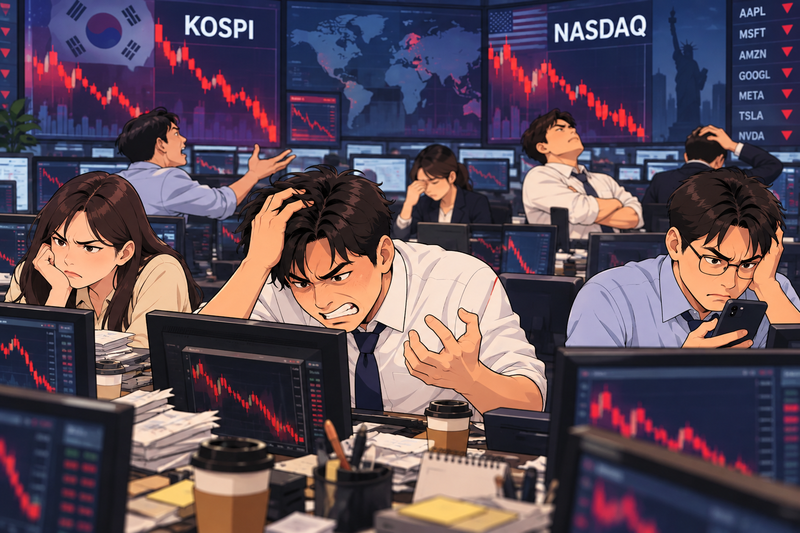
[Financial News] “We were told that soaring interest rates were pushing stock prices down, but now stocks are falling even as rates come down.”
That is the sigh-laden complaint of investors watching the stock market in Yeouido and on Wall Street in recent days. At the start of the year, a sharp rise in U.S. Treasury yields and inflation concerns were seen as major headwinds weighing on stocks, but the situation changed in October.
The U.S. 10-year Treasury yield fell from 5.3645% on the 7th to 4.952% on the 22nd, dropping below the 5% mark. Yet, despite the decline in yields, domestic and overseas stock markets have struggled to find a path to a rebound.
It is a paradoxical situation: stocks fall when interest rates rise, yet remain weak even when rates decline. Just where did the logic driving the market change?
On the 24th, Kang Jin-hyuk, an analyst at Shinhan Investment & Securities, identified not “the number” of interest rates but the “capital constraints and credit risks” underlying artificial intelligence (AI) as the real forces weighing on the stock market.
“Demand is still exploding... The problem is the astronomical sums poured in”
Is the market’s fear driven by the “collapse of the AI bubble”? The data point to the opposite. Demand for AI itself is hotter than ever.According to data from OpenRouter, as “agent AI”—which autonomously handles tasks—began to take off in earnest, AI agents’ token use had already surpassed human usage last February.
Agents now consume 7.8 times as many tokens as humans. As work rapidly shifts from people to AI, AI is gobbling up computing power.
The problem is not “demand” but “the cost of supply” and “the payback period.” Sustaining AI infrastructure requires not only astronomical capital expenditure (CapEx) but also enormous amounts of electricity and data centers. As investment has snowballed, the market has begun asking an increasingly pointed question: “So when, exactly, will that enormous sum be recouped?”
Analyst Kang said, “From an investor’s perspective, stocks fall when rates rise and also fall when they decline, so it may feel as if the logic explaining the market has changed. But what drives the market is not the interest-rate figure itself, but the cause and pace of the change.” He added, “The current market correction is not because AI demand has collapsed; it is the result of growing doubts about whether profitability and cash recovery can justify the massive investment in infrastructure (CapEx).”
SpaceX soars into space while Big Tech burns through cash
The contrasting earnings results announced this week offered a clear illustration of the market’s doubts. Aerospace company SpaceX saw revenue from its AI business division (SI, superintelligence) surge 830% year over year, overtaking its communications and space-launch businesses to become its main source of revenue and helping the company unexpectedly return to profitability.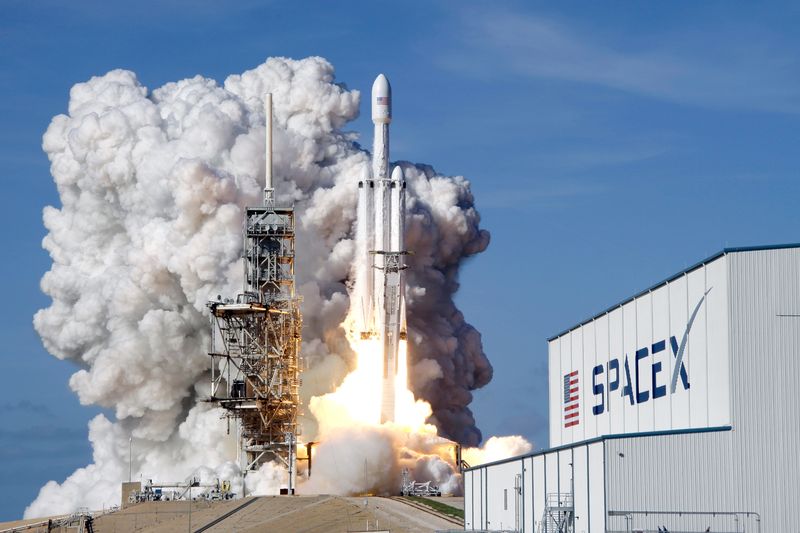
Despite making a massive $19.6 billion in capital investments in the third quarter, it won market acclaim by offering clear evidence that it could earn as much as it invested right away.
By contrast, social media company Meta (META) faced a sobering reality. Third-quarter revenue rose 26% year over year, but infrastructure CapEx surged to $34.9 billion, sending free cash flow (FCF) into a $2.12 billion deficit. Its share price was swept up in volatility after it failed to provide specific guidance for next year’s capital spending.
Then credit risks at neocloud companies such as CoreWeave, which have expanded their AI infrastructure through borrowing, also came to the fore, with CDS premiums surging. The market took falling interest rates as a warning signal reflecting demand for safe-haven assets and the side effects of investment.
Analyst Kang characterized the market during earnings season as a process of “checking the evidence.” He said, “Paradoxically, growing market doubts mean that the ‘value of evidence’ capable of dispelling them has become very high.” He explained, “As SpaceX offered a clue by unexpectedly turning a profit on surging revenue from its AI (SI) business despite large-scale capital investment, the key is whether proof of monetization can spread across Big Tech companies reporting earnings next week.”
Rather than hastily declaring the end of the AI investment cycle, this is a time to calmly verify whether profitability sufficient to justify astronomical CapEx is actually emerging, and whether credit risks at vulnerable links such as neocloud companies are stabilizing.
KOSPI P/E at 4.2 times... Could strong earnings and shareholder returns be the key to finding a floor?
With global markets on edge, domestic stocks are also suffering. The KOSPI has hovered near its late-July capitulation low of around 5,590 points, falling as far as the 5,530 level, while its 12-month forward price-to-earnings ratio (P/E) has plunged to 4.2 times, a historic low.Foreign investors have unleashed net sales of more than 26 trillion won in the KOSPI market over the past month, and the focus has now shifted to major events coming up next week as the key to a market rebound.
The earnings reports from global Big Tech companies, continuing through the end of this month, are expected to be a turning point that will determine the fate of the AI investment trend. In Korean time, Alphabet Inc. and Microsoft Corporation (MS) will release their results early on the 29th, followed by Amazon.com, Inc. early on the 30th. Apple Inc. is also set to report earnings on November 3. These results are expected to be a key indicator of whether concerns over the AI industry’s profitability, which have recently weighed on the market, can be allayed.
The domestic market’s resilience in the face of overseas factors is also being put to the test. The leading semiconductor companies are preparing to fire the starting gun for an escape from rock-bottom valuations by unveiling major shareholder-return measures.
After completing a 40 trillion won share buyback, SK hynix is set to announce additional shareholder-return measures alongside its third-quarter earnings. Samsung Electronics, too, is said to be considering a 40 trillion won share buyback and cancellation in the fourth quarter, following 30 trillion won in dividends in the third quarter. The market is closely watching to see whether shareholder returns from the two major semiconductor companies underpinning the domestic market can come to the rescue and inject life into the lackluster stock market.
A securities industry source said, “The index has fallen to near a historic low amid global uncertainty and a gap in supply and demand. Attention is now focused on whether next week’s U.S. Big Tech earnings and major shareholder-return policies from domestic companies will serve as a defensive line supporting the market’s floor.”
[email protected] Kang Jung-mo Reporter