Credit warnings flash for NPL investment firms: Hana, Woori and Kiwoom F&I fall below profitability downgrade-review thresholds [fn Market Watch]
- Input
- 2026-10-25 14:09:01
- Updated
- 2026-10-25 14:09:01
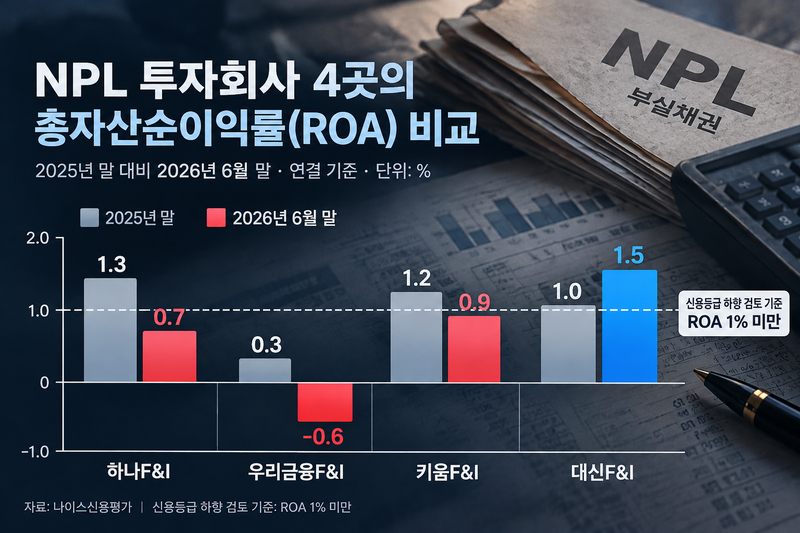
[Financial News] Profitability at major domestic nonperforming loan (NPL) investment firms has repeatedly fallen below thresholds for reviewing credit rating downgrades. The return on assets (ROA) of all three firms—Hana F&I, Woori Financial F&I and Kiwoom F&I—was below the 1% downgrade-review threshold set by credit rating agencies. Hana F&I was found to have breached the downgrade threshold not only for profitability but also for its leverage ratio. Although all three firms have Stable credit rating outlooks, analysts say a prolonged decline in profitability could weigh on their creditworthiness going forward.
On the 25th, according to NICE Investors Service data on credit rating adjustment triggers and financial indicators for financial companies, Hana F&I’s consolidated ROA stood at 0.7% at the end of June this year. That was down 0.6 percentage points from 1.3% at the end of last year, putting it below the 1% threshold for a downgrade review.
Its borrowing burden is also high. Hana F&I’s leverage ratio was 5.3x at the end of June this year, above the downgrade-review threshold of more than 5x. The ratio rose from 4.1x at the end of 2022 and 4.7x at the end of 2023 to 5.2x at the end of 2024, and remained at 5.2x at the end of last year. It has therefore exceeded the downgrade threshold at three consecutive observation points through the first half of this year.
Among the NPL investment firms covered in the review, Hana F&I was the only one whose two key financial indicators—profitability and leverage ratio—both breached downgrade-review thresholds. Nevertheless, its corporate bond rating remained A+ (Stable) both at the end of last year and at the end of September this year.
Profitability at Woori Financial F&I also deteriorated. Its consolidated ROA was -0.6% at the end of June this year, down 0.9 percentage points from 0.3% at the end of last year. After standing at 1.2% at the end of 2024, its ROA fell below the 1% downgrade threshold at the end of last year and turned negative in the first half of this year.
Woori Financial F&I’s ROA fluctuated from 0.6% at the end of 2023 to 1.2% at the end of 2024, 0.3% at the end of last year and -0.6% at the end of June this year. With the exception of 2024, it fell short of the downgrade-review threshold at recent key observation points. Its corporate bond rating, however, remains A (Stable).
Kiwoom F&I stands out because its credit rating rose even as its profitability indicators worsened. Its consolidated ROA was 0.9% at the end of June this year, down 0.3 percentage points from 1.2% at the end of last year. This puts it below the 1% downgrade-review threshold.
By contrast, Kiwoom F&I’s corporate bond rating was upgraded from A- at the end of last year to A at the end of September this year. Judging solely by its financial indicators, the company’s profitability had entered the downgrade-review range, yet its actual credit rating rose by one notch. The assessment is that the rating process also took into account factors beyond profitability, including business competitiveness, financial stability and the outlook for future performance.
Differing trends also emerged within the NPL investment industry. Daishin F&I’s consolidated ROA improved to 1.5% at the end of June this year from 1.0% at the end of last year. Its corporate bond rating was also upgraded from A at the end of last year to A+ at the end of September this year.
NPL investment firms buy nonperforming loans from financial institutions and others, then generate revenue by collecting on the loans and selling collateral assets. Because their business requires them to borrow funds to purchase assets, funding costs, collection performance and changes in the value of investment assets affect profitability and financial stability.
In particular, if the leverage ratio rises as ROA declines, a company’s capacity to build capital through internally generated earnings may weaken. As a result, the ability to restore profitability and manage borrowing burdens is an important factor in assessing NPL investment firms’ creditworthiness. The credit rating industry expects the recovery of profitability at NPL investment firms to be a key factor in defending their credit ratings going forward.
[email protected] Kim Hyun-jung Reporter