Born in Pyeongtaek, heart repaired in Seoul: Two-month-old makes a full recovery after emergency surgery at Seoul St. Mary’s Hospital
- Input
- 2026-10-23 09:17:16
- Updated
- 2026-10-23 09:17:16
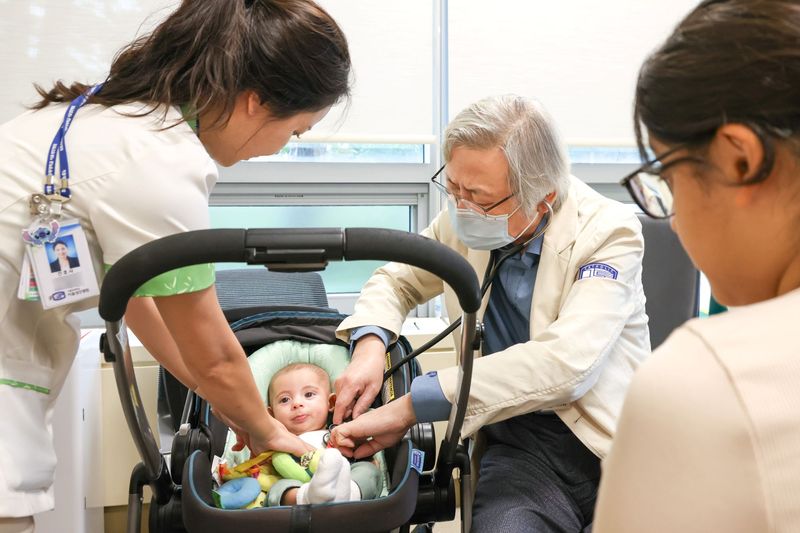
[Financial News] A baby who gained just 300 grams in the first two months of life has overcome emergency heart surgery and returned to the hospital with a bright smile.
The Catholic University of Korea, Seoul St. Mary’s Hospital said on the 23rd that Flores, a boy from a U.S. military family who underwent emergency heart surgery for a ventricular septal defect, had recovered and received his first postoperative outpatient care on the 13th.
Flores was born by normal delivery at the hospital on a military base in Pyeongtaek, where his father, a U.S. service member, was stationed. At around two months old, he developed symptoms of heart failure, including a rapid heartbeat and difficulty breathing, and was transferred to the pediatric emergency medical center at Seoul St. Mary’s Hospital. Tests confirmed a ventricular septal defect, which also affected his growth: his weight had increased by only about 300 grams since birth. Professor Lee Cheol of the Department of Cardiovascular and Thoracic Surgery performed the operation, and Flores was discharged after a week of inpatient treatment.
The baby’s mother recalled, “At first, I thought he was having trouble breathing because he couldn’t digest his food, but I was so shocked when I was told he needed heart surgery.” She added, “I was even more taken aback because no one in our family had ever had heart disease. The medical team explained everything thoroughly, which reassured me. My husband had to stay in Pyeongtaek to care for our eldest daughter, but the nurses were so attentive and helpful, and that meant a lot to me.” She added, “I’m so happy to see the baby getting his strength back.” Flores is expected to receive regular outpatient care at Seoul St. Mary’s Hospital while he remains in Korea.
Professor Lee Jae-young of the Department of Pediatrics and Adolescent Medicine at St. Nicholas Children’s Hospital said, “At first, he was so weak and listless that we were very concerned, but now his eyes are bright and he has more energy.” Lee explained, “He is eating well, and his heart failure symptoms have disappeared, so he no longer needs medication.”
Pediatric heart failure is a condition in which weakened heart function prevents the body’s tissues from receiving enough blood and oxygen. Its main causes are congenital heart defects and cardiomyopathy. Infants and young children who become short of breath while feeding or do not gain weight as expected for their age should see a specialist. Depending on the cause and severity, treatment may involve medication or a nonsurgical, catheter-based procedure. Congenital heart disease may require corrective surgery to repair the structure of the heart, and if left untreated, it can lead to poor growth, developmental disorders, and damage to vital organs such as the brain and liver.
Professor Lee Ji-yeon, director of the International Healthcare Center, said, “We operate a patient-transfer hotline with U.S. military hospitals, and in this case, the swift cooperation of the pediatric emergency medical center enabled the patient to proceed quickly to surgery.” Lee added, “I’m grateful to all the medical staff who worked with us, and we will continue to strengthen our cooperation with U.S. military hospitals.”
Seoul St. Mary’s Hospital operates St. Nicholas Children’s Hospital for pediatric and adolescent patients with severe, rare, and intractable conditions, providing specialized care through multidisciplinary collaboration, from diagnosis of complex diseases through recovery. Professor Lee Cheol has performed at least 2,000 pediatric heart surgeries and also specializes in pulmonary valve replacement and the treatment of tetralogy of Fallot. The pediatric emergency medical center is staffed by specialist medical personnel 24 hours a day and has dedicated inpatient rooms, isolation beds, and intensive care beds in a separate area from adult services.
[email protected] Jung Myung-jin, Medical Correspondent Reporter