Oh Se-hoon faces a ‘fateful appeal verdict’ today... A pivotal moment for Seoul city government
- Input
- 2026-10-23 08:42:04
- Updated
- 2026-10-23 08:42:04
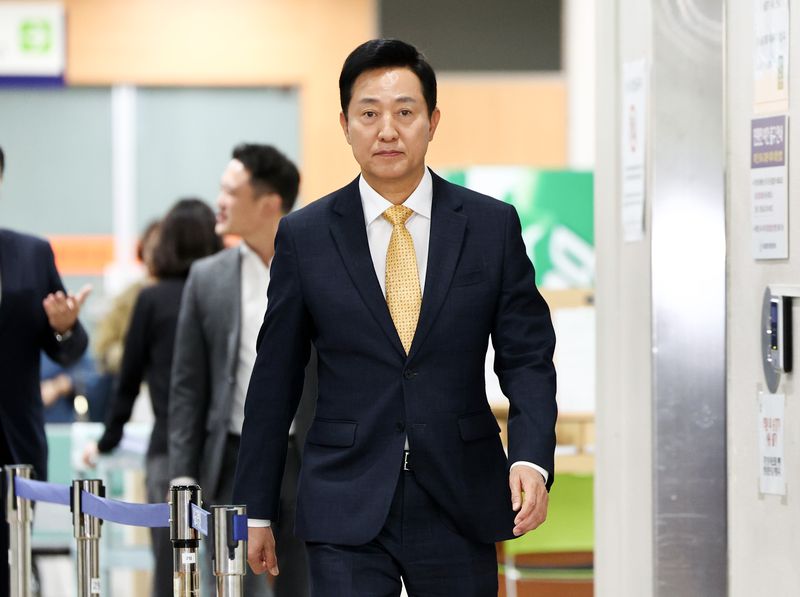
The Seoul High Court’s Criminal Division 7, presided over by Judge Koo Hoe-geun, will hold the appeal verdict hearing in Mayor Oh’s Political Funds Act violation case at 2 p.m. today.
Mayor Oh was indicted on charges of commissioning opinion polls from political broker Myeong Tae-gyun ahead of the 2021 Seoul mayoral by-election and arranging for his supporter, businessman Kim Han-jung, to pay the polling costs on his behalf. In July, the first-instance court found him guilty of having the costs covered for five of the 10 polls and sentenced him to a fine of 10 million won and an additional collection of 21 million won.
If a sentence of a fine of at least 1 million won for violating the Political Funds Act becomes final, the mayor loses his office. However, even if the guilty verdict is upheld on appeal, Mayor Oh can continue performing his duties until the Supreme Court of Korea’s ruling becomes final.
If the appeal court upholds the same sentence as the first-instance court—a sentence that would cost him his office—Mayor Oh will have to run the city administration while awaiting the Supreme Court of Korea’s decision. He can legally continue exercising the mayor’s full authority, but uncertainty in the policy-making process could grow because the possibility remains that the head of the city government will change depending on the final ruling.
This could weigh particularly on major development projects and transportation infrastructure expansion projects that are to be pursued in earnest after the ninth popularly elected administration takes office.
The Seoul Metropolitan Government is pursuing long-term urban development projects, including the development of the Yongsan International Business District (YIBD), the creation of a sports and MICE complex in Jamsil, and the redevelopment and reconstruction of key areas. These projects require complex procedures, including private investment, consultations with relevant agencies, and permits and approvals.
Analysts say that if Mayor Oh’s legal risks persist, the projects themselves may not be halted, but uncertainty over long-term policy direction and investment schedules could increase. For projects requiring large-scale private investment, expectations about whether the city’s policy direction will be maintained are important, so the possibility that this could affect the pace of project implementation cannot be ruled out.
Transportation could also be affected. The Seoul Metropolitan Government faces challenges including expanding its urban rail network, such as the Gangbuk Crossing Line; addressing transportation disparities between regions; and stabilizing operations of the Hangang Bus. The mayor’s policy commitment and ability to coordinate are particularly important for projects that require funding and consultations with relevant agencies.
If the guilty verdict is upheld, the city government’s focus could shift from expanding new projects to managing existing ones stably.
Conversely, if Mayor Oh is acquitted on appeal, he is expected to shed much of the burden stemming from the first-instance guilty verdict and focus on running the ninth popularly elected administration.
Of course, the special counsel may still appeal to the Supreme Court, so an acquittal on appeal would not immediately bring the case to a final close. Even so, overturning the first-instance sentence that would cost him his office could ease the political and administrative burden.
After an acquittal, Mayor Oh is expected to pick up the pace again on key policies he has pursued so far.
Expanding housing supply and revitalizing urban renewal projects are among the key priorities. The Seoul Metropolitan Government has pursued policies to shorten procedures for redevelopment and reconstruction projects and increase housing supply through initiatives such as Rapid Integrated Planning. If legal risks ease, the city is expected to be able to focus its administrative resources on fleshing out implementation plans for the ninth administration’s housing policies and strengthening consultations with relevant agencies.
The balanced development of the Gangbuk area is also drawing attention. Under its Gangbuk Renaissance Era vision, the Seoul Metropolitan Government is pursuing transportation infrastructure expansion and regional development. Restarting long-stalled urban rail projects such as the Gangbuk Crossing Line and securing funding are expected to be major tests for the city government going forward.
The Hangang Bus is also a key issue. With debate continuing over operational stability, commercial viability and the financial burden, its performance and safety will be important going forward. An acquittal would not remove the need to scrutinize the project itself, but it could create an environment in which Mayor Oh can take a more active role in implementing policies and resolving problems.
[email protected] Lee Seol-young Reporter