'1,000-Won Barrier' Proves Too High... Five 'Penny Stocks' Face First-Ever Delisting Proceedings
- Input
- 2026-10-23 07:47:58
- Updated
- 2026-10-23 07:47:58
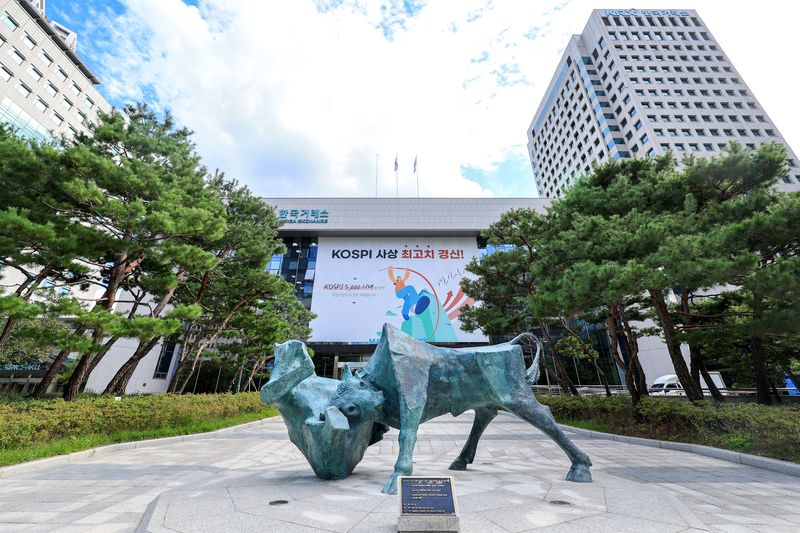
[Financial News] The 1,000-won barrier was a high hurdle. Five companies—TKG Aegang, Newintech, Hyungji Global, Barunson E&A and i-Scream Edu—are expected to enter delisting proceedings after failing for an extended period to escape penny-stock status (a share price below 1,000 won). This would be the first case of delisting proceedings on the grounds of a share price below the minimum since stricter delisting requirements took effect last July.
According to the Korea Exchange on the 22nd, the share prices of all five companies listed on the KOSDAQ market—TKG Aegang, Newintech, Hyungji Global, Barunson E&A and i-Scream Edu—were below 1,000 won that day. At the close, TKG Aegang stood at 773 won and Newintech at 544 won, while Hyungji Global (301 won), Barunson E&A (418 won) and i-Scream Edu (527 won) also failed to clear the 1,000-won barrier.
That day was effectively the last chance for the five companies to escape the threat of delisting for failing to meet the minimum share price (below 1,000 won). Under the stricter delisting requirements that took effect on July 1, the companies were designated as administrative issues on August 13 for failing to meet the share-price requirement. If they fail to recover to at least 1,000 won for 45 consecutive trading days within 90 trading days of their designation, they will become subject to delisting.
The share prices of four companies—TKG Aegang, Newintech, Hyungji Global and Barunson E&A—remained below 1,000 won throughout the period after their designation as administrative issues. i-Scream Edu’s share price briefly rose above 1,000 won from the 10th through the 28th of last month due to a tender offer, but then fell below 1,000 won again.
Even on that day, the 46th day since their designation as administrative issues, none of the five companies’ share prices rose above 1,000 won, leaving them with no way to avoid delisting.
If the Exchange announces their delisting, the five companies will be the first to face delisting proceedings on the grounds of penny-stock status.
Delisting generally takes effect after a period of liquidation trading. If a company asks a court for a provisional injunction suspending the effect of its delisting, the proceedings are temporarily halted. Some observers had speculated that, since courts recently put the brakes on delisting proceedings resulting from stricter market-capitalization requirements, the Exchange might also slow down delistings on penny-stock grounds.
Earlier, on the 2nd, the 51st Civil Division of the Seoul Southern District Court granted a provisional injunction suspending the effect of delisting, requested by Jooyon Tech and KM Pharmaceutical, which had become subject to delisting for failing to meet the market-capitalization requirement. The Exchange subsequently said it would suspend all delisting proceedings until a ruling on the merits.
However, the Exchange is reportedly maintaining that the delisting rules based on penny-stock status remain in effect and that the proceedings will continue as planned.
Meanwhile, the Exchange plans to disclose the names of low-PBR (price-to-book ratio) companies on the 2nd of next month. These are companies whose PBR has ranked in the bottom 25% (KOSPI) or bottom 10% (KOSDAQ) for six consecutive half-year periods, by market and industry.
Even if they meet the criteria, companies can be exempt from disclosure for one year going forward if they disclose a “low-PBR improvement plan” in the prescribed format by that day. As of 3:30 p.m. that day, 34 companies had disclosed such plans in the prescribed format.
[email protected] Kim Hee-sun Reporter