NVIDIA's Jensen Huang on memory oversupply concerns: “The more, the better”
- Input
- 2026-10-23 07:32:04
- Updated
- 2026-10-23 07:32:04
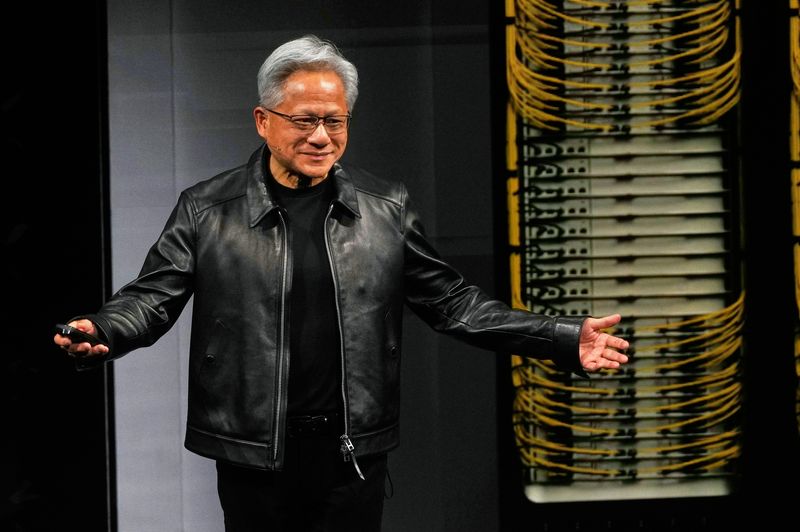
[Financial News] Jensen Huang, CEO of U.S. artificial intelligence (AI) chipmaker NVIDIA Corporation, said there was no need to worry about an oversupply of memory semiconductors used in AI accelerators and other products. He predicted that demand for memory semiconductors would continue to rise.
On the 22nd (local time), Jensen Huang attended NVIDIA's developer conference, “GTC Berlin,” in Berlin, Germany, and spoke with U.S. business news outlet CNBC. Asked about the possibility of an oversupply of memory semiconductors, he replied, “I don't think so.” He said, “The real advantage of memory is that the more you have, the better,” and predicted that demand for memory would continue to grow.
This month in South Korea, concerns were raised that the memory semiconductor market—led by Korean companies—could be oversupplied by 2029. Some experts argued that an oversupply of memory semiconductors could bring the broader semiconductor market's super-boom to an end.
CNBC explained that, amid concerns over this outlook and the technological advances of Chinese memory chipmakers, shares of major memory companies, including Samsung Electronics Co., Ltd., SK hynix, and U.S.-based Micron Technology, Inc., have recently fallen sharply.
On the 22nd, Jensen Huang said that high-bandwidth memory (HBM), essential for AI accelerators, would continue to be used for years to come. He also said use of low-power DRAM (LPDDR), which is used mainly in smartphones and other devices, would continue to increase. “We were the first company in the world to bring LPDDR memory used in mobile phones into data centers,” he said. “That enabled us to deliver performance with twice the energy efficiency of any other product in the world.”
Meanwhile, Jensen Huang said NVIDIA could buy Chinese-made memory semiconductors, whose manufacturers have recently been rapidly catching up with Korean products. Asked about the possibility of working with China's ChangXin Memory Technologies (CXMT), he said he was “open” to it. On the possibility of purchasing CXMT products, Jensen Huang said, “We work with Chinese companies, and almost every company in the world works with Chinese companies somewhere in its supply chain.” He said, “China has remarkable capabilities in foundational technologies,” adding, “No country surpasses China in manufacturing in terms of its overall national capabilities. We have to take China's capabilities very seriously.”
[email protected] Park Jong-won Reporter