Oh Se-hoon’s second-trial verdict, with his mayoral post at stake, due today... Key factor: ‘Myeong Tae-gyun recordings’
- Input
- 2026-10-23 07:00:00
- Updated
- 2026-10-23 07:00:00
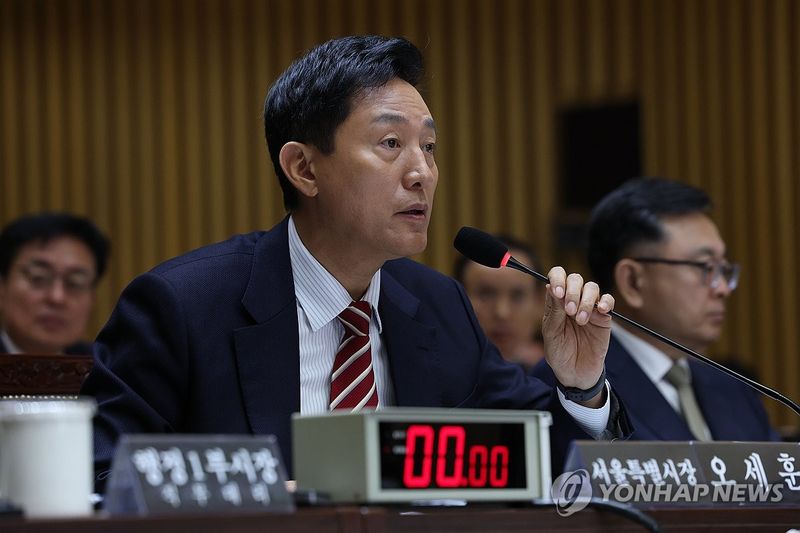
According to legal circles, the Seoul High Court’s Criminal Division 7, presided over by Judge Koo Hoe-geun, will hold a sentencing hearing at 2 p.m. today in the appeal of Mayor Oh, who was indicted on charges of violating the Political Funds Act. The hearing will be livestreamed.
Mayor Oh is accused of commissioning opinion polls from Myeong ahead of the April 7, 2021, Seoul mayoral by-election and having his supporter, businessman Kim Han-jung, pay the 33 million won cost on his behalf. Kang Cheol-won, a former Seoul vice mayor for political affairs, and Kim are also standing trial.
On July 22, the first-trial panel, Seoul Central District Court’s Criminal Division 22, presided over by Judge Cho Hyung-woo, sentenced Mayor Oh to a 10 million won fine and an additional collection of 21 million won. It found that Oh had commissioned five of the 10 opinion polls and that Kim had paid the 21 million won cost on his behalf. It found the remaining 12 million won not guilty in the reasoning of the judgment. This means the court found the defendant not guilty only in its reasoning, without separately stating an acquittal in the operative part of the ruling. Article 57 of the Political Funds Act stipulates that anyone whose conviction for illegally receiving political funds becomes final with a fine of at least 1 million won may not hold public office for five years and must leave any office already held. The Public Official Election Act also bars such a person from standing for election for five years. If the first-trial sentence is upheld, Mayor Oh will lose his office and be unable to run for election for five years. The first-trial panel said, “We impose a sentence of disqualification from public office commensurate with the culpability.”
The Kim Keon Hee Special Prosecutor Team, led by Special Counsel Min Joung-kie, reportedly sought a sentence of one year and six months in prison for Mayor Oh, and one year each for Kang and Kim, at closing arguments on the 2nd. If only the defendant appeals, the second trial cannot impose a heavier sentence than the first. Since the special counsel has also appealed this time, a heavier sentence remains possible. In his final statement, Mayor Oh reportedly wept as he said, “I deeply regret that I am standing trial because, when I sensed something was off about Myeong Tae-gyun, I failed to cut ties decisively and gave him room to keep approaching me.” He denied the charges, however.■ Myeong Tae-gyun recordings shake credibility, but have limitsThe biggest factor in the appeal is a recording of calls submitted by Kim. It consists of three calls between Kim and Myeong in March 2021, which the panel admitted as impeachment evidence on the 16th of last month. Impeachment evidence is not used to directly prove guilt or innocence, but to challenge the credibility of another person’s testimony.
The recordings reportedly include a passage in which Myeong says, in effect, that he does not know Mayor Oh. Kim reportedly said, “I didn’t ask for it there; I did it on my own.” This differs from Myeong’s statement to investigators that Oh introduced Kim as “someone who could provide the money.”
One point favorable to Mayor Oh’s side is that the recordings could undermine the credibility of Myeong’s testimony. When admitting them, the panel reportedly said, “There are no indications so far of unlawful acquisition or fabrication, so I will admit them as impeachment evidence despite the special counsel’s objection.”
The limitations, however, are clear. Since these are impeachment evidence, the recordings alone cannot prove that “there was no commission.” Another factor is that the first trial did not rely heavily on Myeong’s testimony. It credited mainly the parts of his testimony that aligned with objective evidence or the circumstances at the time. Instead, it found that the polls had been commissioned based on call records and internal campaign messenger chats, among other evidence.
The timing of the recordings is also an issue. The calls took place after all the payments that the first trial found criminal had been completed. The first trial found that the two men had built a personal relationship between late February and mid-March 2021. In its sentencing rationale for Kim, the first-trial panel also noted that Kim deleted all the recorded call files with Myeong once the case began receiving media coverage. The special counsel questioned the authenticity of the recordings, noting that only three of the 35 recordings had been submitted. Myeong also submitted a written statement to the panel on the 30th of last month, reportedly arguing that the remarks in question were about the progress of opposition-party unification talks, not opinion polls.■ Same panel acquitted Yoon in ‘free opinion polls’ caseLegal circles are also watching the same panel’s earlier ruling. On the 7th, the Seoul High Court’s Criminal Division 7 acquitted former President Yoon in the appeal of his case for violating the Political Funds Act. Myeong, who was indicted alongside him, was also acquitted.
Yoon is accused of conspiring with his wife, Kim Keon Hee, to receive 58 opinion polls worth 274.4 million won from Myeong free of charge between June 2021 and March 2022. On July 13, the first-trial panel, Seoul Central District Court’s Criminal Division 33, presided over by Judge Lee Jin-gwan, found Yoon guilty in connection with 14 polls worth more than 27.92 million won and sentenced him to two years in prison. Myeong was sentenced to one year and six months.
The appeals court overturned that ruling. The panel found that what Myeong provided was less the opinion polls themselves than assistance such as political advice and introductions to influential politicians. It reportedly ruled, “The political advice provided by Myeong Tae-gyun may be viewed as a political benefit, but it cannot be converted into a pecuniary benefit.” It also said there was no evidence of an agreement to commission or consult on opinion polls. The special counsel appealed to the Supreme Court on the 13th. The case against Kim, who was separately indicted on the same charge and acquitted in both the first and second trials, is being heard by the Supreme Court Grand Bench.
The two cases, however, differ in structure. The issue in Yoon’s case was whether receiving opinion polls for free constituted a “benefit in property” under the Political Funds Act. In Mayor Oh’s case, a supporter actually paid the cost of the opinion polls. The Political Funds Act also treats a third party’s payment of a politician’s political activity expenses as a political donation. The first trial relied on this provision in finding that Kim’s payment on Oh’s behalf constituted a donation to Oh.
The link between the two cases is the question of whether the polls were “commissioned.” The appeals court in Yoon’s case found no evidence that there had been a commission or consultation. In this case too, the panel’s decision on whether Mayor Oh commissioned opinion polls from Myeong and whether he knew about and requested Kim’s payment is expected to determine the outcome.
[email protected] Kim Dong-kyu, Chang-hun Lee Reporter