[Editorial] Startups are dwindling as ailing companies multiply
- Input
- 2026-10-22 18:48:57
- Updated
- 2026-10-22 18:48:57
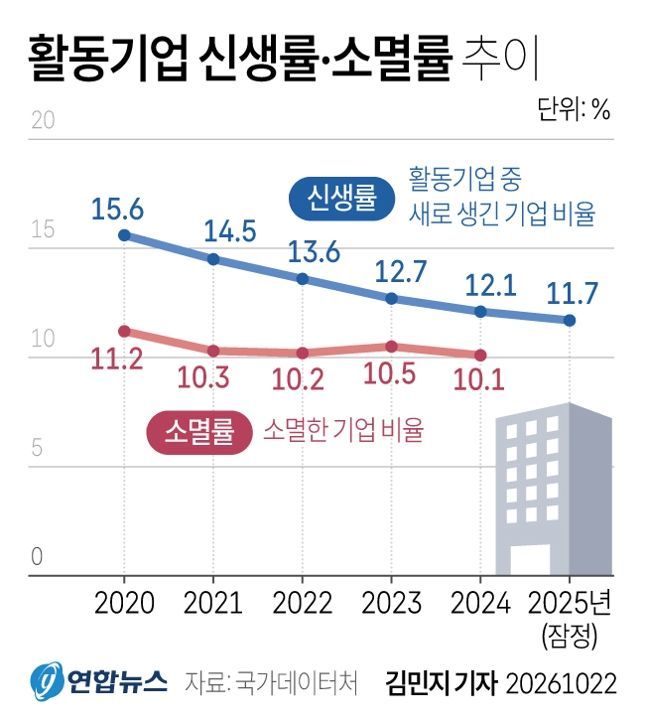
According to the National Data Agency’s “2025 Business Demography Administrative Statistics,” the number of “high-growth companies”—those whose regular employees and sales each grew by an annual average of at least 20% over the past three years—fell by 855, or 15.9%, from the previous year to 4,534. The number of “active businesses,” defined as those with sales or regular employees, rose by 108,000, or 1.4%, to 7.748 million. But the number of “new businesses” fell by 14,000, or 1.5%, to 908,000, marking a fifth consecutive annual decline. The business birth rate—the share of new businesses among active businesses—also fell by 0.3 percentage points to 11.7%, its lowest level since statistics were first compiled in 2011.
According to the Bank of Korea’s “2025 Annual Corporate Management Analysis,” marginal companies accounted for 42.9% of businesses. This means that at least four out of every 10 companies with debt earned less in operating profit than they owed in interest. That was the highest figure since related statistics were first compiled in 2009. Strong performance by some large high-tech exporters, including semiconductor companies, lifted large firms’ operating profit margin on sales to 6.7%, while the rate for small and medium-sized enterprises fell to 2.8%. Overall profitability improved on the back of the semiconductor boom, but the benefits failed to spread across the economy, deepening the divide between companies.
Weakness in key industries and distortions in resource allocation are also cause for concern. The decline in high-growth companies was seen across all industries except the public and utilities sectors. The downturn was particularly pronounced in manufacturing and construction, pillars of the South Korean economy.
There are also concerns that, in the wake of the COVID-19 pandemic, companies that have lost competitiveness amid high interest rates and costs are staying in the market by relying on loan maturity extensions and policy financing. If support for troubled companies delays restructuring, it could tie up capital and labor, hindering the flow of resources to more productive startups and high-growth companies.
High-growth companies and innovative ventures drive job creation and innovation. Their decline could also hurt the creation of quality jobs favored by young people. With interest rate volatility and external uncertainties persisting, delaying restructuring increases the risk that the exit of troubled companies will happen all at once, triggering a cascade of bankruptcies and expanding losses across the financial sector.
Our economy faces a structural problem: the birth and growth of new innovative companies are sluggish, while the exit of companies that have lost competitiveness may also be delayed. In short, conditions have recently deteriorated sharply for companies outside the semiconductor sector.
If we become complacent amid the semiconductor industry’s boom and ignore these warning signs, the weakening of growth momentum could become even more pronounced after the supercycle ends. Life-support measures such as indiscriminate loan maturity extensions and repayment deferrals should be reconsidered, and marginal companies with little chance of recovery should be identified through rigorous credit assessments and restructured.
Regulations that hinder entry into new industries also need a comprehensive review. We must restore a virtuous cycle in which financial resources freed up through restructuring flow to new ventures with technological capabilities and companies with high growth potential. Revitalizing the business ecosystem requires both the exit of troubled companies and the growth of innovative ones.