Loans Below 4% Are Hard to Find as Interest Burdens Grow for Households and Businesses
- Input
- 2026-10-22 18:38:08
- Updated
- 2026-10-22 18:38:08
An analysis on the 22nd of the Bank of Korea’s Economic Statistics System data on the share of deposits and loans at deposit-taking banks by interest-rate bracket, showed that 12.9% of newly issued household loans in August carried annual rates below 4%. The share fell from 30.1% in June to 21.1% in July, with a total decline of 17.2 percentage points over the two months.
The share of low-rate corporate loans also declined. The share of large-corporation loans with annual rates below 4% fell for two consecutive months, from 44.3% in June to 42.8% in July and 39.5% in August. For small and medium-sized business loans, the share fell from 45.1% in July to 37.2% in August.
As the share of low-rate loans declined, the share of loans carrying high rates of 5% or more annually increased for both households and businesses. For household loans, it rose from 17.8% in July to 20.0% in August, an increase of 2.2 percentage points. Over the same period, the share rose from 8.1% to 10.7% for large-corporation loans and from 18.3% to 21.8% for small and medium-sized business loans, increases of 2.6 and 3.5 percentage points, respectively. In effect, annual rates of 5% or more applied to about one-fifth of newly issued household and small-business loans.
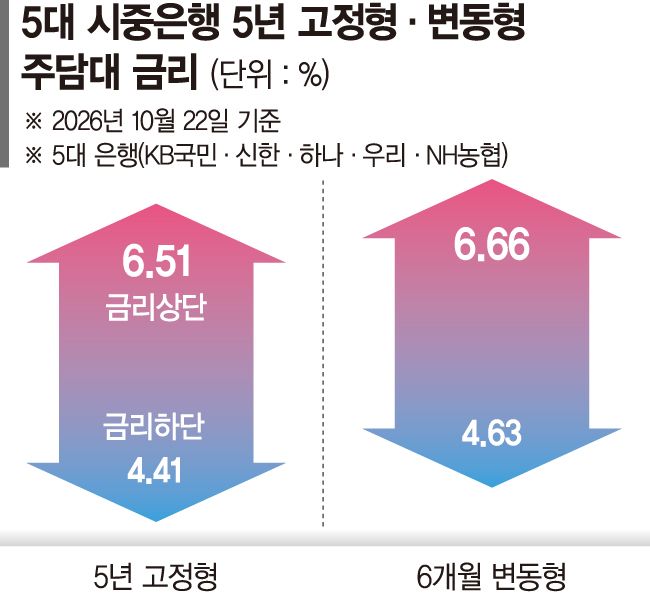
The upper end of mortgage rates at banks is already nearing 7% annually. As of that day, five-year fixed-rate mortgage loans at the five major commercial banks (KB Kookmin Bank, Shinhan Financial Group, Hana, Woori and Nonghyup Bank) ranged from 4.63% to 6.66% annually. The yield on five-year bank bonds (AAA-rated, unsecured), which serves as a benchmark for fixed-rate mortgages, stood at 4.284% annually as of the previous day. As of that day, six-month variable-rate mortgage loans at the five banks ranged from 4.41% to 6.51% annually.
As mortgage rates rise, borrowers’ monthly interest burdens are also growing. For example, if someone borrows 300 million won at an annual rate of 4% and repays it over 30 years in equal monthly installments of principal and interest, the monthly payment would be about 1.43 million won. Under the same terms, at an annual rate of 7%, the monthly payment would rise to 2 million won. A 3-percentage-point difference in the interest rate would mean monthly payments were 570,000 won higher.
Another factor is that the effects of the July and August base-rate hikes are being reflected in existing loans with a time lag. It typically takes several months for base-rate hikes to affect rates on outstanding loans, and with the possibility of further hikes still open, there are concerns that borrowers’ interest burdens could grow by the end of the year. A financial-sector official said, “The effects of the July and August base-rate hikes are being reflected in loan rates now, so rates could rise further by the end of the year.”
As banks expand productive and inclusive finance this year, managing the repayment capacity of vulnerable borrowers and small and medium-sized businesses has also emerged as a challenge. That is because persistently high rates could cause borrowers’ interest burdens to accumulate. A banking-sector official said, “As interest rates rise, the risk of defaults among vulnerable borrowers with insufficient repayment capacity and marginal businesses could increase,” adding, “Since banks have expanded productive and inclusive finance over the past year, managing their financial soundness will become increasingly important.”
[email protected] Lee Hyun-jung Reporter